Despite the perfect timing, we are not talking about lunch. Policymakers often sit together and have crucial discussions that would greatly benefit by being scientifically informed. Scientists are sometimes invited to join those conversations but are starting to tune in on their own initiative as well.
Field camps and labs are where us scientists usually feel the most at home. Being surrounded by like-minded people and talking about our -very specific- shared passions all day is great! However, stepping out of those spaces is, most of the time, necessary, and can even be beneficial for science itself. This is especially true when it comes to interactions with policymakers who, among other things, decide how science gets funded and therefore shaped. Policy can do a great deal for science, and vice versa. Many scientists know this and would want to get involved by providing their scientific expertise as the basis for meaningful discussions.
However, political and structural contexts can sometimes make exchange at the policy-science interface frustratingly difficult. As a scientist it’s easy to feel overwhelmed and helpless, thus giving up on pursuing science policy even if you would love to. The good news is: you are not alone! There are many people actively working towards facilitating the relationship between science-makers and policy-makers. Some of them gathered at the EGU General Assembly of 2026, for a Great Debate focused on how and why scientists should get involved in science policy, to bridge the gap between scientific evidence and political action while still considering the diversity in national and international systems.
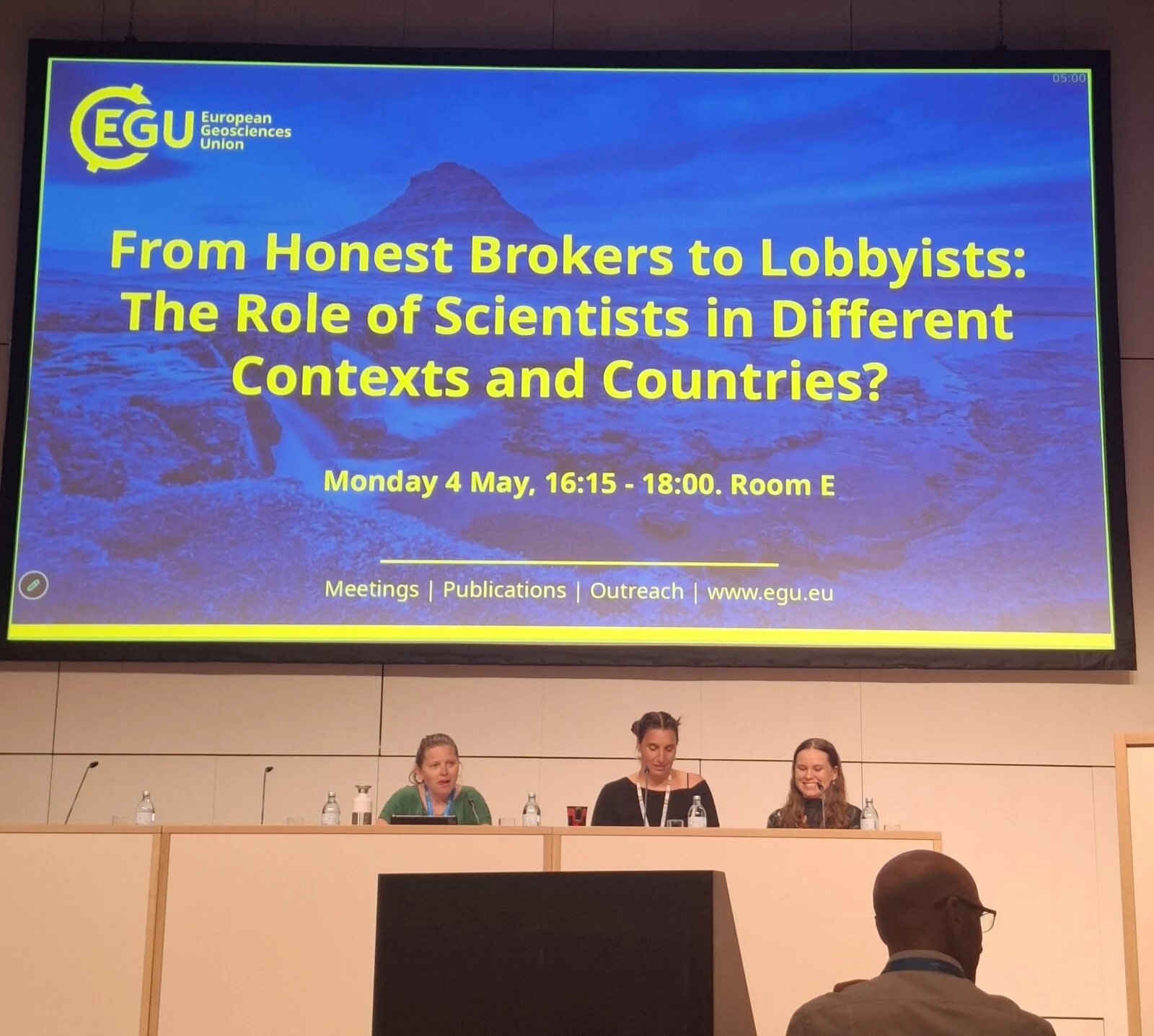
Speakers at the Great Debate 1 during EGU26. From left to right: Lene Topp, Nicole Arbour and Linda Lammensalo. Lorenzo Melchor Fernandéz and Alessandro Allegra were presenting online.
Brevity was the first desired quality to be highlighted in the session, as Convener Lene Topp noted that high level policymakers request complex scientific explanations to be given in the span of a meeting-to-meeting walk. Hence, we’ll keep it short and sweet. Here’s how you can start getting involved in science policy and why you should do it.
It takes a village (or even more)
Similarly to a dance party, science policy works better when multiple people are involved, plus coordinated action is key. There are a lot of networking groups that can help with that. If you are currently attending EGU26, you can start by visiting the Science for Policy Helpdesk that is active every day from 12:00 to 13:00 at the EGU booth in Hall X2. There is also a monthly EGU Science for Policy Newsletter, packed with news, activities and opportunities. You can subscribe here.
Read the rulebook
Ministries, governmental committees and local administrations are all possible locations for science-policy exchanges. They also all have unique nuances and inner working mechanisms. In the same way that driving a car doesn’t make you automatically qualified for boating, being an expert in “academic diplomacy” or even having some experience with local policy makers won’t necessarily be enough to knock on governmental doors. Networking groups can help with that as well but just know that it can take time. During the Great Debate, panelist Lorenzo Melchor said that, when the Spain government first started employing professional science advisors a year ago, their first assigned task was rather peculiar. For the first 100 days they were asked to do nothing but immerse themselves in the ministerial cabinet world, to really understand these spaces from the inside.
When I grow up, I want to be an honest broker!
As you’ve probably guessed from last paragraph, it is possible to develop a career in science policy. The so called “honest brokers” are especially on the rise and are being gradually more professionalized. Honest brokers are people that gather evidence-based opinions from multiple experts in a given field and then compile it in a way that can be used as a base for political decisions. Basically, they bring evidence into the discussion. As panelist Linda Lammensalo, a professional knowledge broker, put it:
“In conditions of deep uncertainty, policymakers do not primarily need more information. They need help structuring what is known, what is contested, and what is genuinely unknown.”
Most people, however, still take on science policy as a sort of demanding side-quest, that’s carried out in more traditional scientific settings as well. Some universities are starting to consider policy making efforts when evaluating scientists’ careers, following a new vision on academic merit that’s been outlined by CoARA (Coalition for Advancing Research Assesment) among other actors. So, whether you want to quit the lab and hop into cabinet chambers, or if you just want to help tackle very specific aspect, there’s likely something for you to do.

Scientists gathering at the Science for Policy helpdesk in 2023.
Look around, listen up
Science is a team effort, we know that. Science policy is as well. It is important, once finally sitting at the table, to look around. Notice who’s missing, whose voice is still unheard, and maybe invite them to join the talk as well. Of course, there are always going to be limitations to what can be done. This may quickly lead to frustration, which in turn develops into mistrust. It’s easy to assume malicious intent from some of the players involved, especially when the situation seems stuck. Honest discussions, even critical, difficult ones, are the only way out. They are the way forward too!
Did all this sound incredibly exciting to you? Then, if you have a little more time for your walks than policy makers do, feel free to browse the resources mentioned above and start from there.