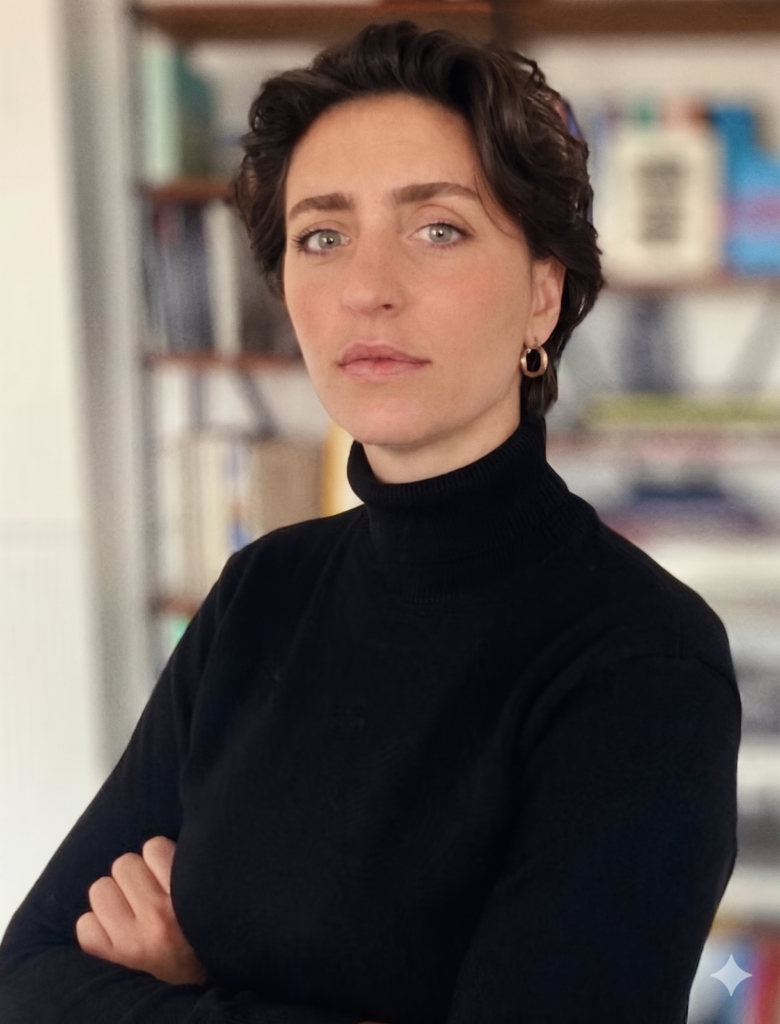
Hello Elsa & welcome to GeoTalk! Before we dig deeper, could you introduce yourself to our readers?
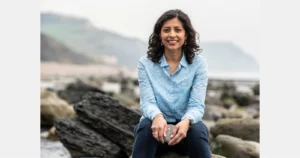
Hi! I’m Elsa (they/them). I’m a microbiologist/biogeochemist, and I just started a permanent position at the French National Centre for Scientific Research (CNRS) one month ago.
I work with one PhD student, Elisa Richard, and two postdocs, Mathilde Bourreau and Thomas Cortier, on my ERC Starting Grant project called GAMEchange. We investigate how the genetic evolution of soil microbes impacts future projections of global carbon stocks in response to climate change.
Microbes adapt to environmental change, including climate change, through different mechanisms, such as mutation and dispersal. How might these adaptations feedback into climate change?
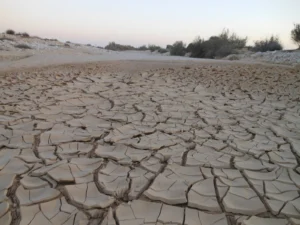
Mutation and dispersal bring microbes with new features into the community – for example, microbes that can decompose carbon faster, or that are better adapted to drought. These changes can feed back into the climate because if microbes decompose carbon faster, soils might lose more carbon to the atmosphere as CO₂ emissions, which would accelerate climate change.
We actually don’t yet know how microbes are adapting over short vs. long timescales and in different locations. That’s something we’re investigating in the GAMEchange project using genomic data.
Beyond your research, you also champion inclusive practices in communities and institutions. What key practices do you think people should consider when engaging in research and their scientific communities?
As a half-Lebanese non-binary person, I don’t see many queer and/or people of color in my institutions. I think institutions should provide mandatory training on conducting inclusive research, as I consider it my responsibility, as a PI, to be equitable and inclusive.
I’m still learning how to do this, but it involves things like explicitly stating lab values that include inclusiveness; speaking in a language everyone feels comfortable with, and providing tools when that’s not possible (e.g., AI live translation) – and doing this not only during scientific discussions but during all lab activities.
It also means making sure everyone feels heard, asking for feedback on how inclusive the lab environment feels, and actively listening and getting creative, rather than defensive, when receiving criticism.
You are also the Early Career Scientist Representative for the Biogeosciences (BG) division. What does this role entail?
There are two main roles an ECS rep can have:
- Organise ECS activities for your division (e.g., division-level networking events at the EGU General Assembly, or online events such as webinars or seminar-style “Campfire” events),
- Get involved in EGU-wide activities which address cross-cutting themes relevant to the ECS community (e.g. via ECS representative task groups on careers, communication, and Union-wide initiatives at the General Assembly.)
Many ECS reps contribute to both, whilst some focus more on their division; I focus on organizing activities for the BG division. With my co-rep, Silvia Poblador, and our ECS team, Rebecca Varney, Getachew Adnew, Thomas Guzman, and Anas Emad, we’ve organized gatherings at the EGU annual meeting, a webinar series (on diversity, mental health, and how to get grants), and we’re preparing a grant application to organize a free-of-cost in-person gathering somewhere in Europe!
How can people get involved with ECS activities for the Biogeosciences division?
They can join the team! You can contact me at ecs-bg@egu.eu. We meet monthly online: it’s a really nice way to get to know each other, to get to know the BG section and our ECS community, and to organize a bunch of cool events 🙂
You can also stay up to date on ECS activities and opportunities by signing up for the ECS BG mailing list.