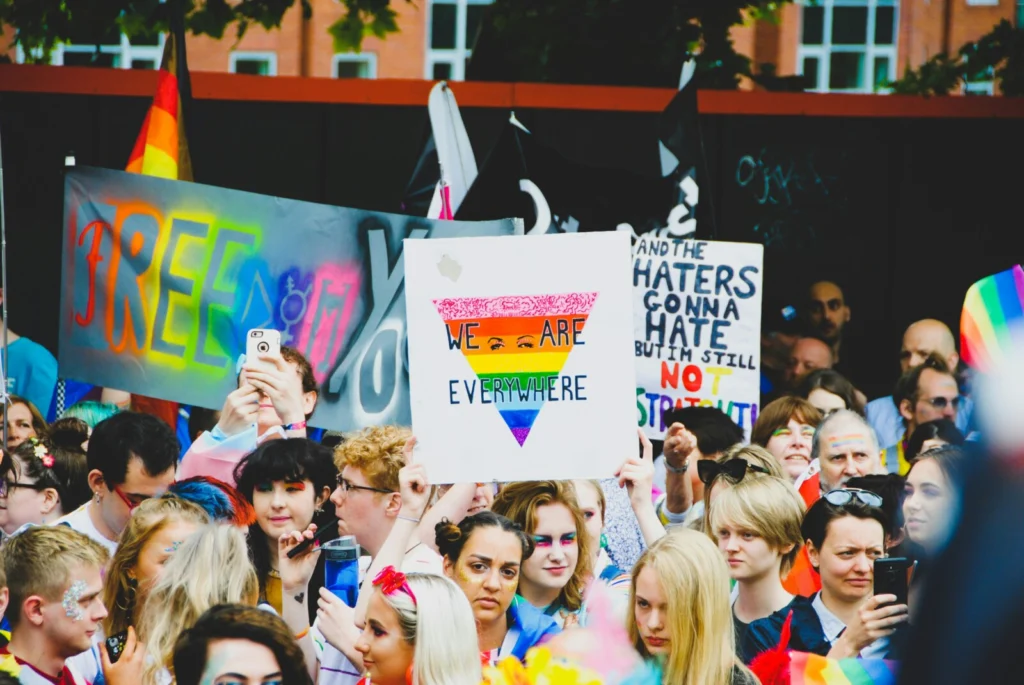
Pride month arrives this year against a backdrop of institutional irony. In the United States, federal research funding has been thoroughly weaponised and forced a massive scientific brain drain across the Atlantic. In Europe, a multi-million-euro effort to capture that exiled talent is underway, even as Europe’s own domestic politics fracture along the exact same ideological fault lines.
For queer researchers, especially those in the geosciences, this transatlantic war over Equity, Diversity, and Inclusion (EDI) compromises networks for international collaboration, visa security, and the mentorship pipelines needed to sustain the next generation of scholars. As we look at the state of research in 2026, it has never been more urgent to peel off the corporate rainbow decals and remember an important (perhaps the most important) truth: Pride was not born in an administrative boardroom or a well-funded university lab. Pride was a riot.
The dismantling of the word “diversity”
The current crisis escalated dramatically following executive mandates that targeted diversity infrastructure within American higher education. Federal research agencies were pressured to freeze or cancel programs containing specific keywords. The National Science Foundation archived flagship diversity programs like ADVANCE, purging over 1,600 grants and stripping millions of U.S. dollars in funding as documented in the comprehensive CEWS Journal analysis of the war on DEIA.
This disruption did not remain confined to American borders; it immediately triggered a geopolitical domino effect across the Atlantic. To make matters worse, many European institutions appear to be preemptively capitulating to protect their commercial and academic ties to the US. European academic entities and multinational corporations are actively downplaying diversity initiatives, in a move that seems designed to appease American political interests, an alarming trend noted in the HEC Paris analysis of corporate and academic self-censorship.
The very lexicon of “diversity” betrays a flawed institutional framework and treats human variation as a mere ornamental appendix to an unquestioned default, European norm. Yet, for us, the ones relegated to this administrative category, including queer researchers, migrant scholars, and scientists with disabilities, are far from peripheral extras.
We constitute the scaffolding that sustains the European economic, social, and scientific landscape. Therefore, when European institutions dismantle these protections to protect bilateral ties and appease shifting political currents, shouldn’t we question their principles? This regression exposes a fragile and conditional commitment to human rights, one that treats equality as a political luxury to be bartered away under electoral pressure. When the very communities that build, research, and sustain these societies are deemed disposable in times of friction, the rhetoric of European values is therefore less of a moral compass and more of a geopolitical commodity.
Queer vulnerabilities increase with attacks on Geoscience
While laboratory-based disciplines can sometimes isolate themselves from political crosswinds, the geosciences stand exposed because their primary laboratory is the planet itself. Whether it’s mapping structural faults, taking hydrological samples, or spending weeks on an oceanographic cruise, a geoscientist must physically go where the data resides.
When academic institutions cave to political pressure and dismantle their equity, diversity, and inclusion frameworks, they are throwing field safety protocols completely overboard and are therefore stripping away the structural protections that keep vulnerable researchers safe in remote or hostile environments.
In a study published six years ago in Eos, researchers Alison Olcott and Matthew Downen exposed the realities faced by LGBTQ+ geoscientists. Their survey shows that 55% of queer geoscientists have felt physically unsafe on location due to their identity, and a third have been forced to refuse field deployments entirely out of fear for their well-being. This environment breeds a severe power imbalance. While 57% of tenured professors possess the career security to refuse an unsafe fieldwork destination, a mere 29% of graduate students can exercise that same choice (although, is it really a choice?)
As universities seem to delete inclusive risk assessments to maintain a politically neutral profile, early-career scientists are left to navigate criminalising laws, hostile local cultures, and border checks completely alone. In geoscience, you must ‘go where the rocks are’, but institutions are increasingly refusing to ask if those rocks lie in a place that will jail or harm the scientist gathering them.
Pathways to resistance
Resisting this systemic rollback in 2026 requires an approach that moves far beyond standard advocacy. For tenured faculty and scientists who are safely out, resistance can mean leveraging their career security to act as physical and administrative shields.
- If this is you, you can refuse to authorise departmental field expeditions that lack explicitly documented, queer-inclusive risk assessments.
- You can redirect private endowments to fund censored environmental or demographic research and step up as the public principal investigators to absorb the political heat from state legislatures or hostile committees.
- This is the time to use your privilege to establish safe spaces and ensure that vulnerable fieldworkers are never forced to choose between their career progression and their safety.
Conversely, for early-career researchers and those who cannot safely come out, resistance can become something of an underground subversion. Maintaining a low profile is a valid survival tactic, believe me, I know.
However, this doesn’t mean being passive:
- You can still, for instance, leverage digital networks to share crowdsourced safety logs that detail local hostile behaviours, discriminatory law enforcement, and border risks with junior colleagues before travel.
- You can also practice data archiving and help back up marginalised environmental justice and climate equity datasets to secure, off-campus servers before university networks face state-mandated purges.
- Your underground work, that still keeps you safe and anonymous if desired, proves that even when institutional or governmental support is revoked, the community can still find ways defend both its people and its science.
If we want a future where a queer geoscientist can safely map a changing planet or decode climate systems without sacrificing their dignity or safety, it’s time we stopped asking institutions for permission to exist. We cannot keep shrinking ourselves so we look less threatening to a university budget. Pride was a riot after all, and our queer ancestors would have wanted us to push back with the same power and desire to exist publicly without shame or fear.
This Pride month, I wish you safety, resilience, and love, whether you are out, safely, or not. Know, you are not alone, because we have always been here, and we will continue to be.
Remember, EGU’s EDI committee is always here to support you, and make sure to check out the work that the EGU pride group does and join us if you want!