Hello Martin! Welcome to GeoTalk. Could you briefly introduce yourself to our readers?
Dear EGU Community! My name is Martin, and since 2004 I have had the honour of being the Managing Director of Copernicus. By training, I am a hydrologist, but even before I graduated, I was drawn into the EGU General Assembly in 2003 in Nice, so this year marks my 24th EGU.
To be precise, it is actually my 25th, as my first EGU was the EGS General Assembly in Bologna in 1988, which I attended with my family when I was 9 years old, since my father was Executive Secretary of the EGS – one of EGU’s precursors – and later the EGU. So, Copernicus and EGU are very close to my heart. Outside of Copernicus with 50 people entrusted to my care, I am a proud father of 5 wonderful kids.
Could you give an overview of what Copernicus does in their work with EGU?
We Copernicans are privileged to support the EGU in two areas: conferences and journals.
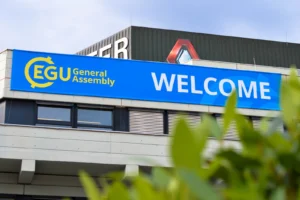
In the conference sector, the General Assembly is paramount, where we provide services ranging from abstract and programme management and registration to local organizing, including technical support, catering, signage, exhibitions, and many more.
Beyond the General Assembly, we support the vast majority of EGU Topical Events over the past decades. The EGU continually inspires and empowers us to develop ourselves and the conferences, to learn, and to adapt our offerings to the evolving needs of the participants.
Our first EGU conference was the organization of the EGS General Assembly in 1988. We have therefore been a proud EGU partner for 38 years.
We became involved with the journals in 1994, when the EGS launched its first journal, Nonlinear Processes in Geophysics (NPG), with us. Since 2001, we have been involved with every new journal from the very beginning. The trust placed in us by the EGU and the innovative spirit of their community have consistently led to exciting new developments, and together we have launched revolutionary ideas, most notably Interactive Open Access Publishing with public peer review.
From 1988 to 2010, we also supported the members of the EGS and EGU by running the back office. After, the EGU Executive Office launched for Union activities.
How has the General Assembly changed in your time with Copernicus?
When I first helped organizing an EGU General Assembly in 2003, we had just introduced PowerPoint presentations. However, for safety and for enthusiasts, every lecture room still had the indispensable overhead projector, and a slide projector for the photos.
Subsequently, the oral sessions have evolved considerably over the years. After PowerPoint became the standard, the LAN and Wi-Fi connections in all rooms became reliable so that web content could be incorporated, pre-recorded presentations were added, and, due to the pandemic, the hybrid format was introduced.
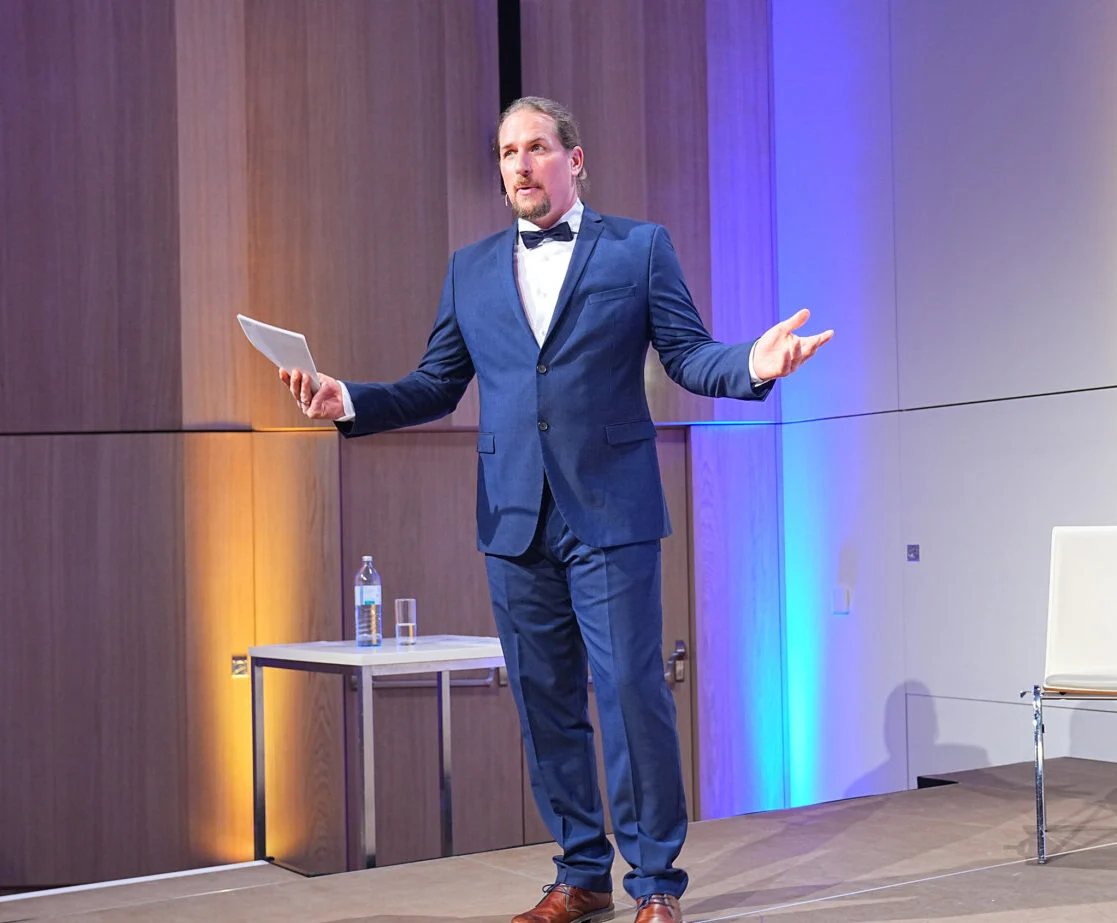
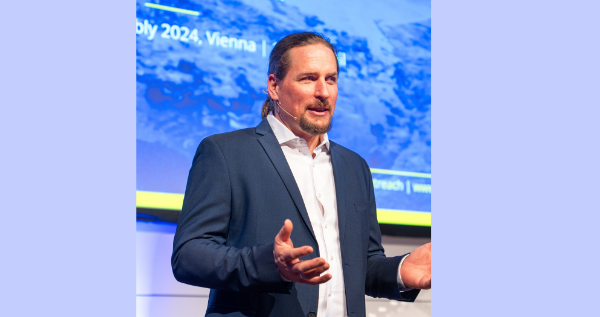
Martin Rasmussen at EGU24. Credit: Photo Pfluegl/EGU
How did the conference presentations evolve?
Since the mid-2000s, we have streamed individual sessions online and subsequently made them available on demand and included virtual speakers. In 2022, we seized the opportunity to equip all lecture rooms, which meant that many people participating in sessions can do so independent of their location.
The demand for more interactive content led us to introduce PICO – Presenting Interactive Content – for the first time in 2013. The combination of a short pitch followed by individual discussions on touchscreens with rich media content remains quite unique.
While the on-site posters look almost identical to the ones 20 years ago, we have enabled virtual posters since the pandemic. This was the necessary step to stay hybrid and inclusive in all 3 main presentation formats: orals, posters, and PICOs.
What developments have there been in how people connect at the General Assembly?
The entire networking has become much more professionalized. Initially networking had to be organized independently. Today, there are numerous sessions, bringing people much closer together and providing a much easier entry point for early career scientists.
And thankfully, over the decades we have witnessed an incredible shift towards greater diversity. The General Assembly is now much more vibrant and open, and, even though the pursuit of true equality is far from complete, the EGU community can be very proud of what has been achieved.
What is changing in the publications landscape?
Many players in the publishing landscape are currently addressing topics that have long been on our agenda: open peer review, code and data sharing, transparency in scientific quality assurance, and open science.
We were incredibly fortunate to have been able to delve into these topics 25 years ago, thanks to the openness of the EGU community. But even here, much remains to be done before everything is open access: the preprint and the final article, as well as the discussions surrounding them, and all assets for true reproducibility of research.
Currently, our most important focus is another dimension of accessibility: ensuring that everyone worldwide can participate in scientific exchange and that this exchange is fair. A significant step in this direction was the introduction of waivers for researchers from Research4Life-listed and economically disadvantaged European countries.
This goes hand in hand with our efforts to establish centralized billing through institutional agreements, so that funding for open-access articles is no longer a barrier. But inclusivity in global research, aimed at reducing and preventing neocolonialism, is also a crucial aspect. And so is the ongoing fight for greater diversity among editors, referees, and authors.
Publishing must finally become a universal good of humanity, available to everyone.
How can our members engage with Copernicus, at the General Assembly and beyond?
Convene a session at next year’s General Assembly, organize your own topical event or summer school, get elected as a decision-maker for the Union, nominate yourself as journal editor, accept referee calls and review brand new science, take part in public peer review, and inspire your colleagues.
With all these exciting opportunities, you will inevitably encounter Copernicus, and we will all be working together toward one goal: advancing your science and connecting with people from around the world. We look forward to it!