Hello Robert! Thank you for joining GeoTalk. Before we turn the page, could you introduce yourself to our readers?
I am an ethnologist and cultural anthropologist. I have the privilege of working in ‘Laboratory for Interdisciplinary Research into the Anthropocene’, led by Prof. Dariusz Brykała, which is part of the Institute of Geography and Spatial Organisation of the Polish Academy of Sciences.
My research focuses primarily on the relationships between the physical, non-living (abiotic) environment and humans – both in their utilitarian aspect and, perhaps most importantly, in their symbolic dimension.
What is ‘geomythology’?
We owe this term to Dorothy B. Vitaliano, who defined geo-myths as narratives referring to specific geological events, transmitted in the form of myth.
geomyths […] represent only one form of cultural expression related to the […] environment.
She distinguished between “true” geo-myths (referring to actual extreme events) and “ex post facto” geo-myths, which emerged as grassroots attempts to explain enigmatic landforms. However, I am increasingly inclined toward the geo-folklorer concept, developed within our research team.
What is ‘geofolklore’?
Geofolklore is a distinct category of folklore that links cultural expressions with the abiotic landscape and geological features, such as erratic boulders. It is closely connected to its geographical and environmental context, encompassing elements of tradition that arise from human interaction with the abiotic environment and express local knowledge, beliefs, and values.
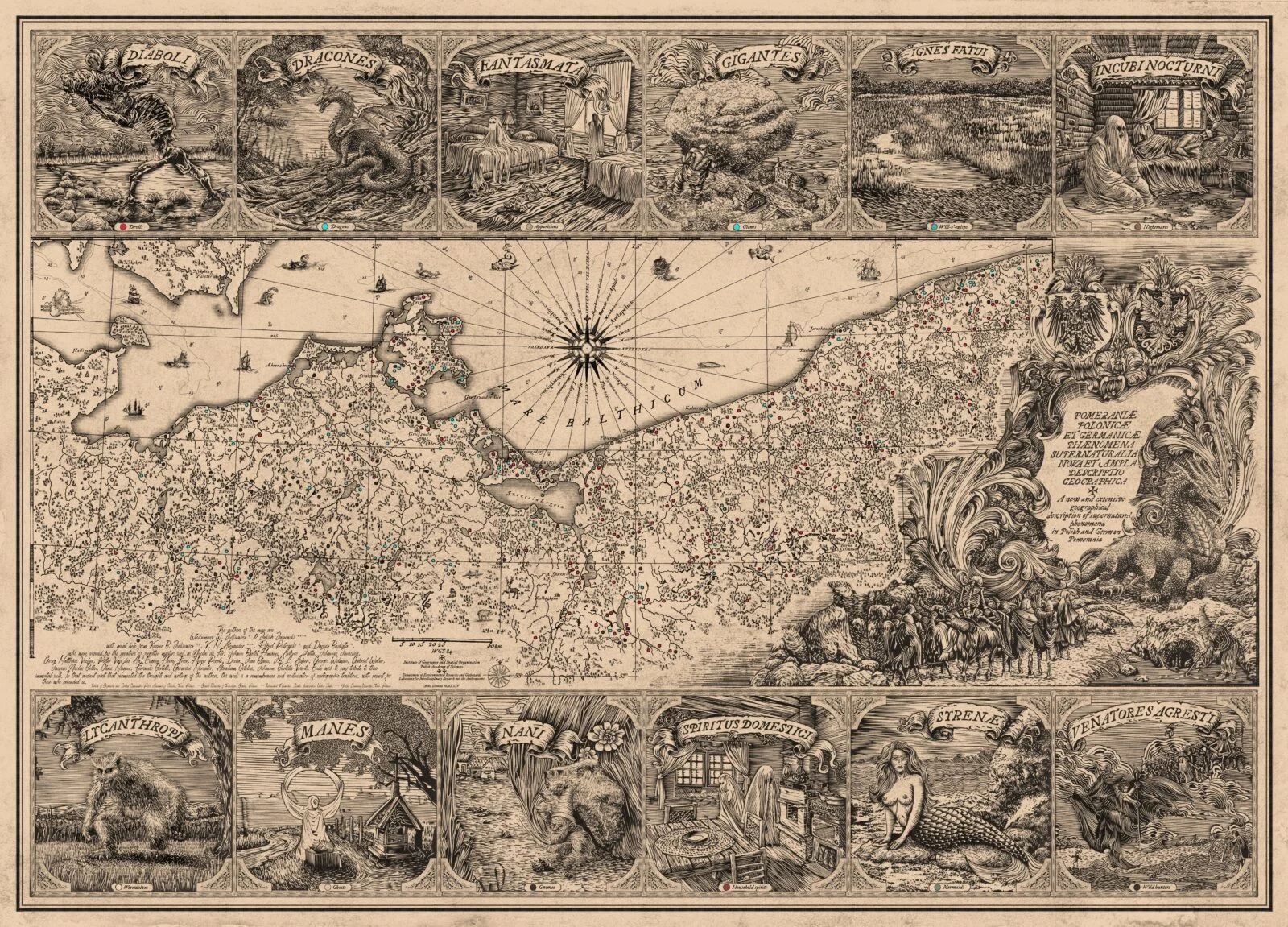
Geographical description of supernatural phenomena in Polish and German Pomerania ( Jaszewski et al., 2024) The map combines GIS and linocut techniques with graphic symbols inspired by Renaissance cartography.
Geofolklore enables the analysis of various forms of folkloric narratives – memorates, fabulates, belief legends, songs, and magical texts – which may contain the fundamental components that make myths – called “mythemes” – but are not myths strictly speaking.
In a broader sense, geofolklore also includes geomyths, which represent only one form of cultural expression related to the abiotic environment. In this way, geofolklore helps to distinguish mythological narratives from local stories and practices associated with the environment, revealing the full geo-cultural value of these sites and objects.
Geomythology is utilised for science communication, education and other activities. How does it help people engage with the geosciences?
Geomythology and geo-folklore have significant potential not only for research but also for education and practical application. Studying the intangible value of geological objects, such as erratic boulders, enhances their importance for local communities and increases their touristic appeal.
…seek collaborators not within disciplinary boundaries, but around shared research questions.
Geological value alone does not always attract public interest; therefore, the analysis of folkloric sources allows us to reconstruct the geo-cultural value of an object, making it easier to engage a broader audience and to highlight its relevance to the geosciences.
As an interdisciplinary scientist who has collaborated with different types of researchers as well as artists, do you have any advice for readers looking to engage beyond their field?
Our experience has shown that interdisciplinarity does not emerge on its own – it requires openness, trust, and a willingness to learn the language of other disciplines. In our team, we have created a genuine space for dialogue between scholars from different fields – historians, ethnologists, geographers, and dendrochronologists. We are able to integrate the natural and human sciences, cross traditional disciplinary boundaries and build a holistic understanding of human relationships with the abiotic environment.
Collaboration with artists further opens new channels of communication, translating research results into the language of emotion and imagination, and making them more accessible to the public.
My advice: interdisciplinarity starts with people, not with projects – seek collaborators not within disciplinary boundaries, but around shared research questions.