Tinted detail of a photo: Fisheye view of bright green aurora bands swirling across a starry night sky above a snowy curved horizon, with a small lit building at the right edge.
ST
Solar-Terrestrial Sciences

Heliophysics

Water Transport from Enceladus through the Saturnian System: From Plume to Neutral torus
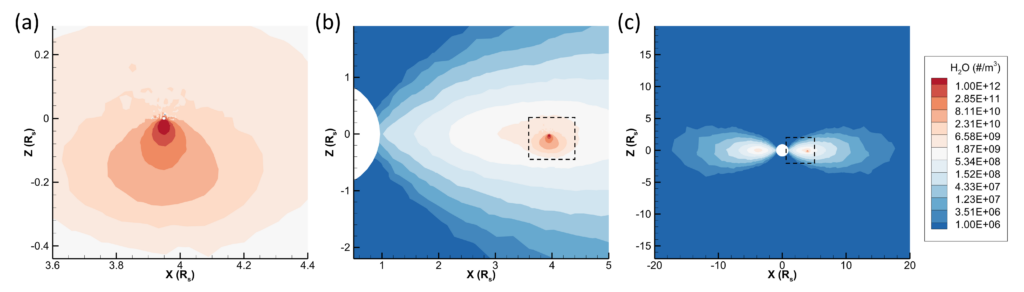
Three contour plots showing water density distributions in blue, white, and red. The views transition from a close-up of a red peak to a wide-angle view of a symmetrical blue and white plume.

Saturn is best known for its spectacular rings, but the rings are closely connected to the surrounding Saturnian environment. One of the sources of material in this system is the small icy moon Enceladus. During the Cassini mission, spectacular plumes were discovered erupting from fractures near Enceladus’ south pole, known as the tiger stripes. These …[Read More]

A talk with scientists across Europe: building the future of European heliophysics together

A talk with scientists across Europe: building the future of European heliophysics together

“Heliophysics studies the Sun, its sphere of influence, and how it affects the bodies in the solar system.” – this holistic approach to understanding our space environment is at the heart of the European Heliophysics Community (EHC), an open and inclusive network of researchers across Europe (https://www.heliophysics.eu/). The EHC promotes collaborative, curiosity-driven science that explores …[Read More]

Chasing solar storms as an early career scientist

Hello! My name is Erika Palmerio and I am a newly qualified Dr in space physics from the University of Helsinki, Finland. In this blog post I will talk about my PhD research and my future career plans. The title of my PhD dissertation is “Magnetic structure and geoeffectiveness of coronal mass ejections”. Coronal mass …[Read More]