The ocean surrounding Antarctica plays a crucial role in the climate system. Along parts of the Antarctic coast, very cold and salty water becomes dense enough to sink all the way to the ocean floor. This process forms Antarctic Bottom Water: the deepest water mass in the global ocean, representing about 40% of its total volume. As this dense water sinks into the abyss, it helps trap heat and carbon at depth and supplies oxygen to the deepest layers of the ocean.
Dense Water Formation at the Antarctic Margins
Dense water formation around Antarctica occurs mainly in coastal polynyas, which are wind-driven, recurring openings in sea ice. These exposed ocean areas lose heat rapidly to the cold atmosphere, promoting sea ice formation. As ice forms, salt is released into the surrounding water, increasing its density. The resulting dense water sinks off the continental shelf, cascades down the continental slope, and eventually contributes to the renewal of abyssal waters.
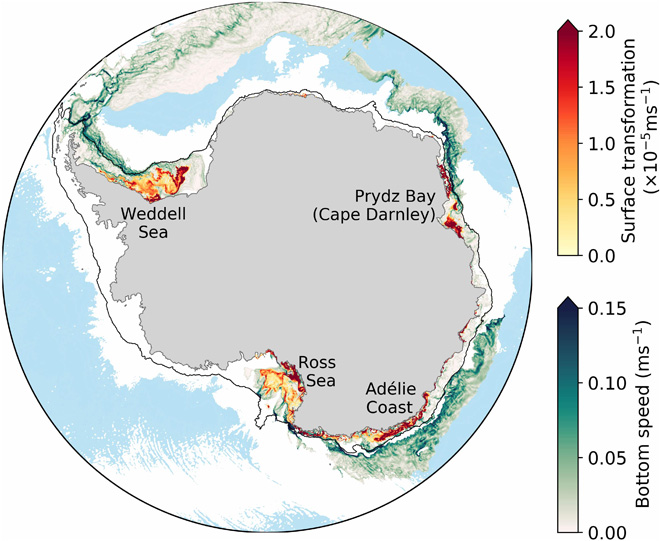
Figure 1: From Morrison et al. (2020): Dense water forms on the Antarctic continental shelf, in four main regions. It then cascades down the continental slope and sinks into the abyss.
Observations indicate that Antarctic Bottom Water formation has declined in recent decades, and models project this decline to continue. Yet the drivers of year-to-year variability remain poorly understood.
The Zonal Wave-3 Mode: A Potential Driver
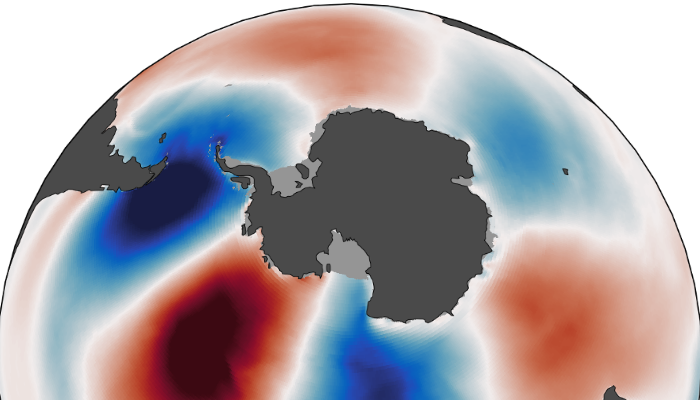
One possible source of variability is the Zonal Wave-3 (ZW3), a mode of atmospheric circulation characterized by three alternating high- and low-pressure systems encircling the Antarctic continent. The longitudinal position of these systems can shift, changing the phase of the ZW3 and altering the direction and strength of north–south winds over the Southern Ocean.
The ZW3 has been shown to explain anomalies in winter sea ice extent, as it can displace the sea-ice edge northward or southward depending on its phase. It is therefore a strong candidate for driving variability in dense water formation, by enhancing or supressing polynya activity at the Antarctic coast.
Modelling the impact of ZW3
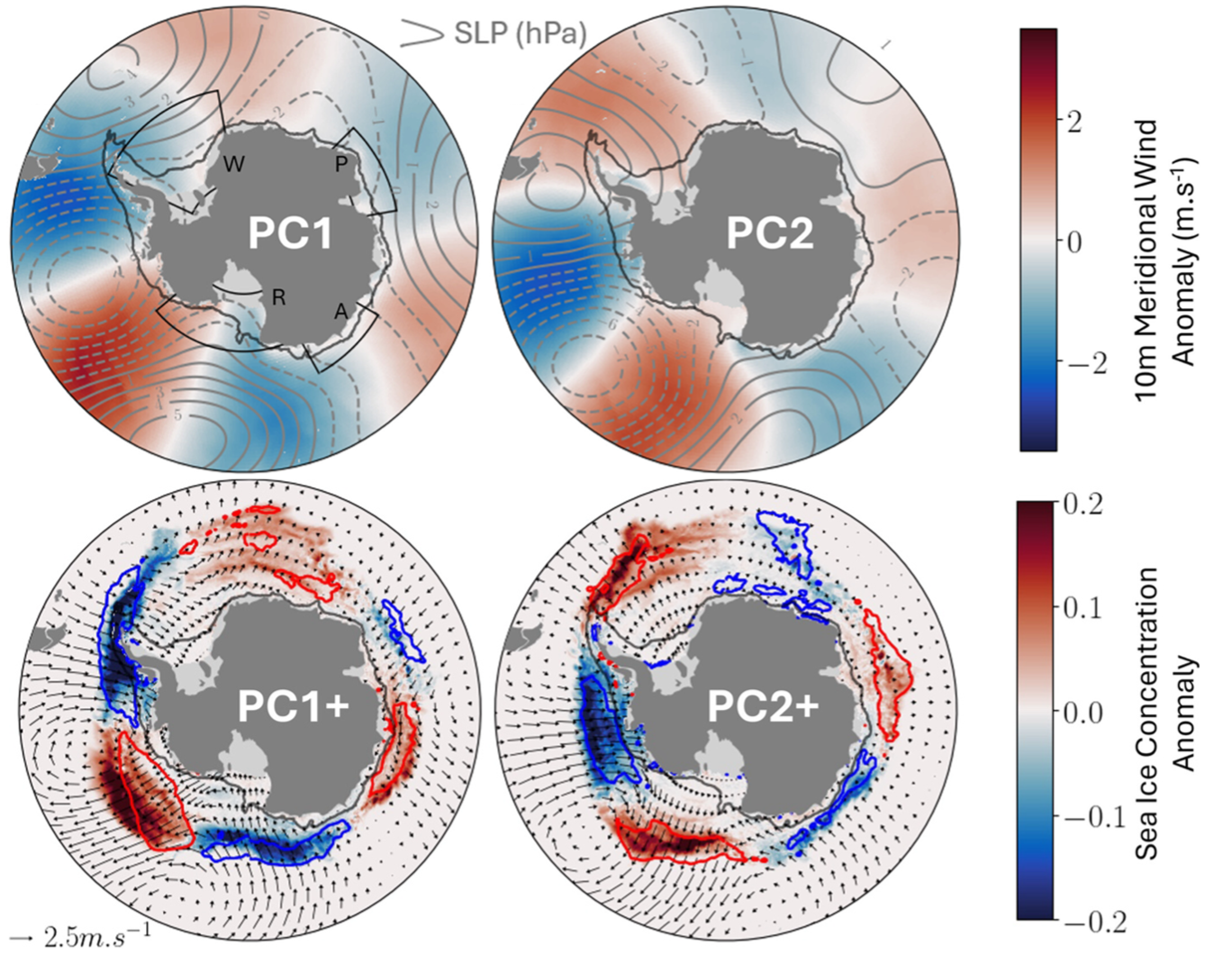
Figure 2: Two phases of Zonal Wave-3 like atmospheric perturbations (top) and their winter sea ice response (bottom).
In our recent study (Auger et al., 2023), we explored how this atmospheric pattern could influence dense water formation using a set of ocean–sea ice model experiments. In each experiment, we imposed a different phase of the ZW3 pattern, effectively shifting where its wind anomalies occur around Antarctica. This allowed us to isolate how large-scale changes in winds affect coastal sea ice production and the export of dense water to the deep ocean.
The simulations reveal that strong ZW3 events can influence dense water formation and export for several years. The effect is especially pronounced in key formation regions such as the Weddell Sea and the Ross Sea.
Depending on where the high and low-pressure systems are positioned, the ZW3 can either boost or suppress dense water formation. In some cases, production nearly doubles. In others, it is greatly reduced, even provoking a halt in dense water export to the abyss over several years. The impacts often work in opposite directions across regions: when formation increases in the Ross Sea, it tends to decrease in the Weddell Sea, and vice versa.
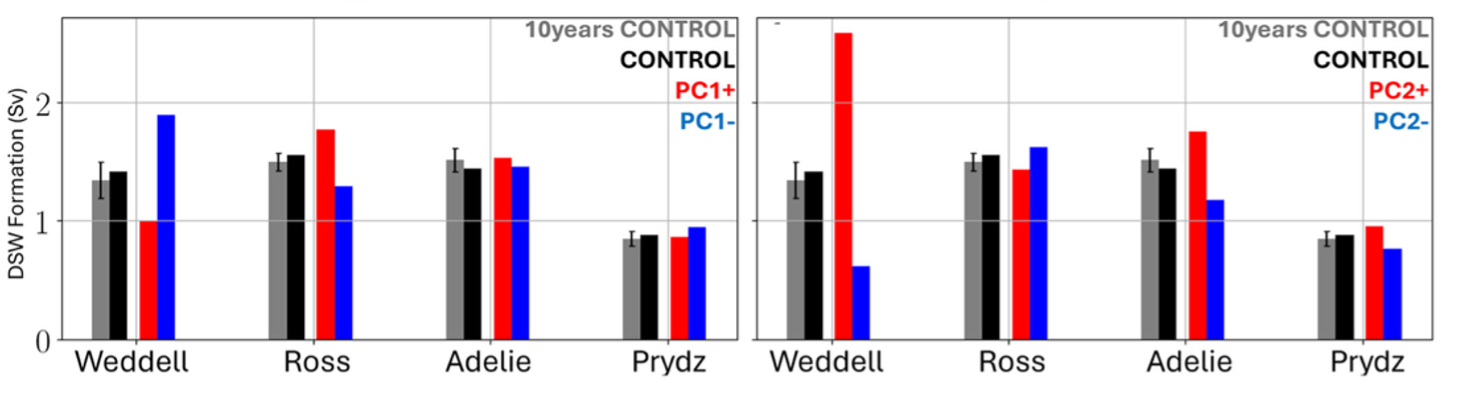
Figure 3: Simulated response of dense water formation to the perturbations shown in Figure 2, for each formation region.
Implications
Our results highlight an important link between large-scale atmospheric circulation and deep ocean processes. Because Antarctic Bottom Water connects the surface climate to the deepest ocean layers, understanding how atmospheric variability controls its formation is essential for anticipating long-term changes in the global climate system.