What flows around comes around
For centuries, hydrologists have studied the flow of water through landscapes near and far. We measured flow rates, mapped aquifers and followed invisible paths of raindrops through soil and bedrock. Hydrology is a meticulous, beautiful science that has taught us much over the years. From the water cycle, surface water in rivers, wetlands and snowpack and groundwater deep and shallow, this is what we were taught as young aspiring hydrologists.
Now, as we are starting to understand our ecosystems better over time, it has become clear that water carries more than just hydrogen and oxygen. It also carries life, but in particular the invisible genetic traces that organisms leave behind as they move through water. Much like a loose strand of hair unintentionally left behind at a crime scene, organisms passing through a water body – however briefly, leave their genetic fingerprint behind. One could almost say that in hydrology, the water always tells. We call it the gene pool of evidence.
Where traditional hydrology meets molecular biology
On the surface, the disciplines could not look more different. Hydrology and the geosciences have deep roots in physics, chemistry and process-based understanding. Molecular biology, driven by genomics and biology, is rooted in understanding life on earth as a whole. At the same time, the hydrological cycle does not respect such disciplinary boundaries. A simple water sample from hillslopes, groundwater, snowmelt or urban runoff does not only reveal chemical properties but also an entire world of biological communities living in these environments, waiting to be discovered and tell their story.
Considering the information contained in a simple water sample’s isotope and geochemical composition – from origins, residence times, and evaporative histories, it isn’t surprising that the environmental DNA (eDNA) in a drop offers a whole other evidence base through which we can understand even more aspects of water movement, flow pathways, and ecosystem interactions that were previously invisible. At the same time, eDNA incorporates hydrological aspects into biodiversity monitoring, carrying the water flows legacy across time and space, allowing us to track flow paths, ecosystem changes and interactions between organisms and their environments.
A recent landmark review paper on how eDNA connects hydrology and biology laid out the untapped potential of how eDNA could help us address unsolved questions about water movement through catchments. While it may be a nuisance for biologists trying to pinpoint the origin of a certain species, the movement of water and transport of genetic material through the surface and subsurface is precisely what makes eDNA interesting for hydrologists.
Hydrologists and Biologists unite
With the idea to bridge the longstanding gap between geoscientists and biologists, a new collaborative research network, eDNA4Hydro, has been created by Dr. Natalie Ceperley, Dr. Yvonne Schadewell, and others. By connecting researchers across fields, their goal is to foster interdisciplinary collaboration and reshape how we study aquatic and terrestrial ecosystems. I (Maria Magdalena Warter) joined this network last year after meeting Natalie and Yvonne at EGU, and getting excited about sharing this interdisciplinary journey with like-minded researchers. A stranger to eDNA before, I am now part of this emerging interdisciplinary research field and can honestly say that it broadened my hydrological horizon and ecological understanding. Because water and sediment have a better genetic memory than most witnesses, I believe that the use of eDNA in hydrology and geosciences will play an important role in the future.
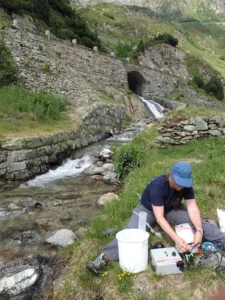
Sampling at Steinsee/Steingletscher/ Wysbach in Canton Bern, Switzerland in June 2026. © Sabine Röthlin
Over the years, the number of publications integrating eDNA into hydrological research has steadily increased. Examples from high mountain streams in Switzerland to urban aquatic systems in Germany, to analyzing hydrological timeseries and subsurface stromflow, to name just a few, clearly show– eDNA is everywhere just waiting to be decoded. Even more so, the investigation of eDNA bound to sediment, which accumulates flood after flood and year after year in lakes and dam reservoirs, also offers new insights into flow and transport dynamics. Through dating the sediment layers, we can actually reconstruct the environmental history and past changes in biological communities in contrasted environments. eDNA is revealing unprecedented insights into hydrological processes. Paired with biogeochemistry, it becomes an unbeatable duo for exploring and understanding complex environments.
The eDNA4Hydro network was founded by Yvonne Schadewell and Natalie Ceperley, together with Peter Chifflard and Olivier Evrard. Yvonne’s research spans biodiversity patterns, molecular ecology, and ecosystem linkages across terrestrial and aquatic environments. Natalie’s research spans from glacier melt in Alpine environments to evaporation from dry-land savannas. Peter’s research focuses on fine-scale hydrological connectivity, water flow pathways, biogeochemical processes, and the impacts of global environmental change on terrestrial and aquatic ecosystems, while Olivier focuses on eDNA bound to sediments to reconstruct spatial and temporal variations of sediment sources and associated contaminants in contrasted environments.
Designed to be a catalyst, the eDNA4hydro network combines exactly the strengths of biological and geoscientific expertise to shed light on pressing water-related challenges in a fast-changing environment. The network provides a platform for researchers of all backgrounds to exchange knowledge, develop and compare new methodologies, and jointly explore and advance the boundaries of the fields of hydrology and geosciences. eDNA is the bridge between disciplinary boundaries that helps us to advance our understanding of water dynamics, connectivity, sediment transport, surface-subsurface water as well as human-environment interactions. It is like nature’s forensics, no warrant needed. New members always welcome.
Edited by B. Schaefli