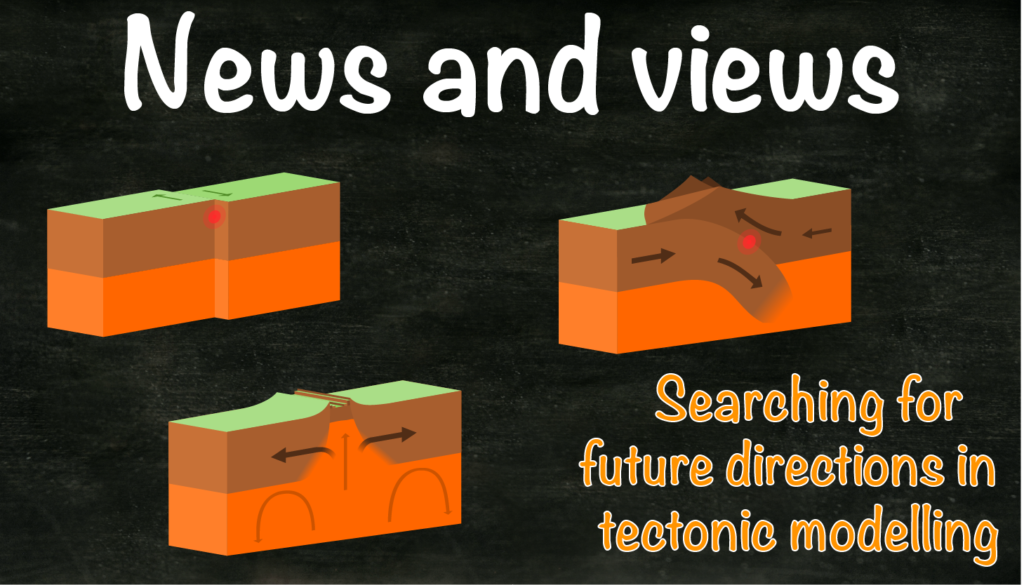
Due to huge difference between the time scale of the mantle convection and the outer core convection, they are modelled separately. In this week’s News and Views, Masaki Yoshida from the Volcanoes and Earth’s Interior Research Center, Japan Agency for Marine-Earth Science and Technology (JAMSTEC), Japan, put forward the recent development on the modeling of the whole solid-Earth. The E ...[Read More]
Modelling the deformation in the Indian plate and the India-Eurasia collision zone
A complete fluid dynamical approach of modeling the Earth’s deformation can not provide a complete picture due to presence of rigid lithospheric plates. In this week’s news and views, Srishti Singh, scientist at National Geophysical Research Institute, India, explains how coupled models of lithosphere dynamics and mantle convection are developed. The ongoing collision of the Indian plate wi ...[Read More]
2021: 100th year of the craton concept and beyond
One hundred years back, Leopold Kober first introduced the term “Kratogen”. With time, the concept of kratogen has evolved, and they are now known as cratons. In this week’s news and views, Jyotirmoy (@GeophyJo), a PhD student from the Indian Institute of Science revisits the history of craton science: how the craton concept has evolved and what are the modern problems related to them. &nbs ...[Read More]
Advanced geodynamic models of giant earthquakes
Though giant earthquakes are disastrous, they provide essential information to investigate earthquake physics. In this week’s news and views, Thyagarajulu Gollapalli, a PhD student jointly from the Monash University and the Indian Institute of Technology, Bombay, discusses our present understanding of such big earthquakes and how advanced numerical models will help to get a more precise picture of ...[Read More]