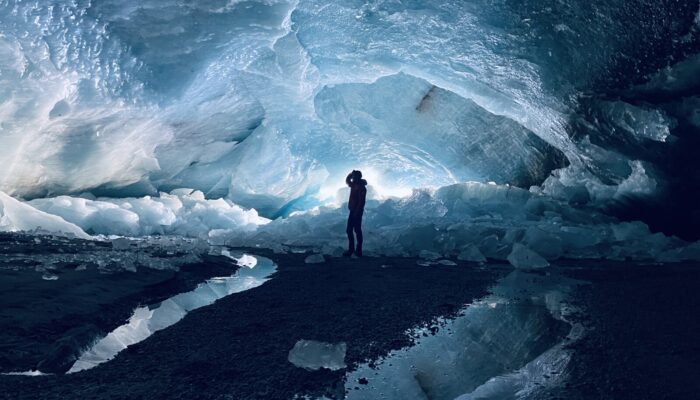
Ice shelves, the floating margins of the Antarctic ice sheet, play an important role in the estimation of future sea-level rise. By their presence, they act as a brake on the flow from the grounded ice sheet to the ocean and therefore modulate how much of this ice is added to the ocean. As the atmosphere and ocean warm, melt is occurring at their surface and at their base, putting their existence ...[Read More]
Peak glacier extinction in the mid-twenty-first century
Have you ever wondered how many glaciers will still exist in the future? Or how many glaciers we might lose each year in the coming decades? In our new study (Van Tricht et al., 2025), we shift the focus of glacier modelling from ice volume to individual glaciers. Because every glacier, no matter how small, can matter. Not necessarily for global sea-level rise, but for landscapes, ecosystems, cult ...[Read More]
Navigating the polar frontier: exploring the effects of sea-ice decline on shipping and sea routes in the Arctic
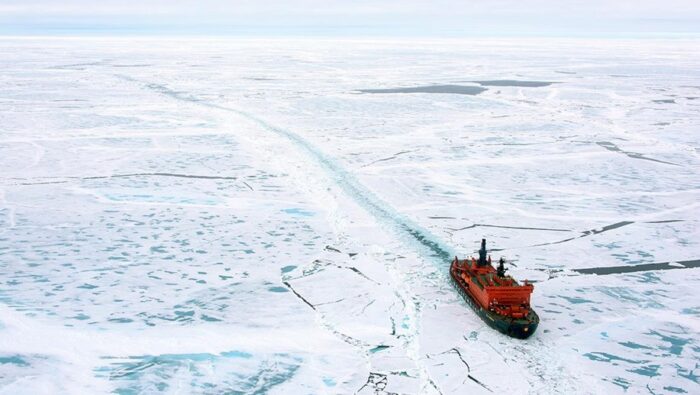
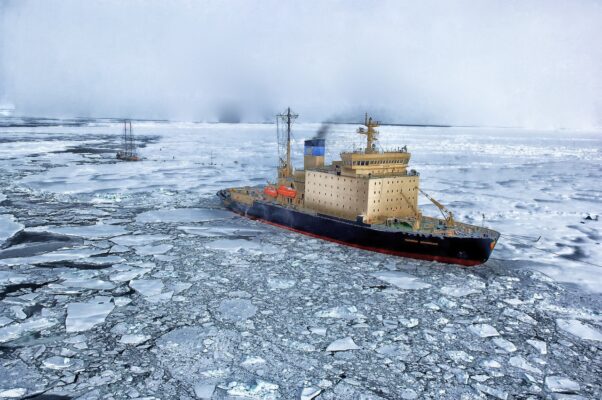
Sea ice is a critical part of the unique Arctic ecosystem, but climate change is becoming a serious threat. Warming in the Arctic has already resulted in the loss of over 4 million km² of sea ice. But is it all bad? Retreat of Arctic sea ice is allowing more ships to navigate the Arctic Ocean, along shorter, faster and cheaper sea routes, providing emission reductions of 24%. But will the growth o ...[Read More]
Friday the 13th – an unlucky day for sea ice?
On this September 13th, coinciding to be a “Friday 13th”, we wanted to scan the cryo-history for expeditions started, sunken ships that day, and mountain myths. And we did find that. But as autumn approaches in the Northern hemisphere, the spookiest story of all was this one: the unlucky timing of the Arctic sea ice in September. TGIF – but not for sea ice Although the median min ...[Read More]
Climate Change & Cryosphere – Can the smallest ice make the greatest impact?
The cryosphere comprises all the ice on Earth, from glaciers in Antarctica, icebergs floating in the ocean, to millimetric ice found in the soils. Soil can hold ice wedges and ice lenses, but there are small ice reservoirs that are usually overlooked: the pore ice. Pore ice is an unknown compartment whose role regarding matter degradation is yet to be determined… stay with us and you will see that ...[Read More]
Did you know that a lack of Arctic shipping regulation has detrimental environmental effects?
Increased maritime transport in the Arctic, facilitated by the reduction in sea ice cover, is causing tremendous harm to an already vulnerable part of the world. Insufficient regulation of Arctic shipping has detrimental environmental effects on a global scale. These effects include, e.g. underwater noise pollution, oil spill risk and threats to the global climate. But did you know what role regul ...[Read More]
Antarctica Uncovered: Exploring the Exposed Surfaces Around the Melting Continent
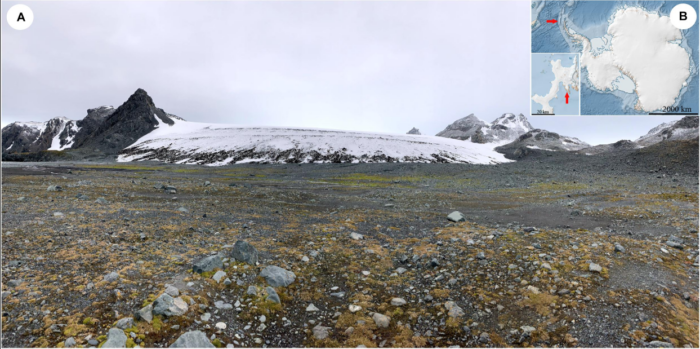
In 2020, ocean scientists discovered a new island off the Pine Island Glacier ice shelf, naming it after the Norse goddess, Sif. The island is one of many new regions being exposed in the wake of increased ice shelf melting and glacial retreat. While these newly-revealed lands have been discussed in the Arctic and alpine ecosystems, the uncovered island and coastlines of Antarctica have been less ...[Read More]
CryoNews – The WMO is making the cryosphere a global priority
To us, the cryosphere has always been a priority. It is our field of interest, research, maybe passion, it is the stuff that gets us excited. Now, the cryosphere also became a priority to the World Meteorological Organisation (WMO). In today’s post we cover a recent news item introducing this very decision made during WMO’s recent congress. Read along to find out why they emphasize the importance ...[Read More]
How over-consumption leads to reduced sea ice: Visualization through artwork
Do you think that it is sometimes challenging to understand science (as a reader or listener) or to explain it (as a scientist)? Then, art may be a good solution to the problem. Between April and June 2023, Zacharie Bodson (artist) and I (climate scientist) are participating in the Seas and Oceans exhibition to explain the links between changes in Arctic sea ice and over-consumption. Read here abo ...[Read More]
The Global Arctic, a personal perspective on interdisciplinary research
Around the summer solstice of 2022, a small group of twenty young researchers met in Svalbard, a small island lost between Norway and the North Pole. The Norwegian Scientific Academy for Polar Research wanted to bring us together around the theme of “The Global Arctic“. The scope of this summer school was to “produce a better understanding of the significance of the concept of Gl ...[Read More]