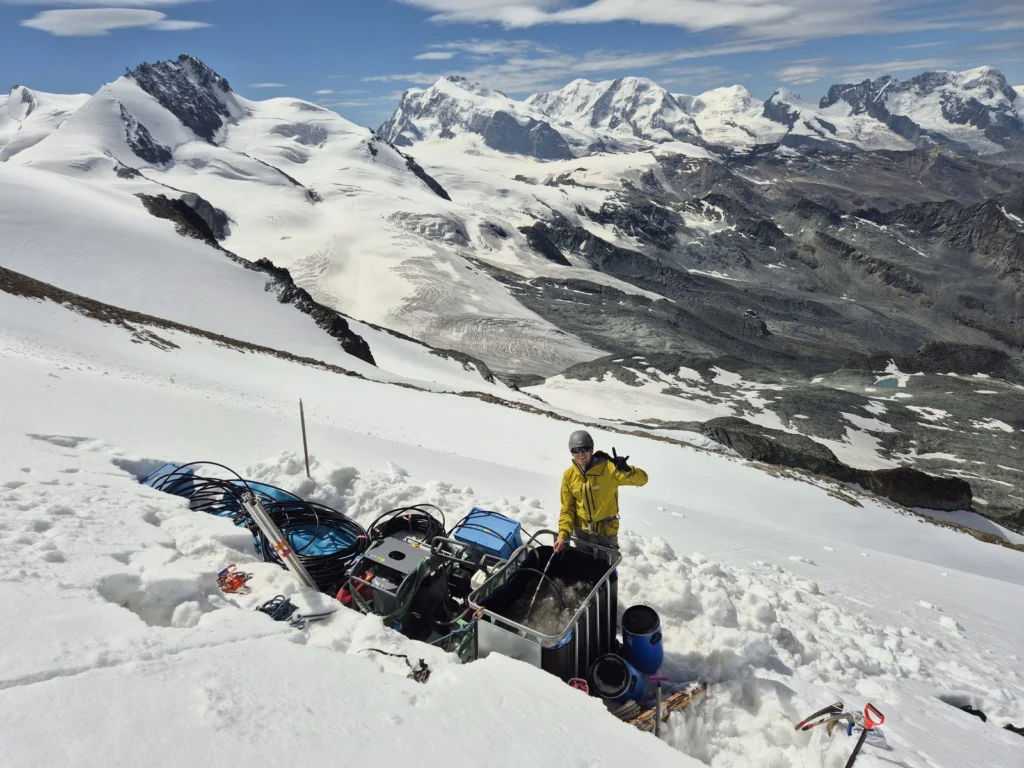
Small glaciers are often written off: too small to matter, and soon gone anyway. Yet recent disasters in the Alps show that they can still pose a threat. And some are doing something rather unexpected: while the climate warms, the ice inside them has turned cold. We drilled into six small Swiss glaciers to find out why, and why it matters.
Why bother with small glaciers? Won’t they soon be gone anyway?
In the early afternoon of 3 July 2022, a small remnant of the Marmolada Glacier in the Italian Dolomites broke away at around 3,200 metres above sea level. About 70,000 cubic metres of ice rushed down the mountain as an ice avalanche and swept across the normal route to the summit. Eleven people died and eight more were injured, making it one of the deadliest glacier disasters in the Alps in decades. For years the glacier had been slowly retreating without being considered a major threat. Then, within minutes, it became one.
Less than three years later, on 28 May 2025, the Birch Glacier in Valais, Switzerland, collapsed under the weight of rock that had fallen onto it from the mountain above. Within about 40 seconds, the avalanche reached the valley floor and buried 90% of the village of Blatten. Thanks to close monitoring, the village had been evacuated nine days earlier. Even so, one person lost his life.
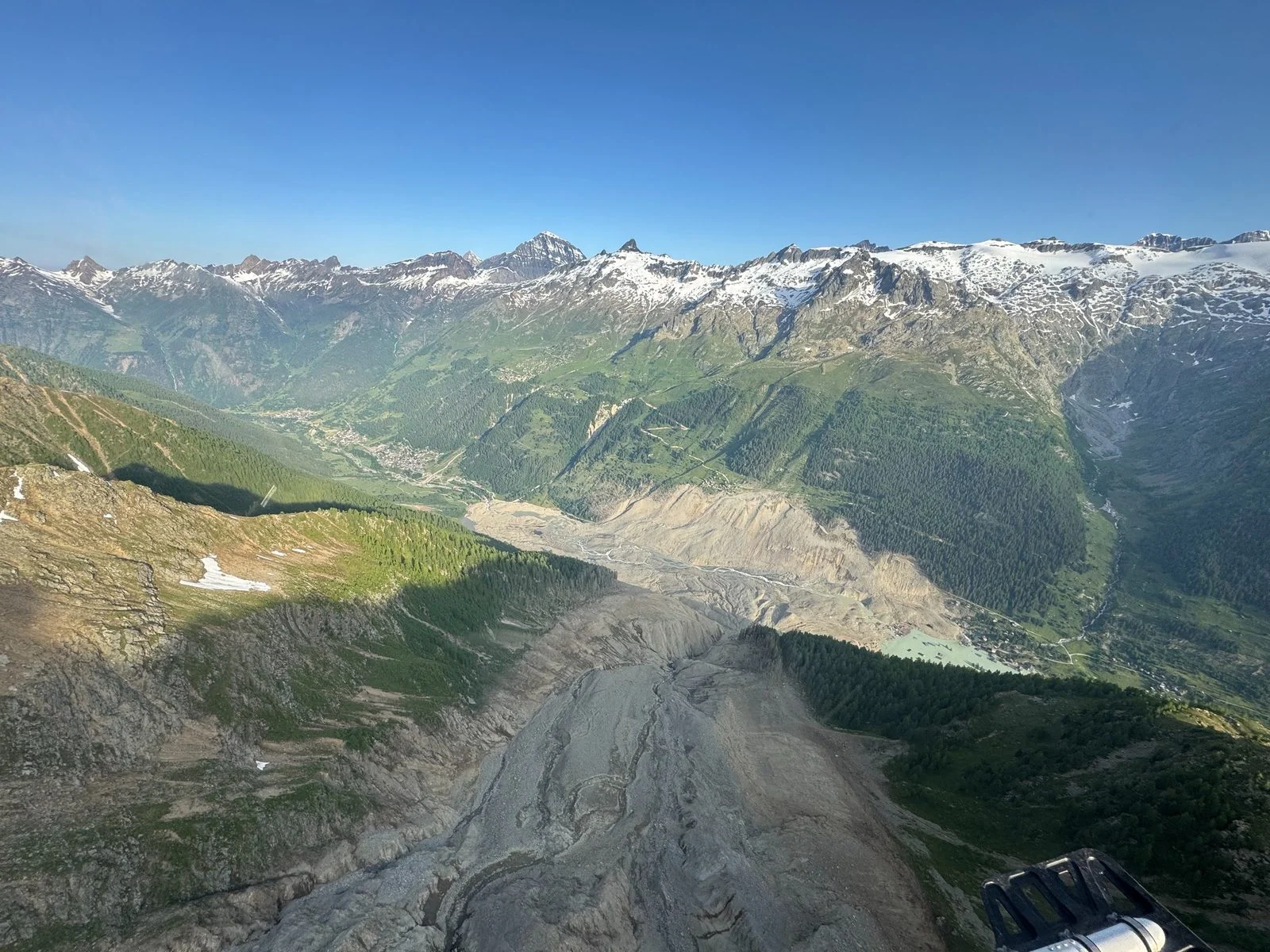
Figure 1. The Lötschental valley in June 2025, a few weeks after the collapse of the Birch Glacier buried most of the village of Blatten under ice and rock debris. [Credit: Gabriel Perren]
The ice remnant at Marmolada (about 0.025 km²) and the Birch Glacier (about 0.34 km²) are tiny compared with large Alpine valley glaciers such as the Great Aletsch Glacier (about 76 km²). Yet both caused disasters. And they are not exceptions: in Switzerland, more than 80% of all glaciers (1,058 of 1,299 in the latest Swiss Glacier Inventory from 2023) are smaller than half a square kilometre. Many small glaciers have already vanished; over 1,000 disappeared in Switzerland between 1973 and 2016 alone. But many others are still tens of metres thick and will be with us for decades. As they shrink, they change in ways that can make them more dangerous. One of these changes is hidden inside the ice: its temperature.
Warm ice, cold ice: why temperature matters for glacier hazards
Not all glacier ice is the same. Most ice in the Alps can be considered temperate: ice at its melting point, around 0 °C, which contains small amounts of liquid water and lets meltwater pass through. Cold ice, in contrast, stays below the melting point. It is dry, largely impermeable to water, and can be frozen to the bedrock beneath it. When a glacier contains both, we speak of a polythermal glacier.
This matters for how a glacier stores and releases meltwater. Temperature alone does not make a glacier collapse, but it can set the stage for ice avalanches, as at Marmolada, or for sudden outbursts of water trapped inside the ice. In polythermal glaciers, a cold glacier tongue can act like a dam, blocking meltwater from the temperate part above so that it accumulates inside the glacier. At Tête Rousse in the French Alps, scientists found exactly this in 2010. Behind the glacier’s cold, frozen tongue, a cavity held around 55,000 cubic metres of water, about 20 Olympic swimming pools, hidden high up in the mountain and invisible from the surface. The same glacier had already released such a water pocket once. In 1892, the resulting flood killed 175 people in the valley below. In 2010, scientists detected the water in time, and engineers pumped it out before disaster could strike again.
Not every polythermal glacier is dangerous. But to know which ones could be, we first need to know where cold ice exists. And here lies the problem: temperature measurements inside Alpine glaciers are rare, and most come from high elevations, where cold ice is expected. The lower parts of glaciers, where the glacier tongue sits and where meltwater could be trapped, have long been assumed to be temperate and were rarely measured. To help fill this gap, we went to six small glaciers, drilled boreholes and measured.
Colder than expected…
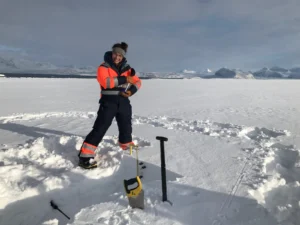
Over two consecutive summers, 2024 and 2025, together with colleagues from ETH Zurich, the Swiss Federal Institute for Forest, Snow and Landscape Research, the Universities of Lausanne, Bern and Fribourg, and the Centre de recherche sur l’environnement alpin in Sion, we visited six small glaciers across the Swiss Alps (see photos below). Using steam and hot-water drills, we drilled 23 boreholes and lowered chains of temperature sensors into them. Once frozen in, the sensors recorded the ice temperature for up to a year. In addition, we surveyed the glaciers with ground-penetrating radar, which sends radio waves into the ice. Temperate ice contains tiny pockets of water that scatter these waves, while cold ice is dry and appears almost transparent. This allowed us to trace the cold ice between our boreholes. Our results are now published in The Cryosphere.
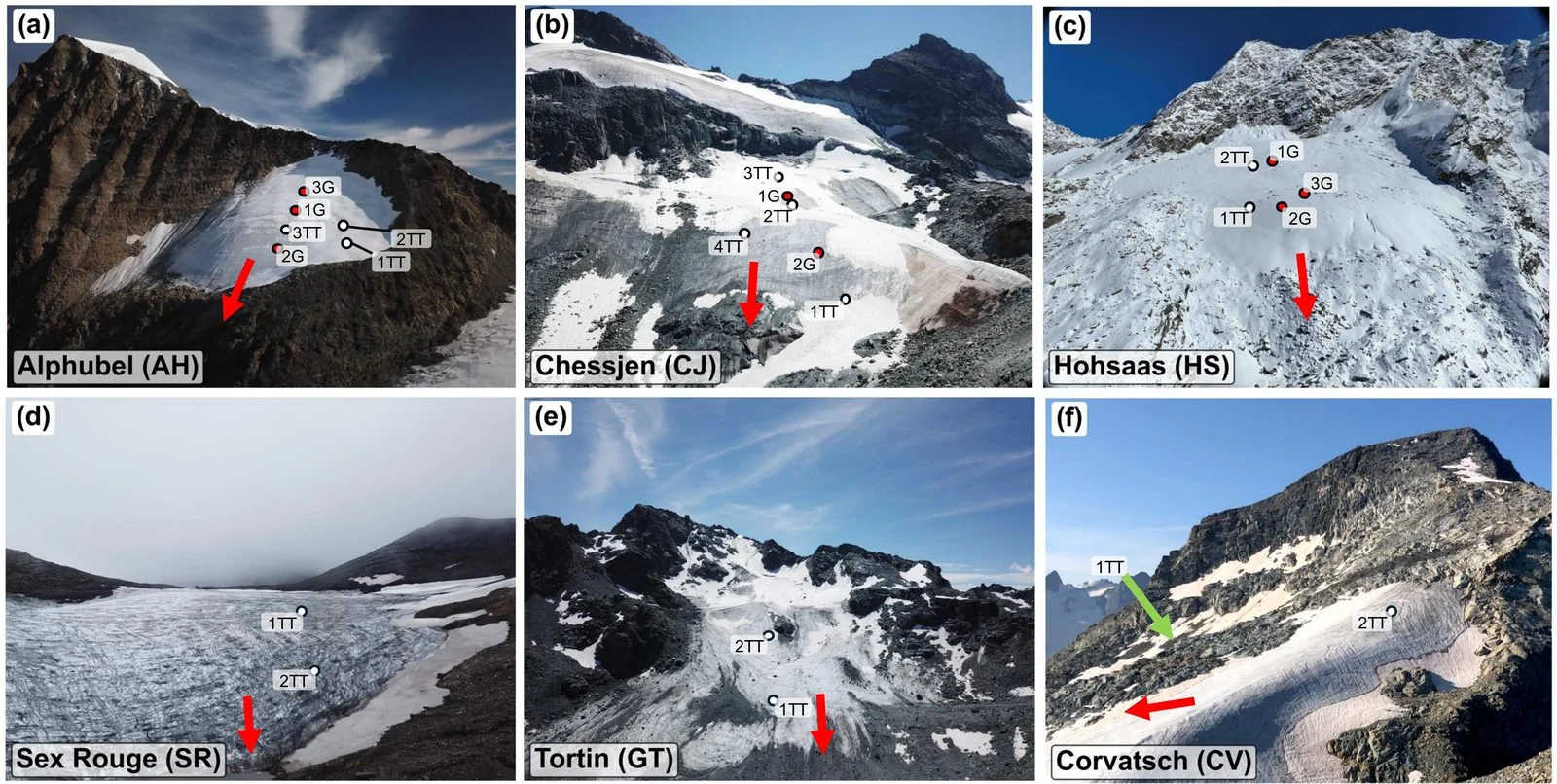
Figure 2. The six small glaciers we studied across the Swiss Alps. Dots mark the boreholes; red arrows show the direction of ice flow. [Credit: Beer et al., 2026, CC BY 4.0]
Three of the six glaciers turned out to be polythermal, with a layer of cold ice reaching 17 to 38 metres below the surface. A fourth glacier very likely still has the polythermal structure measured there about ten years ago, and a fifth was cold throughout. A clear pattern emerged: temperate ice in the upper parts, transitioning into cold ice towards the glacier terminus. At some glaciers, the terminus was cold all the way down and frozen to the ground, with temperatures at the bed as low as −2.1 °C. This is the kind of setting outlined earlier, in which a cold tongue could in principle hold back meltwater. The radar images largely confirmed this thermal structure.
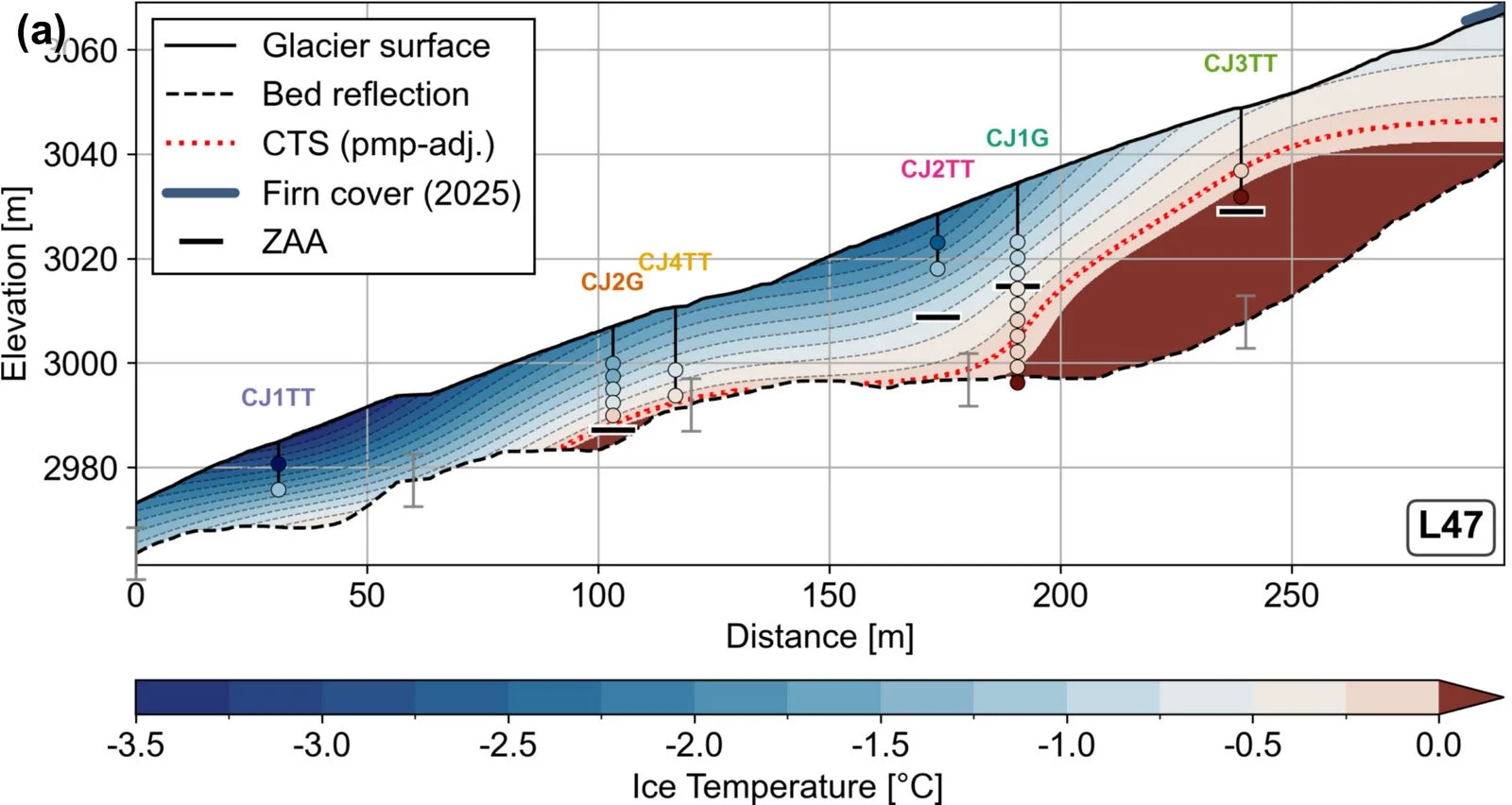
Figure 3. Temperatures inside Chessjengletscher along a cross-section from the glacier tongue (left) to its upper part (right). Blue shows cold ice, red shows temperate ice at the melting point. The dotted red line marks the boundary between the two. [Credit: Beer et al., 2026, CC BY 4.0]
Where does the cold ice come from?
Firn, snow that has survived several summers, acts a bit like a winter coat for the glacier. Together with the seasonal snow, it insulates the ice from the cold winter air.
Even more important, firn works like a sponge. In summer, meltwater seeps into the firn and refreezes there. When water freezes, it releases heat, and this heat warms the surrounding ice. As long as there is enough meltwater to refreeze in the firn, the ice beneath it is kept at the melting point from within.
But on many small glaciers, the firn is disappearing, leaving bare ice behind. Without the sponge, meltwater simply runs off the surface, and the heat it would have released is lost.
And without its coat, the ice is exposed to the winter cold, which gradually works its way in. This is possible because at these elevations, the average air temperature over the year is still below 0 °C, even though the climate is warming.
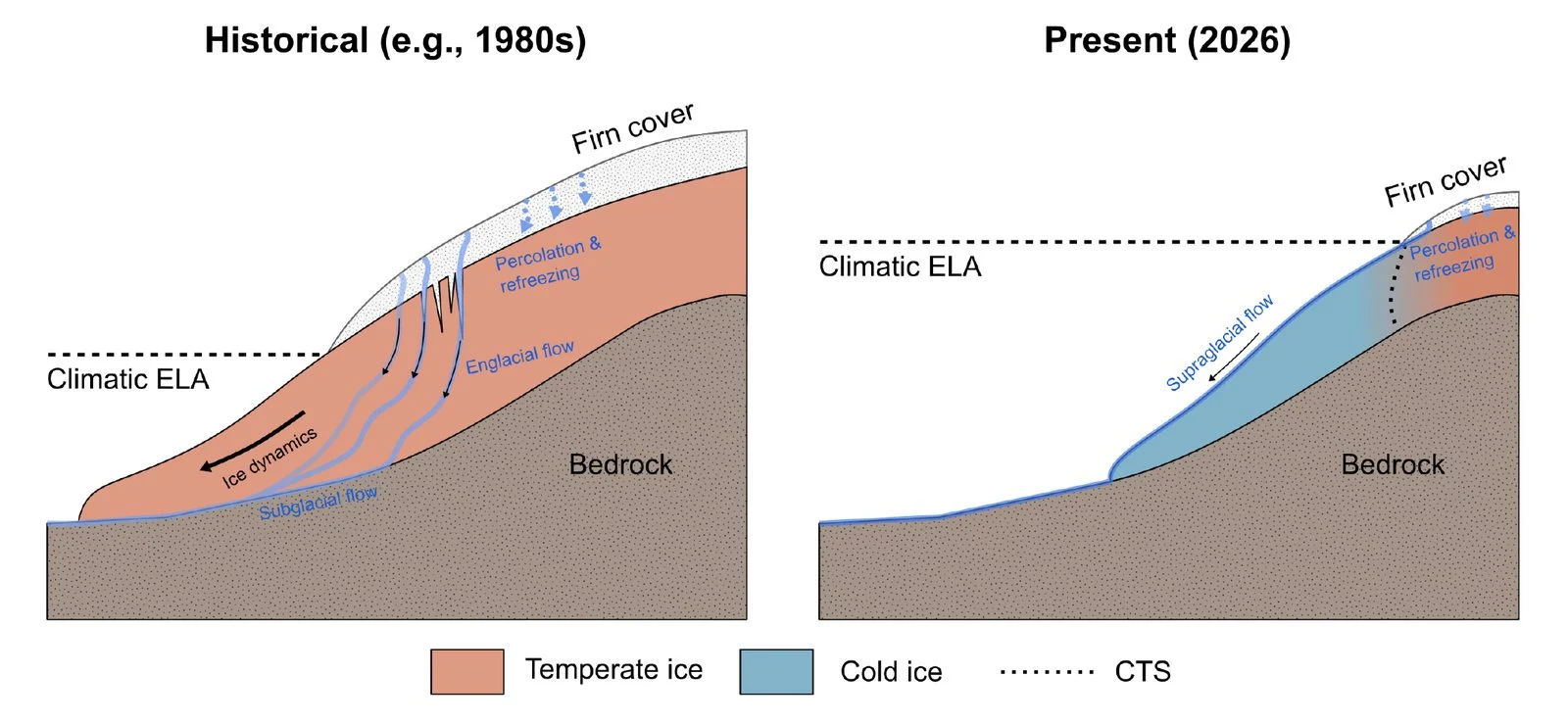
Figure 4. How losing firn changes a small glacier. Left: in the past, a thick firn cover let meltwater seep in and refreeze, keeping the ice temperate (red). Right: today, the firn has retreated to the top of the glacier, meltwater runs off the bare ice surface, and the lower glacier has turned cold (blue). “Climatic ELA” marks the elevation above which snow survives the summer; the dotted line (CTS) marks the boundary between cold and temperate ice. [Credit: Beer et al., 2026, CC BY 4.0]
Why small glaciers in particular? Large glaciers flow relatively fast, and the constant deformation of the ice produces heat, a bit like when you bend a paper clip back and forth. They are also riddled with crevasses that funnel meltwater deep into the ice, where it can warm it. Small glaciers barely move and have few crevasses. Once their firn is gone, there is little left to keep them warm.
Our data support this picture. Using long-term records of how much snow our glaciers gained and lost each year, we reconstructed how their firn cover has changed since 1970. The glaciers that lost their firn earliest showed the most advanced cooling.
To be clear, these glaciers are still melting away. Cold ice might sound like good news for a glacier, but here it is a warning sign. It shows that the glacier has lost its firn, the snow that keeps it alive.
How many more?
Roughly 515 glaciers in Switzerland are similarly small and lie at similar elevations. We don’t know how many of them contain cold ice, but our results suggest it could be more than previously thought. Most of them sit in remote places and are unlikely to ever threaten anyone. But some lie above villages, roads or popular mountaineering routes.
This leaves us with the questions of how many more polythermal glaciers are out there, where we can find them, and which of them could pose a risk to people and infrastructure below. Measuring every one of them is impossible, so in the next chapter of our research we will use computer models to estimate where cold ice is likely to form. Small glaciers may be disappearing, but until they are gone, they deserve our attention.
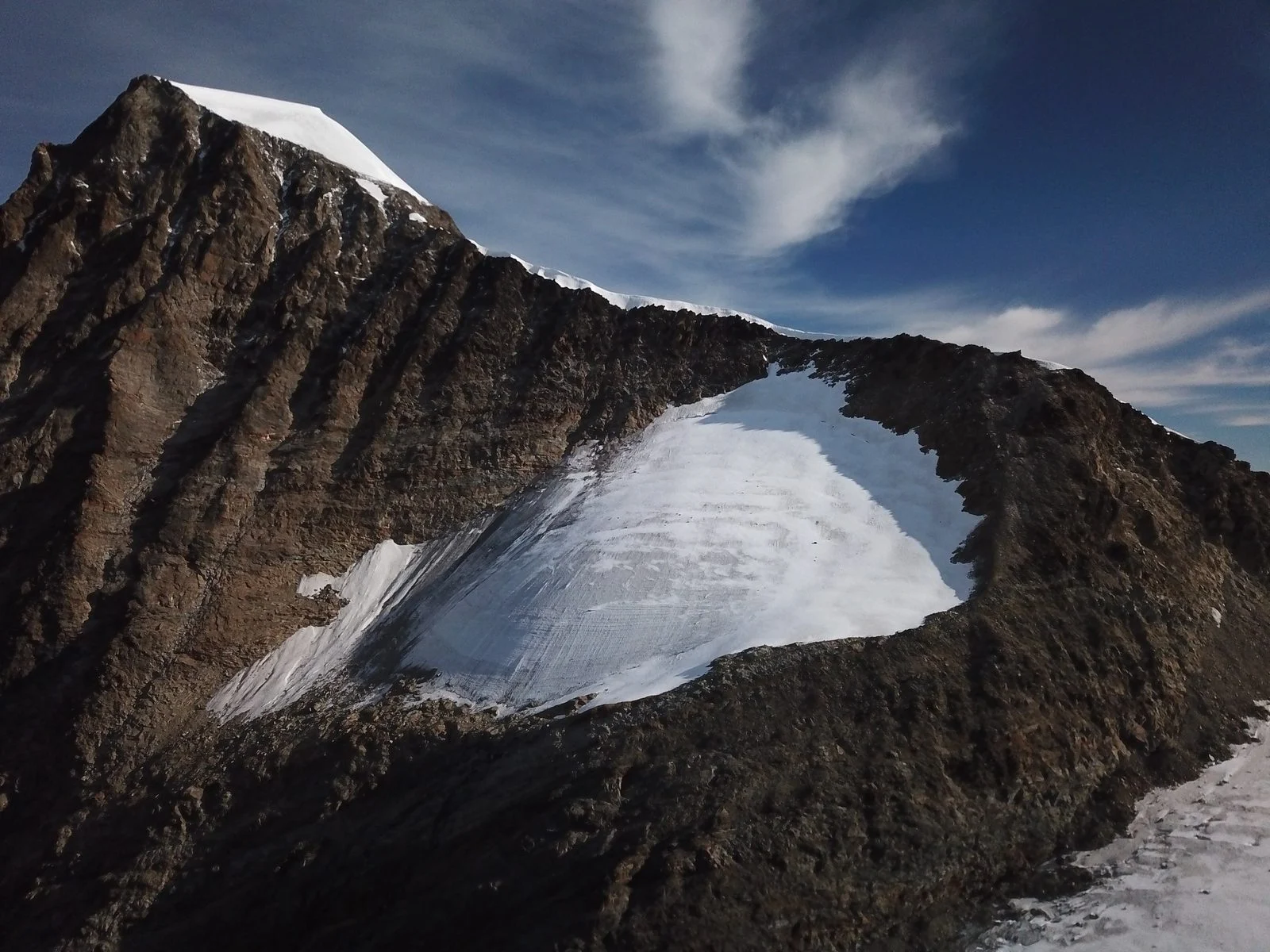
Figure 5. Alphubel South, a small glacier perched in the south face of the Alphubel. Roughly 500 glaciers in Switzerland are of similar size and elevation. [Credit: Janosch Beer]
Further reading
The paper: Beer, J., et al. (2026): Polythermal conditions in small glaciers in the Swiss Alps, The Cryosphere, 20, 5453–5473, https://doi.org/10.5194/tc-20-5453-2026
How water pockets form and burst in Alpine glaciers, including the role of cold ice as a thermal barrier: Ogier et al. (2025), Journal of Glaciology (open access): https://www.cambridge.org/core/journals/journal-of-glaciology/article/definition-formation-and-rupture-mechanisms-of-water-pockets-in-alpine-glaciers-insights-from-an-updated-inventory-for-the-swiss-alps/D9B17E60EB1F686FBEA6864E2DADB483
How snow cover controls the temperature of Tête Rousse Glacier, and what this means for outburst floods: Gilbert et al. (2012), Journal of Geophysical Research: https://doi.org/10.1029/2011JF002258
The 2016 twin glacier collapses in the Aru Range, Tibet, and the role of partly frozen glacier beds: Gilbert et al. (2018), The Cryosphere (open access): https://doi.org/10.5194/tc-12-2883-2018
A detailed analysis of the 2022 Marmolada collapse, Natural Hazards and Earth System Sciences (open access): https://nhess.copernicus.org/articles/25/3027/2025/