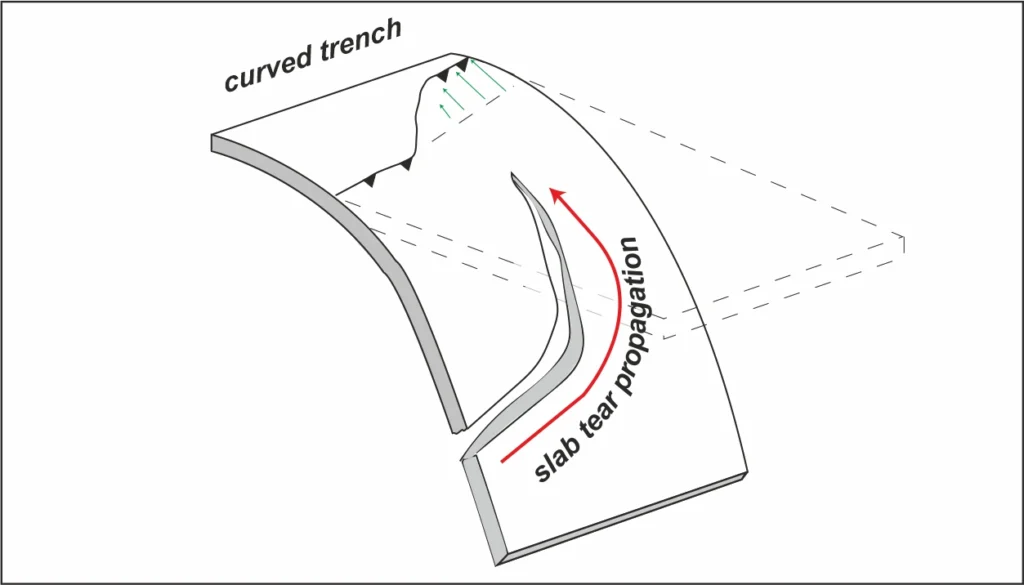
We are living in an anisotropic world. From rock-building crystals, ice, and trees growing in your garden to your favourite slice of cake many materials or objects has some anisotropic behaviour. What does this mean? Anisotropy (non-isotropy) implies that a material property depends on the direction of the measurement. In geodynamics we often talk about seismic anisotropy, originating from microsc ...[Read More]
Nonlinear Processes in Geosciences
El Niño is back: What it Means for Global Warming?
The World Meteorological Organization (WMO) has just announced that the La Niña episode has officially ended, and from autumn onwards, it should give way to an El Niño phase. But what does that mean? And what is the influence of these weather phenomena on global warming?For those who have never heard of La Niña before, here’s an explanation of this phenomenon. The Earth rotates, so there are ...[Read More]
GeoLog
EGU23 has something for everyone: Sessions on networking, policy, mentoring, jobs & careers
As the 2023 General Assembly materializes on the horizon, it’s a good idea to take stock of what sessions you want to attend in advance of attending the assembly proper. Whilst the scientific sessions provide some of the highlights, EGU23 has a rich programme to tempt you to go beyond – including inline and in-person sessions dedicated to early career scientists (ECS) networking, job and careers, ...[Read More]
Geodesy
Women in Geodesy: Veronique Dehant
A few weeks ago we talked with Anny Cazenave, the first Vening-Meinesz medallist, about her view on being a women in science. But, she wasn’t the only influential women in Geodesy that received the Vening-Meinesz medal from the EGU. In 2003, Véronique Dehant was awarded with the Vening-Meinesz medal in recognition of her outstanding contributions to the study of nutations of the Earth ...[Read More]
GeoLog
GeoTalk: Meet Marisa Storm, Molecular Fossil researcher!
Hi Marisa. Thank you for joining us today! Could you tell our readers a bit about yourself and your research? Hi, I am a geologist and organic geochemist, currently working as a postdoc at the NIOZ Netherlands Institute for Sea Research based on the island Texel. After my geology-focused undergraduate and master studies in Germany at the RWTH Aachen and Heidelberg University, I graduated wi ...[Read More]
Climate: Past, Present & Future
Lessons learnt from women in climate science campfire event
‘Women in Climate Science Campfire’ event On November 7th, 2022, the EGU Climate Division outreach team hosted a campfire event, a series of online presentations on ‘women in climate science,’ where we covered subjects from the current state of knowledge on women being affected by climate change to many of the challenges female scientists faced (or faces) in the current societal landscape. Followi ...[Read More]
Natural Hazards
Understanding and assessing hydrological extremes, a discussion with Alberto Viglione
Extreme hydrological events affect billions of people worldwide, and their negative impacts will likely increase due to climate change, urbanisation and ageing infrastructure. Further understanding of hydrological extremes and societal responses to floods is critical in mitigating flood risk and creating better urban environments. In today’s interview, we talk with Prof. Alberto Viglione. Al ...[Read More]
GeoLog
EGU23: A hybrid General Assembly with too many benefits to ignore!
Are you planning to attend the upcoming EGU General Assembly – either on-site in Vienna, Austria or remotely as a virtual participant? This year, EGU has decided to take time for science, and encourages you to do the same. For us, this means offering our attendees the “best of both worlds,” through a carefully and creatively curated hybrid conference. For you, we hope this means a ton of benefits ...[Read More]
Cryospheric Sciences
Image of the Week – Receiving messages from the deep
The Weddell Seal pops his head up through the hole in the floor of the shipping container… for the fourth time today. The shipping container is one of several making up our field camp on sea ice, 40 km from Scott Base – situated on Ross Island, in the south-western Ross Sea. Today I talk about the sub-ice platelet layer, which provides the base for a rich marine environment. Generating super ...[Read More]
Natural Hazards
New positions to join the Natural Hazards Division team!
Interested in being actively involved in shaping the EGU NH Division activities and organising the annual General Assembly? Are you working in the Natural Hazards field? Then keep reading… we need you! Our Division is seeking: a new Science Officer for the NH10 Multi-Hazards sub-division a new Social Media Coordinator For both positions, the term is fixed for a two-year period with a possible ext ...[Read More]