EGU Blogs

Latest posts

GeoLog

Imaggeo On Monday: Iceberg A-81, Brunt Ice Shelf, Antarctica

Imaggeo On Monday: Iceberg A-81, Brunt Ice Shelf, Antarctica

Information from a British Antarctic Survey Press Release. A huge iceberg (1550 km²), almost the size of Greater London, has broken off the 150m thick Brunt Ice Shelf. It calved after cracks that have been developing naturally over the last few years extended across the entire ice shelf, causing the new iceberg to break free. This occurred on Sunday 22 January between 19.00 and 20.00 UTC during a ...[Read More]

HS
Hydrological Sciences

How to organize an EGU24 Session as a newcomer? A guide for early career scientists.

How to organize an EGU24 Session as a newcomer? A guide for early career scientists.

Have you ever thought about organizing an EGU session instead of just attending them? Until September 14th you have the chance to do just that!  It can sound a bit intimidating, especially if you’ve never done it before. But don’t worry – here’s everything you have to know.   Find a Topic and Co-Conveners First off, you need to settle on a topic and find your co-conveners, i.e. the team who ...[Read More]

GeoLog

GeoPolicy: Reflecting on science advice as shown in the 2019 Chernobyl series

GeoPolicy: Reflecting on science advice as shown in the 2019 Chernobyl series

The HBO and Sky UK television series Chernobyl is a historical drama that explores the events leading up to and following the 1986 Chernobyl nuclear disaster in Pripyat Ukraine. Not only does this series focus on one of the worst nuclear accidents in history, but also on the challenges and successes of one of the lead scientists involved in communicating the scientific evidence to key decision-mak ...[Read More]

GD
Geodynamics

Physics-Based Machine Learning – Curse or Blessing?

Physics-Based Machine Learning – Curse or Blessing?

The advance of Artificial Intelligence is impacting all spheres of human activity, and Geosciences are no exception. In this week’s post, Denise Degen from RWTH Aachen University, Germany, gives us a glimpse of what this means for Geodynamics. Discussing the advantages and caveats of different approaches, she shows how physics-based Machine Learning may help us investigating and understanding comp ...[Read More]

GM
Geomorphology

A Day in the Life – Márton Pál

A Day in the Life – Márton Pál

This blog post is part of our series: “A day in the life of a geomorphologist” for which we’re accepting contributions! Please contact one of the GM blog editors, Emily or Emma, if you’d like to contribute.    Márton Pál, Cartographer, Earth Scientist, ELTE Eötvös Loránd University, Institute of Cartography and Geoinformatics, Budapest, Hungary pal.marton@inf.elte.hu How can we visualise spat ...[Read More]

GeoLog

Imaggeo On Monday: Eyjafjallajökull – hot and cold

Imaggeo On Monday: Eyjafjallajökull – hot and cold

Active volcano Eyjafjallajökull is covered by 80 square kilometres of glaciers. Quite often one can feel the warmth from the red igneous rocks that protrude from the ice cap. The volcano is known for the eruption in April 2010, which released ash clouds so large that in some areas they turned daylight into darkness. Many flights in Europe were cancelled. A significant part of the glacier melted in ...[Read More]

GeoLog

GeoTalk: Meet Ann-Sofie Zinck, researcher of Antarctic ice shelves and Cryosphere ECS Representative!

GeoTalk: Meet Ann-Sofie Zinck, researcher of Antarctic ice shelves and Cryosphere ECS Representative!

Hi Ann-Sofie. Thank you for joining this GeoTalk! To break the ice, could you tell us a bit about yourself and what got you interested in the Antarctic? Hi Simon, thanks for inviting me! That’s easy! As a child I always used to be ice cold… No, just kidding! I guess I have always been fascinated about nature, geoscience, weather, climate, and ice (creams). I preferred atlases, weather, and g ...[Read More]

GD
Geodynamics

Going to the mountains is going home

Going to the mountains is going home

Geoscientists explore the nature from a different perspective than the commoners. In this week’s blog, Stephanie Sparks from Arizona State University shares her story how her passion for mountains gradually became her profession. Her journey through different regions in Himalaya leads her to understand the exhumation rate and the underlying geodynamic processes behind the formation of world’s high ...[Read More]

SM
Seismology

An interview with our new division leader: Alice-Agnes Gabriel

An interview with our new division leader: Alice-Agnes Gabriel

At EGU’s GA this year we managed to catch up with Dr Alice-Agnes Gabriel, Associate Professor at the Scripps Institution of Oceanography, University of California, and the new head of the Seismology Division. Over the interview she gave us insights into her relationship with seismology over the years, what she hopes to achieve in her new position, and how EGU can stay relevant into the future. Let ...[Read More]

GeoLog

A chunk of ice the size of Amsterdam: how the calving of Greenland’s glaciers has changed since the 2010 Petermann Glacier event

A chunk of ice the size of Amsterdam: how the calving of Greenland’s glaciers has changed since the 2010 Petermann Glacier event

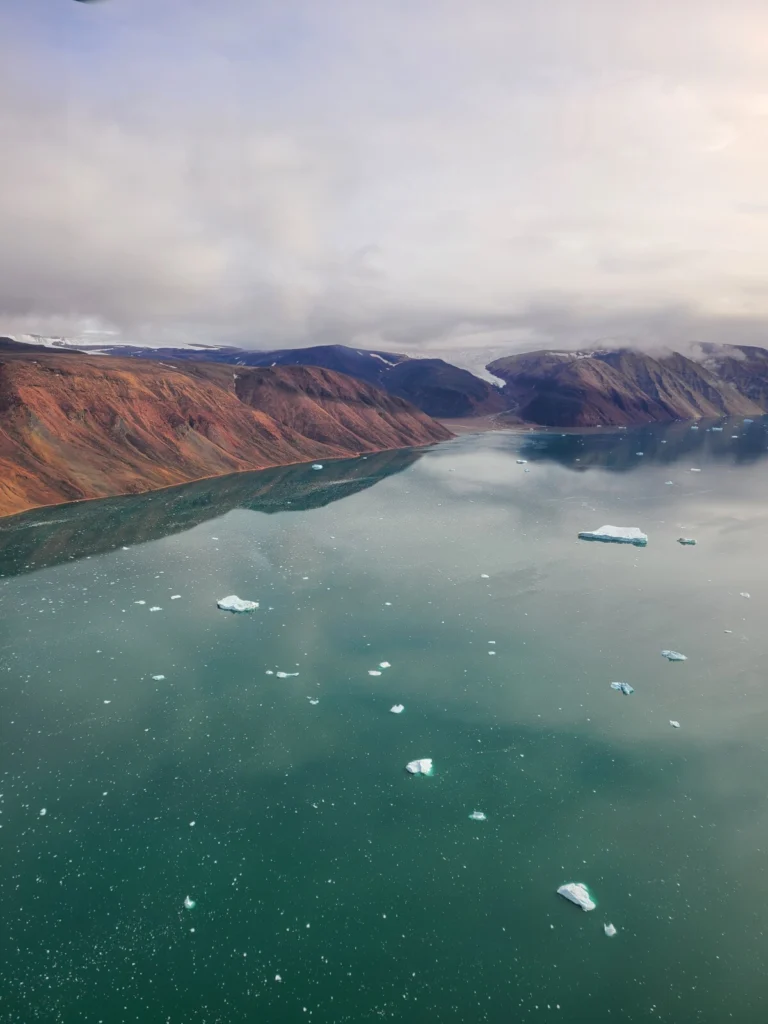
Thirteen years ago, a roughly 251 km2 chunk of ice (or 97 miles2) broke off Greenland’s Petermann Glacier. This Amsterdam-sized piece of ice was the largest to calve in the Arctic since 1962. The massive iceberg traversed the Nares Strait, which lies between Canada’s Ellesmere Island and Greenland, and into the northern part of Baffin Bay—the northwestern-most arm of the Atlantic Ocean, before eve ...[Read More]