The EGU General Assembly is an amazing event, not only because of its size but also due to the number of disciplines represented! This gives scientists, who are diligently focused on their specific research for the majority of the year, the chance to let loose and learn something a bit different. This year’s assembly will …[Read More]
policy
GeoPolicy: How can geoscientists make the most of the Horizon 2020 programme?
As a geoscientist, I’m sure that you have heard of Horizon 2020, an EU programme that is allocating almost €80 billion to research and innovation over 7 years (from 2014 to 2020). This money is distributed throughout various scientific divisions and provides a plethora of opportunities for scientists, not only within the EU but also …[Read More]
GeoPolicy: Science and the policy cycle
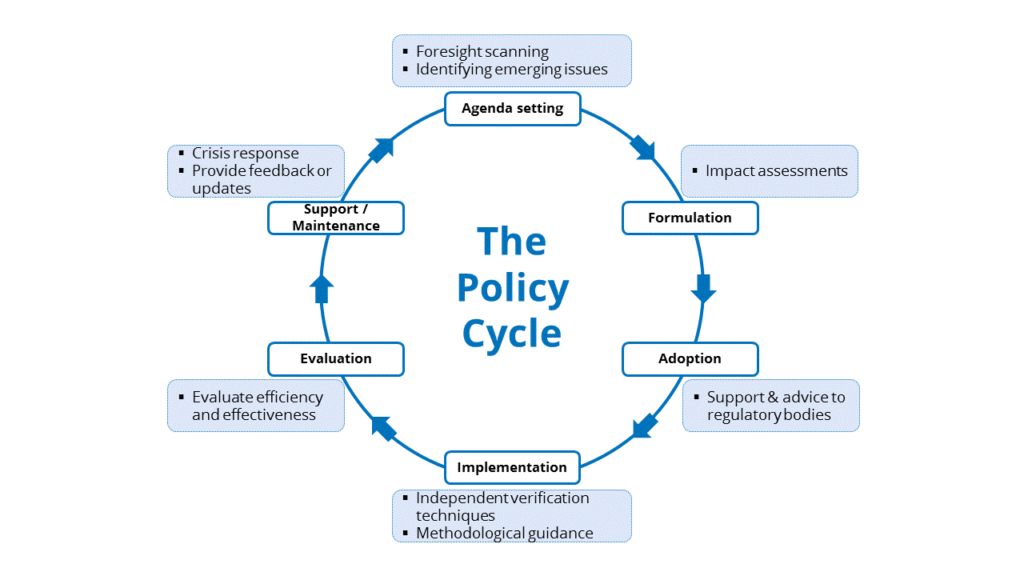
One way to improve the impact of your scientific research is to engage with policy. Doing so can create new opportunities for yourself and your research. The main challenges are knowing when and how to effectively communicate scientific results to policy. If the wrong timing or communication method is chosen then results are less likely …[Read More]
GeoPolicy: 8 ways to engage with policy makers
Scientific research is usually verbally communicated to policy officials or through purposefully written documents. This occurs at all levels of governance (local, national, and international). This month’s GeoPolicy post takes a look at the main methods in which scientists can assist in the policy process and describes a new method adopted by the European Commission (EC) that aims to enhance …[Read More]
GeoPolicy: What’s next for the IPCC & how can early career scientists get involved? An interview with Valérie Masson-Delmotte
This month’s GeoPolicy post is an interview with the newly-appointed co-chair of the Intergovernmental Panel on Climate Change (IPCC) Working Group 1 (WG1): Valérie Masson-Delmotte. Valérie is also a Principle Investigator at the Laboratoire des Sciences du Climat et de l’Environnement, Paris. In this interview she discusses how she balances her two roles, what the …[Read More]
GeoPolicy: How to communicate science to policy officials – tips and tricks from the experts
The EGU General Assembly was bigger than ever this year. Over 16,500 people attended more than 500 sessions. Although many sessions featured policy-relevant science, the short course entitled ‘Working at the science policy interface‘ focused purely on the role of scientists within the policy landscape. For those of you that couldn’t attend, this month’s GeoPolicy post …[Read More]
GeoPolicy: Hazards, climate impacts, resources – Supporting science-based policy at EGU16
As researchers, we spend a lot of time and energy trying to extend the limits of our scientific knowledge, but how much of our new findings can be translated into policies, and what are the best practices for doing this? A multitude of science-policy-related sessions are scheduled at this year’s general assembly (GA), spanning most …[Read More]
GeoPolicy: Assessing environmental and social impact – applying policy in big industry
Former EGU Science Communications Fellow Edvard Glücksman is our second guest blogger for the newly established EGUPolicy column. Edvard is a Senior Environmental & Social Specialist at the UK-based consultancy Wardell Armstrong and an External Stakeholder Affiliate at the University of Exeter. He describes his work along the research-policy-industry interface. The collapse of a wastewater …[Read More]
GeoPolicy: An expert discussion on ozone – working at the science-policy interface
Erika von Schneidemesser is our first guest blogger for the newly established EGUPolicy column. Erika is a Research Scientist at the Institute for Advanced Sustainability Studies based in Potsdam, Germany. Her post gives an insight into working at the science-policy interface by describing a recent project she has been involved in. As scientists and researchers …[Read More]
GeoPolicy: EGU sciences on debate at the European Parliament
The adoption of legislation within the European Union (EU) is a complex process involving many steps. In my first blog post in this GeoPolicy series I highlighted an example of this process. Several draft legislation pieces are currently being assessed within the European Parliament (EP) and Council of Ministers (Council) that have been influenced by EGU-related …[Read More]