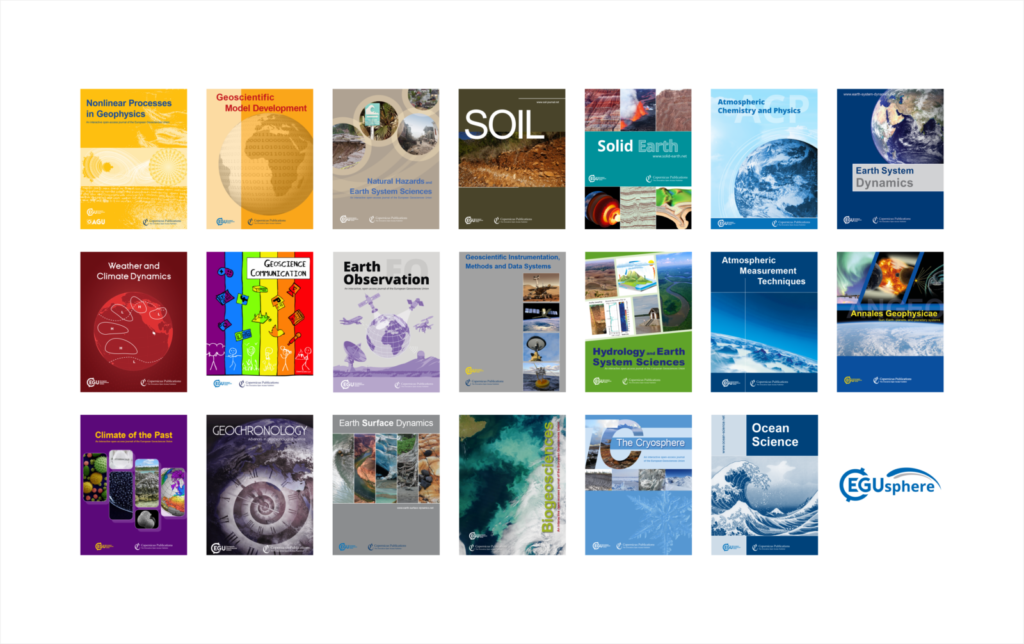
Each month we feature specific Divisions of EGU and during the monthly GeoRoundup we put the journals that publish science from those Divisions at the top of the Highlights section. For September, we are featuring Geoscience and Society (GS), Geomorphology (GM) , Biogeosciences (BG). They are represented by the journals Geoscience Communication (GC), Earth Surface Dynamics (ESurf), Solid Earth (SE), Geoscientific Model Development (GMD), Biogeosciences (BG), and SOIL.
Temperate marine macrophytes are highly variable sources of Biogenic Volatile Organic Compounds – a comparative study from the Baltic Sea and NE Atlantic – 13 October 2026
Biogenic volatile organic compounds (BVOCs) emitted by Earth’s ecosystems have profound climate impacts, but emissions from marine benthic sources are poorly quantified. We quantified BVOC emission rates from three macrophytes across two contrasting marine regions and found highly diverse emission profiles with high intra‑ and interspecific variability. Our results underscore the need for more high-quality data, so that macrophyte emissions can eventually be integrated into marine BVOC budgets.
Warming vs. browning: a dual mechanism behind net ecosystem production of shallow brown aquatic systems – 26 October 2026
Warming and browning (increasing organic carbon) in aquatic systems both promote heterotrophy via distinct mechanisms: browning alone enhances bacterial production and alters stoichiometry, which suppresses primary production. Browning and warming combined shift aquatic ecosystems toward net heterotrophy. This mesocosm study provides mechanistic insight into interacting drivers of global change, with broad relevance for northern freshwaters undergoing increasing browning and warming.

Pokémon Trading Cards reveal visual stereotypes of natural minerals – 07 October 2026
Pokémon cards offer an unexpected 30-year record of how popular culture depicts minerals. Analyzing 223 illustrations revealed a “universal crystal template” reducing natural minerals to a shared visual stereotype: giant, translucent, symmetrical crystals inside caves. While these images oversimplify geological reality, their global familiarity and the diverse mineral examples already represented make this collection an excellent educational hook to inspire interest in authentic Earth science.
Spectral analysis of lunar regions observed by MAJIS during the JUICE Moon-Earth flyby – 23 October 2026
Atmospheric Measurement Techniques
Meteosat Third Generation Lightning Imager detection performances – 20 October 2026
First year of Meteosat Third Generation Lightning Imager observations – 22 October 2026
Observing formation and early evolution of contrails formed by IAGOS aircraft using high-resolution LEO satellite imagery – 30 October 2026
From manual classification to transformer-based language models: assessing the quality and consistency of historical convective event records – 07 October 2026
Historical climate extremes in Europe and the connection between spring precipitation and summer heat – 07 October 2026
Decoded Antarctic snow accumulation history reconciles observed and modeled trends in accumulation and large-scale warming patterns – 02 October 2026
Hydrology and Earth System Sciences
Technical note: Machine learning metamodelling for global sensitivity analysis – 27 October 2026
Natural Hazards and Earth System Sciences
Invited perspective: Uncertainties in natural systems may be uncomfortable, but ignoring them would be absurd – 07 October 2026
Flood exposure and structure damage under deterministic design-storm and stochastic storm transposition rainfall scenarios: a case study in South Louisiana, USA – 23 October 2026
Efficient ensemble estimation using an MCMC sampler: a reconstruction of the Mediterranean low-frequency variability combining observed and simulated sea level – 19 October 2026
Propagating meteorological uncertainty in physically based mountain snow modeling – 15 October 2026
GlaUnTI: a hybrid physics–machine learning model enables transferable glacier surface mass balance estimation – 21 October 2026
EGU in the news:
- EGU releases ‘The Scenario Model Intercomparison Project for CMIP7 (ScenarioMIP-CMIP7)’ to guide future climate risk assessments
- Study presented at EGU links premature leaf aging in European oaks to escalating climate stress and weakened carbon sinks
- Meteorite theory sidelined: EGU feature spotlights ‘Doklady Earth Sciences’ study using gravity and electrical surveys on the Patom Crater