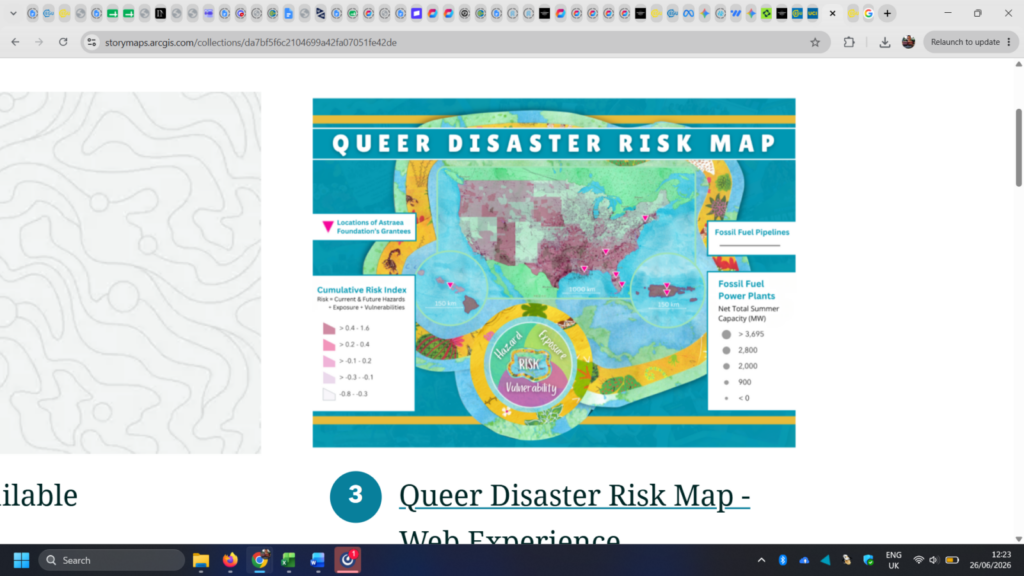
Queer Disaster Risk Map. Source: StoryMapping Queer Climate Justice
In Spring of 2025, just as I was preparing to release the Queer Climate Justice StoryMap I had been building for two years, I received a difficult email from my lead community collaborator, an LGBTQ+ foundation, describing the devastating legal and financial situation the newly inaugurated Trump administration had put them in. We decided to set the project to private to protect the queer and trans-led groups whose climate justice organising we had been trying to uplift.
There is a nested set of problems here: As climate change accelerates, the social vulnerability of queer and trans people is also increasing. But the barriers for research into LGBTQ+ disaster vulnerability and resilience are rising as well, making good evidence more challenging to gather or disseminate.
Recognising that June is both World Oceans Month and Pride Month for LGBTQ+ communities around the world, I suggest that if we bring these agendas together, we can see beneath the problems at the surface to the shared root issues. Indeed, as I thread together the issues, a pattern emerges: the warming sea (increasingly unmonitored) is the literal physical engine accelerating these crises, and the fossil fuels accelerating the warming are also funding the removal of ocean monitors, and fomenting political attacks on queer and transgender communities.
Queer climate vulnerability
Researchers around the world are beginning to build a clearer case that gender and sexually marginalised people are more vulnerable to disasters. My own co-authored research, “Queer and Present Danger: Understanding the Disparate Impacts of Disasters on LGBTQ+ Communities,” documents how the roughly 16 million LGBTQ+ people in the United States are rendered systematically invisible within disaster policies. We describe how bias in federal disaster response programs, a lack of recognition of LGBTQ+ families, and the prevalence of faith-based organisations in disaster relief combine to heighten risk. The recently released anthology Queering Disasters, Climate Change and Humanitarian Crises edited by Dale Dominey Howes et al represents this global field of study coming into maturity after over a decade of slow and steady publications.
The data makes the picture stark: In the United States, disaster displacement is nearly 2x higher for LGBTQ+ people than it is for cisgender, heterosexual people, based on the US Census’ Household Pulse Study. And vulnerability is never evenly distributed even within our communities. As my research emphasizes, queer and trans people experiencing multiple oppressions along lines of race, class, disability, or immigration status, face qualitatively distinct experiences, often more severe. But most importantly, vulnerability to disasters is not something innate to our communities. The problem is not the hurricanes. The problem is the political, economic, and social systems that make certain communities vulnerable, that make hurricanes disastrous.
For queer and transgender people already navigating the ordinary vulnerabilities of daily life, these policies compound every dimension of disaster risk.
While social vulnerability increases, the storms get stronger
The Trump administration has made no effort to conceal where it stands on queer and trans lives. On his first day back in office in January 2025, President Trump signed a wave of executive orders targeting LGBTQ+ people. Executive Order 14168, titled “Defending Women from Gender Ideology Extremism and Restoring Biological Truth to the Federal Government,” effectively removed federal recognition of transgender and nonbinary people, directing all agencies to replace “gender” with “sex” and defining sex as a male-female binary “determined at conception.”
Simultaneously, the administration rescinded Biden-era orders protecting LGBTQ+ people from employment discrimination and reinstated the transgender military ban. Within weeks, the Department of Housing and Urban Development stopped enforcing a 2016 policy prohibiting gender identity discrimination in shelter spaces, which was especially chilling for queer and trans people who rely on emergency housing during disasters.
In a particularly alarming escalation, the administration has now declared that transgender people and those who spread “gender ideology” are terrorists who endanger National Security. The Lempkin Center for Genocide Prevention and Human Security has issued a Red Flag alert for signs of an Anti-Trans Genocide in the United States.
And now we have the news of the powerful El Niño conditions brewing in the Pacific. El Niño events are naturally occurring periodic phenomena marked by rising ocean temperatures around the equator, and a reversing of typical Pacific currents. This can drastically shift typical weather patterns, and can foster disastrous extreme weather conditions. The US National Oceanic and Atmospheric Association (NOAA) recently predicted that there is a 63% chance that this year’s El Niño conditions will be very strong.
Barriers to research
The Trump administration has gutted the scientific infrastructure we depend on to understand these risks. At the National Science Foundation alone, over 1,600 grants were canceled, representing more than $1 billion in lost funding, many of them projects related to diversity and equity in science. Meanwhile, the administration has moved to dismantle the Ocean Observatories Initiative, removing more than 900 deep-sea instruments that have tracked critical real-time climate data since 2016. Oceanographers have raised the alarm that the Pacific array is being pulled out precisely when those instruments are needed most with the intense El Niño season ahead.
The administration’s anti-DEI campaign has simultaneously decimated the research infrastructure for understanding LGBTQ+ lives and disasters. The NIH cut over $800 million in LGBTQ+ health research, including more than 200 federal HIV research grants. Researchers studying sexual orientation and gender identity have had their federal grants terminated simply for using words like “equity,” “disparities,” or “gender” in their project descriptions. At universities, the pressure has been sweeping: institutions across the country have shuttered Women’s and Gender Studies programs, LGBTQ+ resource centers, and cultural offices under threat of losing federal funding.
As I shared in the vignette that opened this blog, when it comes to community-based research like the kind that I prioritise in my scholarship, we must grapple with the ethics of engaging with a politically persecuted minority and how our research impacts their safety. Of course, many researchers around the world have already been dealing with such conditions. It is imperative US scholars learn research ethics forged in contexts of political violence to gender and sexually diverse people.
In sum, whether it is fear and lack of funding on the part of researchers, or the fear of surveillance among gender and sexually diverse communities, the current political situation makes it challenging to understand the true scope of growing climate vulnerability for queer and trans people.
Fossil-fuelled transphobia
Recently, my research has turned towards using a queer lens to examine how all of these climate change induced phenomena like rising sea levels, rising authoritarianism, rising barriers to research are interconnected in a web. I am part of an ongoing research project seeking to trace the tendrils of this web to highlight a pattern we are calling “Fossil-Fueled Transphobia.” There is a century of evidence for how the scapegoating of marginalised communities is core to an authoritarian playbook to divide people with common political interests. What we are identifying is the way that anti-trans media and policy is being funded by those who have amassed their wealth through fossil fuel industries, fomenting a culture war distraction away from the root causes of accelerating climate change.
This research is still in early stages, but it highlights the kind of root cause analysis that queer climate justice offers to researchers: go beneath the headlines and the symptoms of vulnerability to expose the systems and those who benefit from harm.
My documentary film Can’t Stop Change: Queer Climate Stories from the Florida Frontlines illustrates these connections on the ground. Interviewing queer and trans activists throughout Florida in the aftermath of Hurricane Ian in 2022, the film shows both the devastation left by the storm and the extraordinary community solidarity that emerged in response. It also emphasises the role of the American Legislative Exchange Council, funded by corporate interests including fossil fuels, in crafting the model legislation passed in Florida, which is now replicating across the country.
There is, therefore, emerging evidence that the same fossil fuel industry that has caused the acceleration and increased the frequency of supercharged hurricanes and record-breaking ocean temperatures is also the engine funding the political apparatus that strips queer and trans people of their rights and protections, making them more vulnerable when those storms arrive.
Learning from histories of resistance
This month, gender and sexually diverse communities around the world celebrate Pride (when possible)- a tradition that honors the 1969 uprising of queer and trans people resisting police harassment at the Stonewall Inn. Even though this was a specific, local event at a bar in New York, their protest against police violence and social persecution struck a chord, and Pride has become a global phenomenon, with over 100 countries hosting some form of celebration (OutRight International). Whether its a massive street carnival like in São Paulo, Brazil, or a private home gathering in Assam, India, Pride is both a celebration of our histories of resistance and our commitment to survival.
Our film Can’t Stop Change highlights this mutual aid disaster relief organising, and also emphasizes the importance of rooting in the wisdom of nature and our oceans. Indeed, the film starts underwater, and emphasises water as a force of change. Our conclusion uplifts queer ecologies to highlight another important point: when queer and trans people can see themselves reflected in nature, as opposed to being “unnatural” or “crimes against nature”, it gives us a deeper grounding for loving ourselves enough to fight for our futures.
When queer and trans people lead in climate justice, we bring both our analysis and the hard-won tools of communities that have always had to build safety for themselves when institutions refused to provide it, informed by an understanding that we are natural and so we are forces of nature.
What can we do now?
We are in a situation where our ability to do sound research is diminishing while we can assume that the problem is worsening. But there are clear steps that affirming agencies can take to support diverse communities, even when the research is still lagging behind the need:
-
Recognition: Through whatever work that you’re doing, recognise that all communities that are already climate vulnerable contain people who are further marginalized by gender or sexual difference. We are on the precipice of major strides – or major backslides – to the recognition of LGBTQ+ people in global climate governance. Naming us explicitly in policy is not a courtesy; it is a condition for our survival.
-
Resourcing: Yes, the queer and trans community is resilient, but resilience must be resourced. We must find mechanisms to move money towards multiply-marginalised communities. While the UNCCC process has created a robust mechanism for loss & damage, as long as that funding is moved at the level of the nation-state, it will be difficult for politically persecuted communities to receive those benefits. We need alternatives. Community-controlled funds, mutual aid networks, and direct partnerships with queer-led organisations are among the most promising models.
-
Resistance: If you can take risks, take them! Leverage your privilege to promote research, dialogue, funding, and policy regarding climate change and the inclusion of queer and trans people in disaster risk reduction and management. Push back against the defunding of LGBTQ+ health research. Defend Women’s and Gender Studies programs. Expose fossil-fueled transphobia, endorse the fossil fuel treaty, and support researchers and community organisations facing surveillance, funding cuts, and legal threats for doing this essential work.
Continue fighting for ocean health. Because the health of our oceans is a direct lifeline for the vulnerable coastal communities on the frontlines of these supercharged storms. For LGBTQ+ people, many of whom are already in ocean health research and advocacy, this month is an opportunity for us to uplift our Pride in protecting our oceans.
Over a year later, I still question if taking our Queer Climate Justice StoryMaps private was the right choice, especially as a new season of El Niño storms threatens our communities. While rising persecution made protecting our data feel necessary, Audre Lorde’s words still haunt me: “When we are silent, we are still afraid. So it is better to speak, knowing we were never meant to survive.”