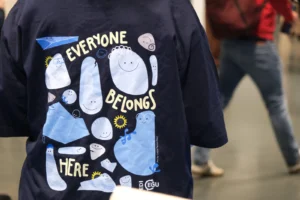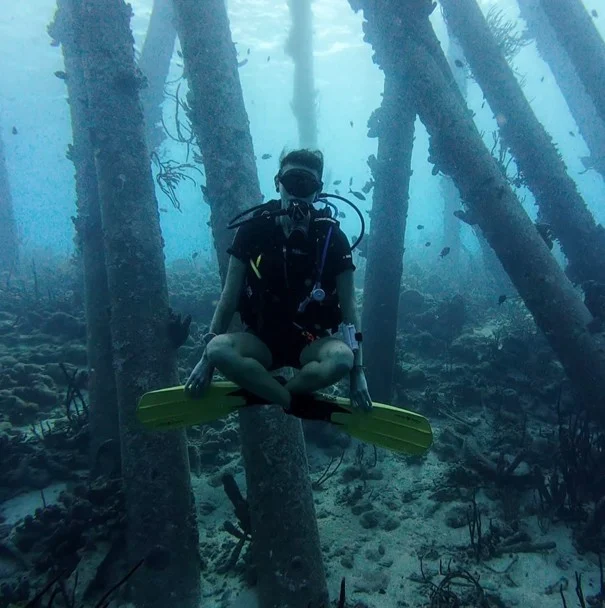
The journey to a Ph.D. is never smooth sailing, plenty who have dared to tackle it will agree. But what if this strenuous, maybe even torturous, endeavor is the easiest part of your life? Welcome to my journey, which I am calling “Transitioning during your PhD”.
Let’s start with a quick backstory. My doctoral journey started in 2024 and I was early in my transition. I came out to my friends and family, but I had not yet taken any legal actions to change my gender marker, name, or anything else. However, the institute I applied for my Ph.D. accepted my chosen name without asking questions, and I was excited to start the long process of legal changes, once I began this big new chapter. I was stoked to find out that the experiments for my project would take place in collaboration with the National Oceanic and Atmospheric Administration in Oregon. But the initial excitement quickly faded into dread, as the presidential election moved closer. There wasn’t really a choice, but to postpone my legal transition until after this 3-month trip to the U.S. or I would risk my whole project.
Fortunately, the working group I joined in the U.S. was incredibly supportive and affected by the governmental changes themselves, although more on a professional than personal level. I could trauma-dump a whole page just from this chapter of witnessing the dismantling of their national scientific backbone, people losing their jobs and listening to the most hate indulged and inhumane political speech I ever witnessed (except maybe during history class). I suffered immense emotional breakdowns trying to balance working more than ten hours a day for weeks without taking any breaks, while this tragedy unfolded in the background. Returning home to Germany did not help, considering that our elections were similarly scary, to say the least. My GP immediately signed me sick for some weeks to recover and she was the first openly confronting me that a Ph.D. itself can lead you straight into burnout, let alone transitioning on top.
Unpacking pandora’s box
Here’s one thing: Transitioning, in my experience, is not hard. At least not harder than the general path of finding myself and understanding who I am instead of whom I was conditioned to be. The hardest part is the societal confrontation and the internalised transphobia, especially for late-blooming queers like myself. In many societies, including the one where I live, there is a fixed idea of two binary genders only, and growing up, one’s developing brain adapts to these definitions, leaving it to one’s (more or less) fully developed brain to question the things it once learned. But by the time someone starts unpacking these boxes and find new ones that fit better, the voices of judgment can start creeping in. These voices stem from the societal norms that many of us absorbed throughout our lives. Growing up, anything associated with queerness was branded as weird at best, and condemned as pathological or unnatural at worst. With such ingrained stigma, it is no wonder so many choose to leave this Pandora’s box shut, only daring to look inside later in life when they have finally found a safer, gentler environment. For me, it took years simple to recognise that this box existed within me, and it took far more courage than I ever thought I possessed to finally open it. Compounding this struggle is the reality that the battle is fought on two fronts: these restrictive, hateful narratives screaming from within as internalised echoes, even as they continue to be reinforced by the outside world.
Fast forward one year and I am now close to celebrating my first anniversary on testosterone, my therapist helps me tremendously with my transition and in one week I will present a talk during an international conference about my research project on arctic fish. Regardless of how difficult times are – another cold-room power outage during running incubations, burning headaches trying to understand my data, life altering decisions like whether or not to freeze eggs before hormone-replacement-therapy or to leave ovaries intact during surgery as a hormonal back-up, because of current world politics and the resulting anxiety about the future of accessing gender affirming care – being able to pursue my dream provides me with so much strength and hope to continue.
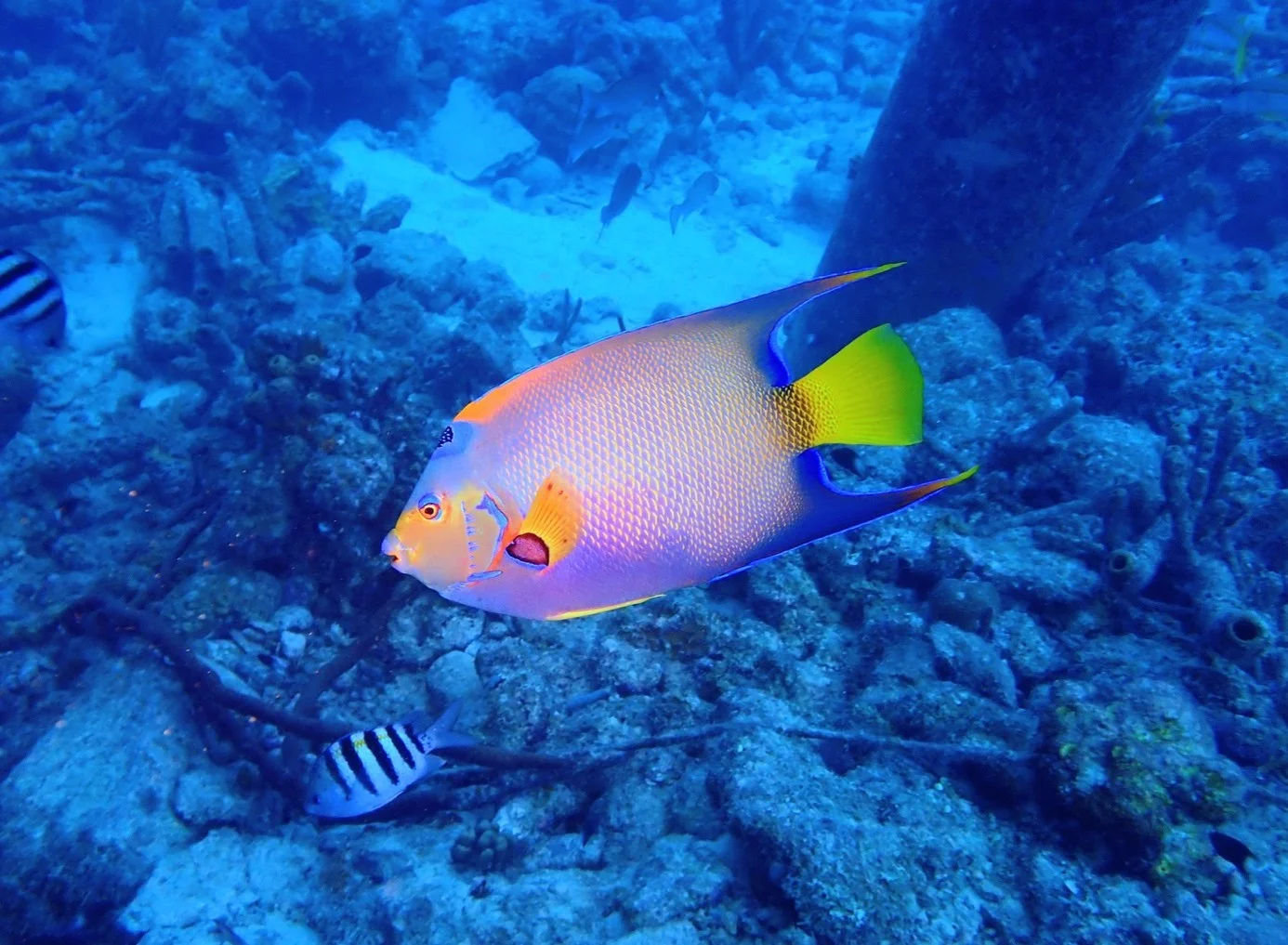
Adult Queen Angelfish (Holacanthus ciliaris). Although little is known about their specific reproductive biology, some marine angelfish species are known to be protogynous hermaphrodites. Their harems consist of typically one male and several females and, once the male disappears, one of the females transitions into a male.
Photo credit: Marina Schiller
As early as kindergarten, I was amazed by nature and evolution and when I learned that fish are in fact older than dinosaurs, the deal was sealed for me: I had to become an Ichthyologist (aka fish nerd). Decades later, this fascination is still rooted within me and, as fed up as I am, about a future in academia, there are few to none alternative tracks I can see myself taking. Over the years, I uncovered a new layer to my interest in nature and that is its diversity and queerness. Growing up in a white, conservative family during the early 00’s, you don’t question sex or gender. It wasn’t until my undergrad that I realized how amazingly queer, diverse, and non-conforming Nature is, and not until finishing my masters before I started reflecting on these labels myself.
The myth of the fixed binary
Have you heard of the field trans*ecology? Yes! Nature is queer, and this queerness includes transness! So, to describe organisms that maintain a single, unchanging biological sex throughout their entire lifespan, scientists use the term gonochorism.
Hermaphroditism, female and male sex organs in the same individual, is the predominant trait for flowering plants (94 % of all angiosperm species1). Within the animal kingdom, 5 % of species exhibit hermaphroditism, rising to roughly 30 % if insects are included2. But most importantly, teleost fish are the only vertebrates to embrace sexual fluidity and very commonly so! At least 25 % of reef fish change their sex throughout their life3. Most of them are protogynous, meaning they first mature into an intermediate female adult before transitioning into the final male stage. For example, California sheephead wrasses live four to six years as female before becoming male, bluehead wrasses are born male or female with females being able to change sex – the list is extensive ad includes species within groupers, seabreams, parrotfish, angelfish, gobies and emperors.
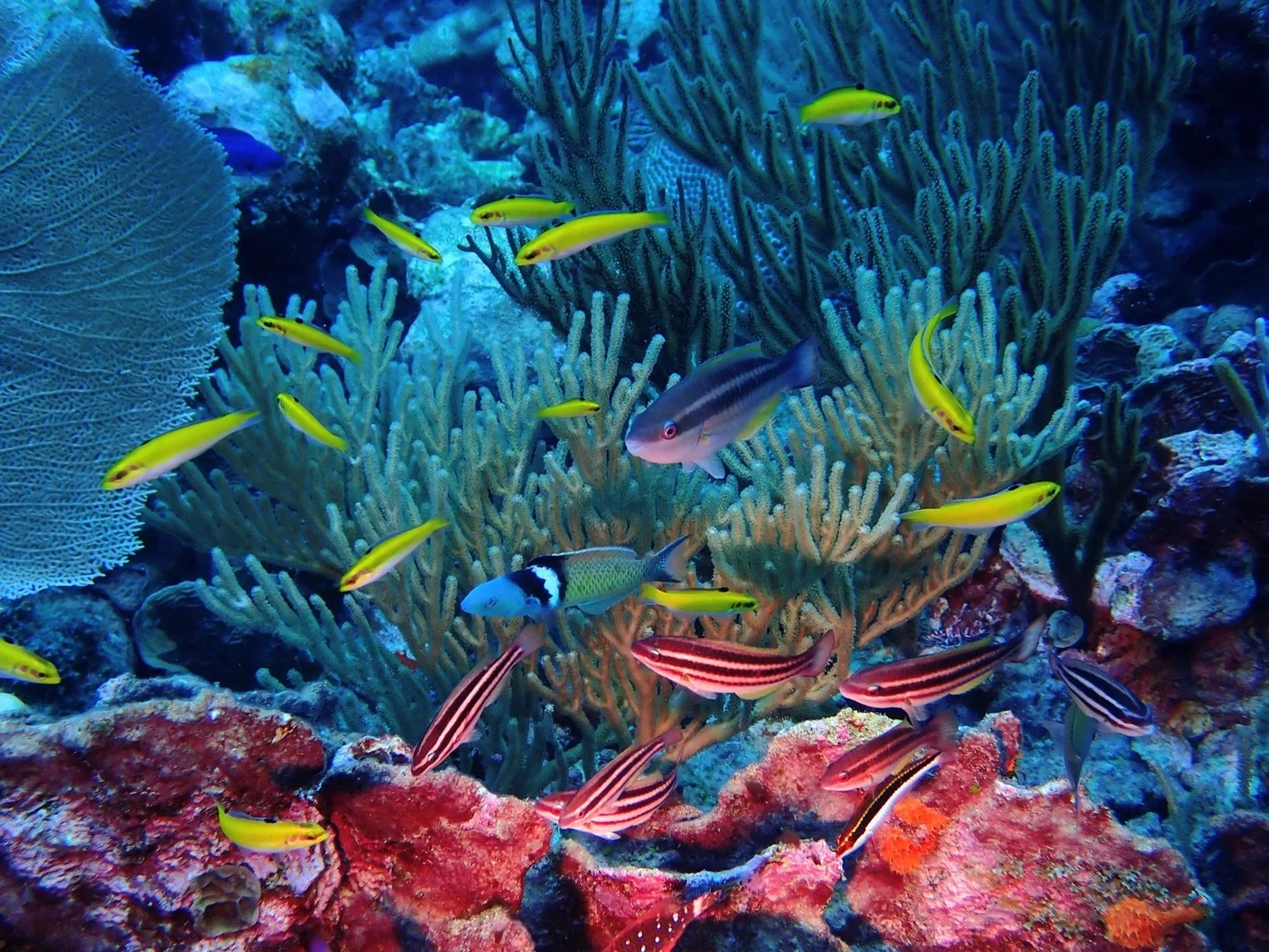
Terminal phase male Bluehead wrasse (center) surrounded by yellow initial phase bluehead wrasses. Bluehead wrasses (Thalassoma bifasciatum) are born female or male and mature into initial phases. Both sexes can later transition into terminal phase males. Photo credit: Marina Schiller
The most famous example is probably the clownfish, although many might not be aware of it. Clownfish are protandrous and live in a very structured society with one dominant female that breeds with the biggest male, while the remaining members are smaller non-breeding males. Now, when the female dies, the dominant male grows and transitions into the new matriarch with a new male stepping up in the breeding hierarchy. Another example of protandry is the ribbon eel, commonly considered a treat when spotted scuba diving.
My personal favorite are hamlets and they are a rare gem in the sexually fluid waters of fish gender. Hamlets are synchronous hermaphrodites and mature female and male gonads at the same time, bending the binary spectrum of sex into more of a circle.
Diving into belonging
A few months ago, my new passport, with my correct name and ‘X’ as gender marker, received its first visa stamp and I can still feel the wave of euphoria sweeping through my body. During the many hours diving at the reef, I felt part of the immense queer community of nature and it reminded me of this deep feeling of belonging during pride parades.
To this day I struggle to fight the boxes and definitions of my upbringing to navigate current experiences. But they could never hold the immense diversity that nature offers, which makes it easier for me to break them open and grasp a complex understanding of how nature actually works. But it is important to find a spark that keeps your light burning – be it friends and peer-groups, sports, arts or anything else. Fortunately, I found my passion very early and it will never cease to fuel me on my journey. I simply have to acknowledge it from time to time to dim the voices and noises of harm.
References
1 Käfer, J., Marais, G. A. & Pannell, J. R. On the rarity of dioecy in flowering plants. Mol. Ecol. 26, 1225–1241 (2017).
2 Jarne, P. & Auld, J. R. Animals mix it up too: the distribution of self-fertilization among hermaphroditic animals. Evolution 60, 1816–1824 (2006).
3 Molloy, Philip P., et al. “Links between sex change and fish densities in marine pro tected areas.” Biological Conservation141.1 (2008): 187-197.