
This week, Imaggeo on Mondays is brought to you by Josep Ubalde, who transports us to a wonderful site in western Turkey: a city of hot springs and ancient ruins dubbed cotton castle, after the voluminous white rocks that spread from the spring’s centre…
Pamukkale is lies in Turkey’s inner Aegean region, within an active fault that favours the formation of hot springs. The spring’s hot waters were once used by the ancient Greco-Roman city of Hierapolis, the remains of which sit atop Pamukkale. The entire area – city, springs and all – was declared a World Heritage site in 1988.
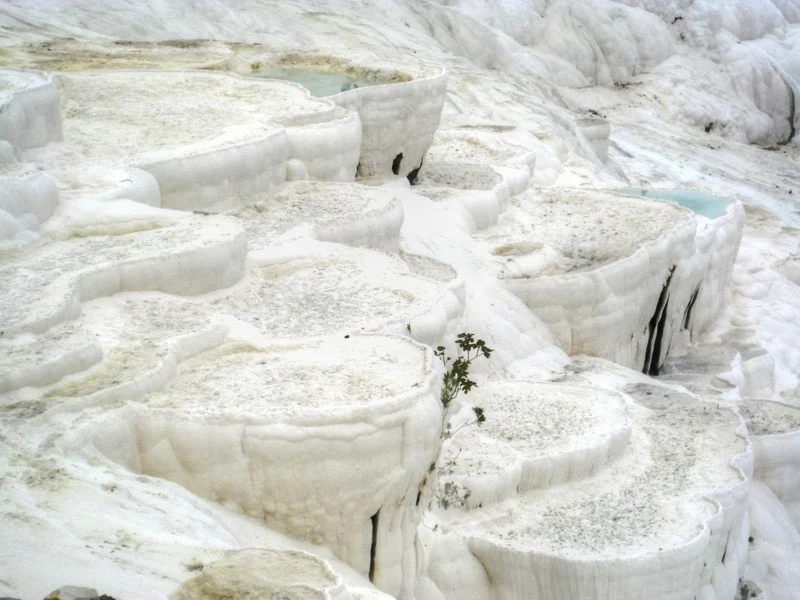
Travertine terraces in Pamukkale, Turkey (Credit: Josep M. Ubalde via imaggeo.egu.eu)
The materials that make up Pamukkale are travertines, sedimentary rocks deposited by water from a hot spring. Here, the spring water follows a 320-metre-long channel to the head of the travertine ridge before falling onto large terraces, each of which are about 60-70 metres long.
The travertines are formed in cascading pools that step down in a series of natural white balconies. These travertines are 300 metres high and their shape and colour lend them the name Pamukkale, meaning “cotton castle”.
At its source, the water temperature ranges between 35 and 60 degrees Celsius, and it contains a high concentration of calcium carbonate (over 80 ppm). When this carbonate-rich water comes into contact with the air, it evaporates and leaves deposits of calcium carbonate behind. Initially, the deposits are like a soft jelly, but over the time they harden to form the solid terraces you see here.
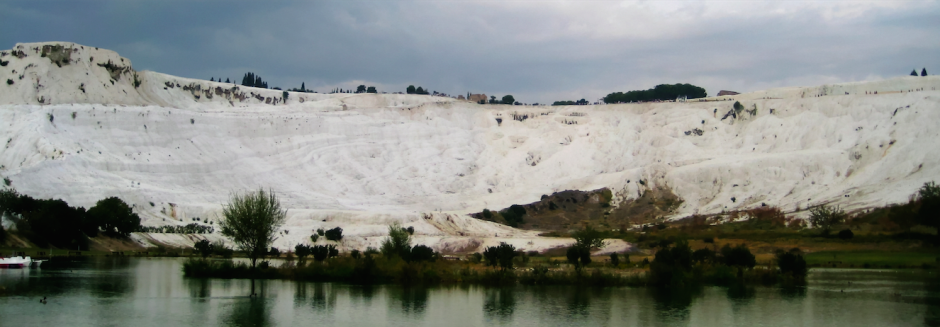
Putting Pamukkale into perspective (Credit: Josep M. Ubalde)
These travertines have been forming for the last 400,000 years. The rate they form is affected by weather conditions, ambient temperature, and the duration of water flow from the spring. It is estimated that 500 milligrams of calcium carbonate is deposited on the travertine for every litre of water. Today, thermal water is released over the terraces in a controlled programme to help preserve this natural wonder. You can no longer walk on them, but they are beautiful to behold.
By Josep M. Ubalde, Soil Scientist, Miguel Torres Winery
Imaggeo is the EGU’s open access geosciences image repository. Photos uploaded to Imaggeo can be used by scientists, the press and the public provided the original author is credited. Photographers also retain full rights of use, as Imaggeo images are licensed and distributed by the EGU under a Creative Commons licence. You can submit your photos here.
