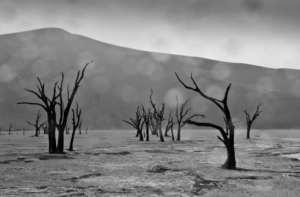
“Plants carry traces of past weather. Reading them may help us navigate a hotter, drier world.” Wenli Zhao
As global warming intensifies drought frequency, understanding how ecosystems store and deplete water is critical for anticipating vegetation stress. This blog walks us through a novel groundbreaking study published on EGU journal Hydrology and Earth System Sciences (HESS). Led by Wenli Zhao, who is also authoring this blog, this paper uses memory-aware machine learning to map how distinct plant functional types retain hydrological legacy effects over long time horizons. The resulting framework provides a non-invasive, surface-based metric to evaluate ecosystem resilience and plant water-use strategies in a changing climate.
Plants are living weather archives
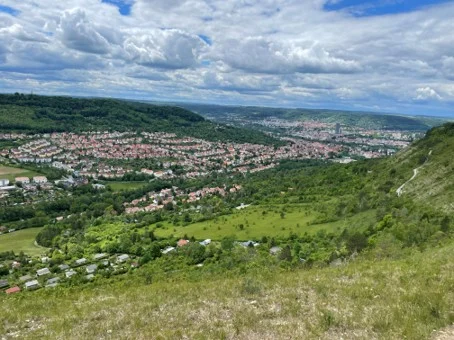
Standing in the green hills above Jena, I could see the city below and the Max Planck Institute for Biogeochemistry, where I began this study. The heat of 2022 and 2023 was hard to ignore. Local records show that 2022 tied Jena’s previous annual warmth record (EAH Jena, 2023), and 2023 became the warmest year in the city’s observational series (EAH Jena, 2024).
As I write this in August 2026, the climate story has moved on again. Western Europe has just recorded its hottest combined June-July period, while recurrent heatwaves and drought have pushed rivers to record lows and placed crops, ecosystems and communities under growing pressure (Copernicus C3S, 2026; European Commission JRC, 2026). The world around us is accumulating a history that matters.
A weather station records each moment as it passes: temperature, rain, radiation and wind. A plant does something different. Through its roots, leaves, stored water and changes in growth and water use, it carries part of that moment forward. In this sense, plants are living environmental sensors and archives. By ecosystem memory, I mean that earlier weather can leave traces in how an ecosystem uses water today.
To read those traces, we focused on evaporative fraction, the share of available surface energy used to move water from soil and plants into the atmosphere rather than directly heat the air. It is not the same as soil moisture; it is the response of the whole land surface, shaped by water availability, vegetation and atmospheric demand. Eddy-covariance towers measure this exchange continuously across many climates and ecosystems.
Teaching a model to read the past
In our 2025 study, we brought together daily observations from 90 eddy-covariance sites in the ICOS, AmeriFlux and FLUXNET2015 networks. For each prediction, a memory-aware model could look back over the previous 365 days. It received rainfall, incoming shortwave radiation, air temperature, atmospheric dryness, wind, leaf area and site characteristics, but not measured soil moisture.
The model could therefore learn whether yesterday, last month or the previous season still mattered. After testing it on years withheld from training, we used an explainable machine-learning method, Expected Gradients, to trace which earlier days and variables influenced each prediction. These attributions show what the trained model learned and help us ask how an earlier weather event may be linked to a later plant response; they do not establish causation.
Take August 2, 2014 at Tonzi Ranch, a woody savanna in California. The centre of the figure compares the observed and predicted evaporative fraction. Around it sit the previous 365 days of weather and vegetation information. Red and blue bands mark earlier conditions associated with a higher or lower prediction.
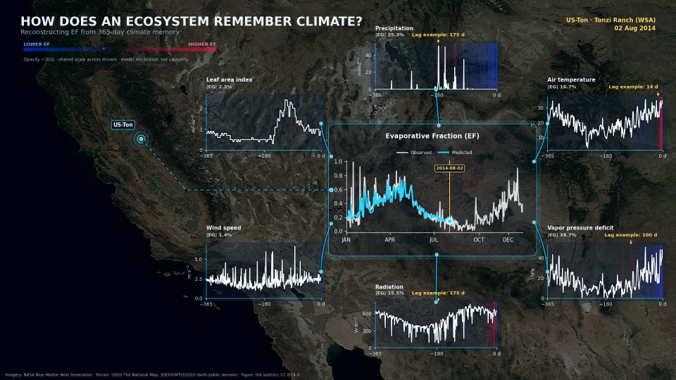
Tonzi Ranch, California, 2 August 2014. A year of weather and vegetation history contributes to one daily evaporative fraction prediction. Red and blue bands show model attributions, not causal effects. Analysis and figure: Zhao et al. (2025). NASA and USGS basemap data are public domain; figure licensed under CC BY 4.0.
On this day, rainfall from roughly 175 days earlier, almost six months before the prediction date, still left a visible imprint on the model’s prediction, alongside signals from more recent conditions (Zhao et al., 2025). This is an example, not a universal response time. What made memory tangible was that a single daily value carried fingerprints from several moments in the past.
Different ecosystems, different clocks
Across the 90 sites, rainfall, temperature, radiation and atmospheric dryness all mattered, but not in the same way everywhere. Many grasslands placed most weight on recent days and weeks. Many forests retained a meaningful influence from months earlier, while shrublands and savannas often fell between them. Individual sites varied, but the broad contrast suggested that ecosystems keep different clocks (Zhao et al., 2025).
Roots offered one possible explanation. Deep-rooted vegetation can reach water stored after earlier rainfall, whereas shallow-rooted systems may track recent rain more closely. When we compared learned memory with independent observations of rooting depth, longer memory was associated with deeper roots in several ecosystem groups, although not all.
This relationship is a clue rather than a universal rule. The model did not observe roots directly, and ecosystem memory is also shaped by soil texture, water-holding capacity, seasonality and plant regulation. Even so, the comparison points to an intriguing possibility: memory inferred from aboveground weather and water and energy fluxes may offer clues about belowground rooting strategies that are otherwise difficult to observe. These patterns cannot serve as a hidden ruler for measuring roots, but they can help identify where field observations should look next (Zhao et al., 2025).
Learning from the past
If we focus only on today’s weather, we can misread ecosystem vulnerability. Two landscapes may experience the same hot afternoon but arrive there with different water stores and different histories. A grassland may react quickly to a recent shower or dry spell. A deep-rooted forest may be buffered for longer, yet still carry the influence of an earlier season.
Memory effects can connect long tower records with plant water-use strategies and delayed drought responses. They are not a replacement for experiments, and their ecological interpretations must be tested in the field. But they can help us ask a better question: not only what weather is happening now, but what earlier weather is still shaping the present.
Looking again across the hills around Jena, I no longer see vegetation as a passive backdrop beneath the weather. I see natural sensors that have been integrating rain, heat and dryness over time. By reading their exchanges of water and energy, we can begin to ask what they remember. The weather passes, but its story remains in soil, roots and plant water use. In a hotter, drier world, learning to read that story may help us prepare for what comes next.
References
Copernicus Climate Change Service (C3S): Exceptionally hot and dry conditions fuel wildfires in Europe as ocean surface temperatures reach record highs for July, 2026. Available at: https://climate.copernicus.eu/exceptionally-hot-and-dry-conditions-fuel-wildfires-europe-ocean-surface-temperatures-reach-record (last access: 24 August 2026).
Ernst-Abbe-Hochschule Jena (EAH Jena): Jahresrückblick 2022 – Wieder warm und trocken, 2023. Available at: https://www.eah-jena.de/wetter/statistik/verbale-jahresrueckblicke/jahresrueckblick-2022 (last access: 24 August 2026).
Ernst-Abbe-Hochschule Jena (EAH Jena): Jahresrückblick 2023 – Neue Temperaturrekorde, 2024. Available at: https://www.eah-jena.de/wetter/statistik/verbale-jahresrueckblicke/jahresrueckblick-2023 (last access: 24 August 2026).
European Commission Joint Research Centre (JRC): Worsening drought and record heat grip Europe, fuelling extraordinary wildfires and extremely low river flows, 12 August 2026. Available at: https://joint-research-centre.ec.europa.eu/jrc-news-and-updates/worsening-drought-and-record-heat-grip-europe-fuelling-extraordinary-wildfires-and-extremely-low-2026-08-12_en (last access: 24 August 2026).
Zhao, W., Winkler, A. J., Reichstein, M., Orth, R., and Gentine, P.: Learning Evaporative Fraction with Memory, EGUsphere [preprint], 2025. DOI: https://doi.org/10.5194/egusphere-2025-4082.