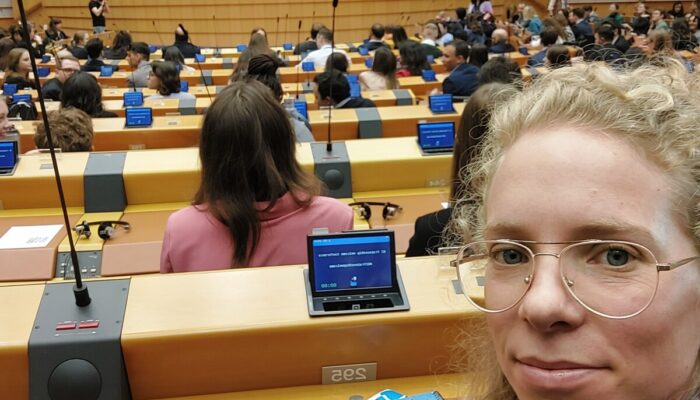
Welcome, Marie! Could you please introduce yourself to our readers?
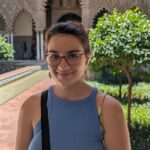
Hi, my name is Marie Cavitte. I’m a glaciologist and climatologist with a passion for the polar regions. I spent 10 years studying Antarctica. I started off during my Masters, then PhD, looking at the oldest ice on Earth, hunting for THE region of the ice sheet that might contain million-year-old ice. An ice core has been drilled since and all initial results indicate that we hit the target spot-on (very nice to see this years later!). During my postdoc, I transitioned into researching recent climate change in Antarctica, trying to see if we can measure increasing snowfall rates in East Antarctica, key to understanding how fast sea levels may rise in the decades to centuries ahead.
I have the travel bug, so moved around a lot during my studies, having done my undergrad in the UK, then PhD in the US. I’m now back in Belgium. In my current position as valorisation officer for the climate team of the Water & Climate Department at the Free University of Brussels (VUB), I facilitate the uptake of science into policymaking. I support the team’s research on climate impact by sharing the science done with all relevant stakeholders: policymakers, NGOs, the media, the public. I also keep a foot in science by working on proposal applications, writing scientific reports, policy briefs… And of course, I’m still working on a few polar files.
I’m very much involved with the EGU for a while, as I am the policy officer for the Cryosphere Division and a member of the EGU Climate Hazards and Risk Task Force. When I’m not doing all this, you’ll find me running everywhere (physically and metaphorically).
When did you apply for the Blue Book Traineeship programme, and how did your everyday work at the Commission look like?
I applied for the traineeship in my last year of postdoc. I interned with the Directorate-General for Climate Action (DG CLIMA) in 2024. My work of my unit was quite transversal, I contributed to the climate science team and the team working on monitoring, reporting and verifying greenhouse gas emissions for the EU.
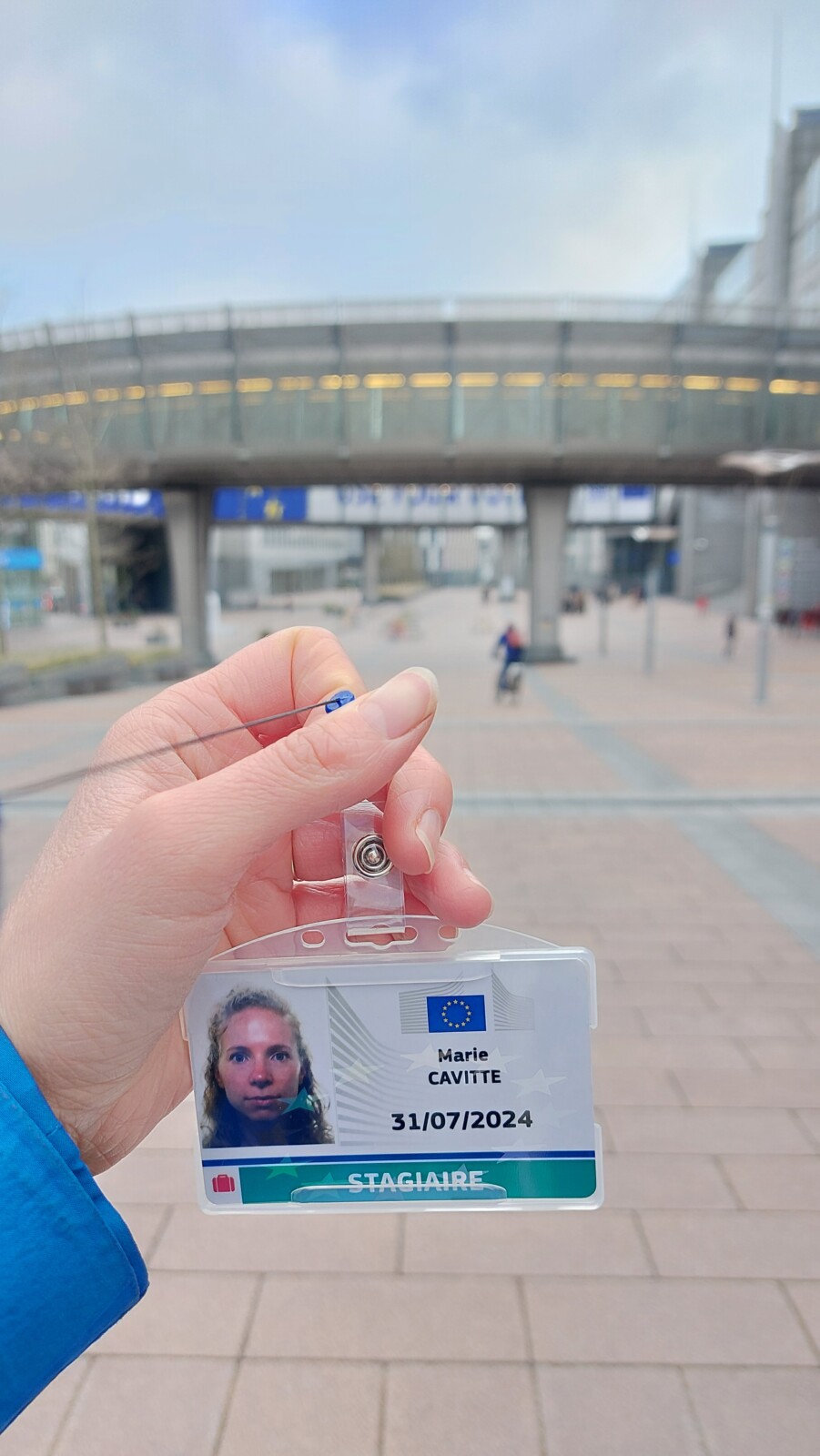
Marie Cavitte’s internship badge
Part of my role was to keep an eye on the latest science that could be relevant to the unit’s work and share it through summaries, policy briefs, presentations in meetings. I attended feedback-to-policy workshops where I acted as the intermediate between scientists and my colleagues, organising follow-up meetings where relevant. All those soft skills we tend to undervalue as researchers (presenting, writing, working collaboratively, networking) were essential in my day-to-day work.
I really enjoyed my work at the DG CLIMA and for sure it triggered my change in career path: going from research to knowledge brokering.
How has the traineeship experience contributed to your science for policy skills?
Before starting the traineeship, I was a little nervous that I wouldn’t have enough policy background to make a difference. It turned out that to develop solid policy skills, you really need to do the work, and you pick it up faster than you think.
During my 5 months at DG Climate Action, I learned to work in bilateral and multilateral settings and to listen to scientists as policymakers do, focusing on how science aligns with policy needs and how it can be translated into action. I also learned a lot about multilateral processes under the UNFCCC workflows, and COPs. And importantly, I developed a strong network in climate policy that I continue to develop to this day.
Where did you see the value of your training as a glaciologist during your time with DG CLIMA?
While applying for this position, I felt that I can put my climate science knowledge into use. Antarctica has direct impacts on our world, most visibly through its role on rising global sea level. The West Antarctic ice sheet is one of the biggest tipping points in our climate system. A total collapse of this ice sheet (possible if we reach 2°C of global warming) would raise sea level by around 7 meters. The Arctic is also home to two tipping points: permafrost and the overturning ocean circulation, compounded by the geopolitical issues around rapidly disappearing sea ice.
As an insider to cryospheric research, I was able to pick up on relevant science updates much faster and share them. I was also supporting the drafting of funding topics, where I could apply understanding of the state of the art of climate science. In some of my work, I had less expertise of course, but I think one of our superpowers as scientists is the ability to read lots of material and learn fast, so I definitely applied that skill for the win.
What were the most surprising aspects and the main challenges of this experience?
One of the biggest surprises for me was how few scientific profiles work inside the Commission, even in climate policy. At the same time, it makes sense, since economics, psychology, political science are incredibly important to design and implement (climate) policies. I think what makes DG CLIMA so strong is having a combination of all these domains, and I was definitely trying to learn as much as I could from my colleagues.
Regarding the challenges, I already knew the workload was intense at the Commission, but I don’t think I realised just how intense. Colleagues were working on so many files, often all equally urgent and important, having to understand the big picture but also the nitty-gritty details of policies. A lot of the work entails continually reading policy news, climate updates, EU news, following what the Commission is putting out as new priorities. Policymakers in DG Climate Action are incredibly knowledgeable and invested in their work.
The rigid hierarchical structure was the hardest to get used to. Any note, any decision, any communication, must be approved from above, which certainly slows down things at times. But it also means you’re part of this big machine and you feel part of a larger effort, rather than working in isolation. So, it also has its good sides.
What would be your advice to those who would like to apply for the traineeship?
Apply! If you are curious about the science-policy interface and whether you would be a good fit, I think the best way to find out is to dive in and be part of it. You will learn SO much in just 5 months. It’s really a perfect length as it is long enough to learn if you are a good fit or not, and not too long such that you can go back to your research if it turns out that that was more your thing.
Regardless, I think the bluebook traineeship exchange brings a lot for both sides: as researchers, we get to understand how our research fits in the big picture, and how we can steer research in general to be relevant for (in my case, climate) policies. On the Commission side, we bring our own set of knowledge and perspectives inside the units we intern in, bringing with us new ways of thinking which can sometimes unlock fresh thoughts or policy developments. So, it’s really a win-win. Plus, you might just meet some great people, make lifelong friends.
I am happy to be contacted by anyone interested in applying to the Blue Book Traineeship programme. You can reach me at marie.cavitte@vub.be.