Working with marine carbonate-system observations has taught me how much effort lies behind every row of an oceanographic dataset: long hours at sea, careful sampling, laboratory analyses, calibration and quality control. A single bottle of seawater may represent only one place, one depth and one moment, but when many such samples are brought together, they can reveal how the ocean is changing.
On 8 July 2026, the Global Ocean Data Analysis Project released its newest major synthesis: GLODAPv3.
From individual bottles to a global picture
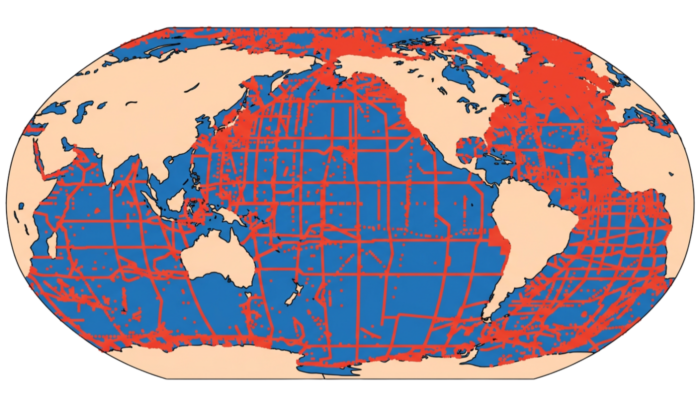
GLODAPv3 combines surface-to-seafloor biogeochemical observations from 1,181 research cruises, spanning 1972 to 2023 (Figure 1). Altogether, it contains around 1.5 million water samples, including approximately 648,000 samples with marine carbon chemistry measurements.
The observations come from discrete water samples collected during oceanographic cruises, often using bottles attached to a CTD-rosette (Figure 2). They include temperature, salinity, oxygen, nutrients, dissolved inorganic carbon, total alkalinity and several tracers that help scientists estimate how recently a water mass was in contact with the atmosphere.
Together, these variables support research into ocean acidification, deoxygenation, nutrient cycling, water-mass ventilation and the storage of human-produced carbon in the ocean interior. The value of GLODAP lies not only in its scale, but in the possibility of placing an individual cruise or regional study within a global and multi-decadal context. One cruise provides a snapshot, while GLODAP helps connect many snapshots into a history of the ocean.
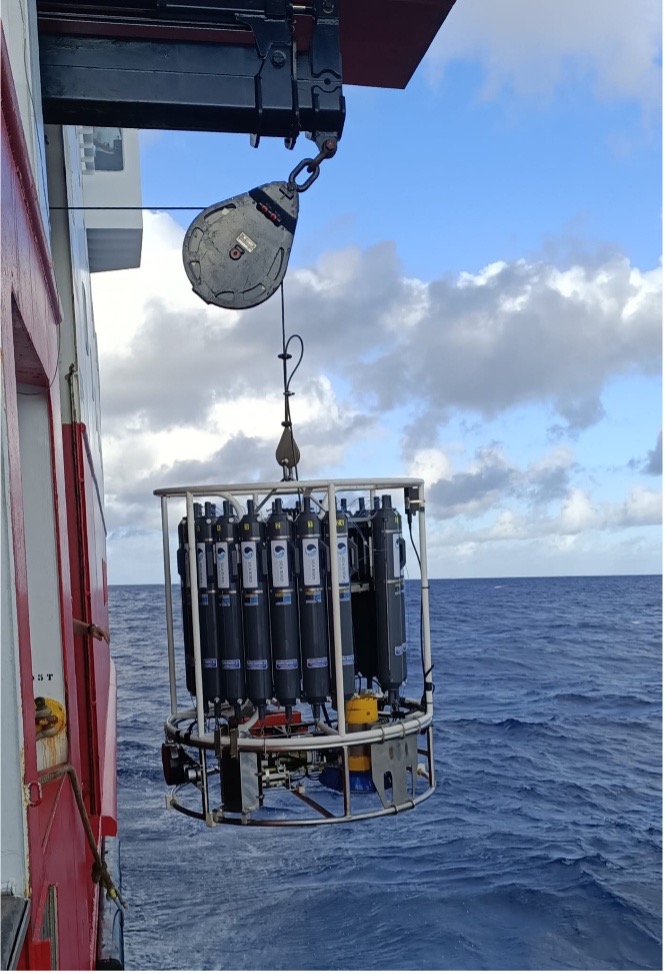
Figure 2. A CTD-rosette equipped with niskin bottles allows scientists to collect seawater at selected depths. Each sample may later contribute to regional and global synthesis products such as GLODAP. Credit: David Curbelo-Hernández, personal archive.
Making decades of observations comparable
Bringing together data from different ships, laboratories and decades is not simply a matter of placing all the measurements in one spreadsheet. Even when each analysis is carefully performed, small differences among instruments, methods or laboratory practices can produce systematic offsets between cruises.
GLODAP therefore works like both an archive and a common language. The team checks the observations for outliers and compares measurements collected by different cruises. Where the evidence supports it, adjustments are applied to selected variables so that the merged product is as internally consistent as possible.
Users can access both the original cruise data and the merged product. GLODAPv3 is available as global and regional files in several formats, while cruise-level uncertainty estimates, metadata and the code used to prepare the synthesis are also openly available.
What is new in version 3?
GLODAPv3 is more than the addition of recent cruises. It is a complete re-evaluation of the full dataset. The team introduced a new “furthest-first” method for determining the set of adjustments, explicitly considered real trends in the deep ocean so that these are not accidentally removed during quality control, and estimated uncertainty for the core variables on each cruise.
There is also an important detail for carbonate-system users: although pH measurements are included in the compilation, pH did not undergo the secondary, cross-cruise quality-control step in GLODAPv3. As with any large synthesis, users should therefore read the documentation, examine the flags and choose variables according to their scientific question.
Open data still depend on people
A polished global dataset can make it easy to forget the human effort behind it. GLODAPv3 represents the work of hundreds of scientists and technicians who secured funding, collected samples, carried out analyses, prepared metadata, shared their results and performed years of synthesis and quality control.
The data are open, but their use comes with responsibilities. The GLODAP team asks researchers to cite both the dataset and its supporting publication. Studies relying heavily on particular cruises should also cite the cruise datasets and related papers, and consider contacting the original investigators. Besides giving appropriate credit, this can bring valuable knowledge about the measurements and regional context into a study.
GLODAPv3 is a reminder that major advances in ocean science do not come only from new instruments or new expeditions. They also come from preserving observations, making them comparable and ensuring that samples collected decades ago can continue answering questions that scientists had not yet imagined.
Further reading
- Explore the GLODAPv3 website and learn more about the observations included in the new release.
- Access and download the GLODAPv3 merged and adjusted data product.
- Read the GLODAPv3 Data Use Statement for guidance on citing the dataset and recognising the scientists who collected the original observations.
- Learn more about the new quality-control methodology used in GLODAPv3.
References
- Lange, N., Lauvset, S. K., Carter, B. R., Humphreys, M. P., Woosley, R. J., Olsen, A., Bittig, H. C., Kozyr, A., Álvarez, M., Azetsu-Scott, K., Becker, S., Brown, P. J., Cotrim da Cunha, L., Hoppema, M., Ishii, M., Jeansson, E., Murata, A., Müller, J. D., Pérez, F. F., Schirnick, C., Steinfeldt, R., Ulfsbo, A., Velo, A., and Tanhua, T. (2026). The Global Ocean Data Analysis Project version 3 (GLODAPv3) – an internally consistent biogeochemical data product for the World Ocean (NCEI Accession 0315582). NOAA National Centers for Environmental Information. Dataset. https://doi.org/10.25921/m6tp-mj50. Accessed 16 July 2026.
- Lange, N., Lauvset, S. K., Carter, B. R., Humphreys, M. P., Woosley, R. J., Olsen, A., Bittig, H. C., Kozyr, A., Álvarez, M., Azetsu-Scott, K., Becker, S., Brown, P. J., da Cunha, L. C., Dias, L., Hoppema, M., Ishii, M., Jeansson, E., Murata, A., Müller, J. D., Pérez, F. F., Schirnik, C., Steinfeldt, R., Ulfsbo, A., Velo, A., and Tanhua, T. (submitted). The Global Ocean Data Analysis Project version 3 (GLODAPv3) – an internally consistent biogeochemical data product for the World Ocean.
- Humphreys, M. P., Lauvset, S. K., Lange, N., Bittig, H. C., Carter, B. R., Hoppema, M., Murata, A., Olsen, A., Tanhua, T., Ulfsbo, A., Velo, A., Woosley, R. J., Azetsu-Scott, K., Müller, J. D., and Pérez, F. F. (2026). Furthest-first inversion for internal consistency adjustments in the biogeochemical data product GLODAPv3. EGUsphere [preprint]. https://doi.org/10.5194/egusphere-2026-3063.