Chlorophyll-a (chl-a), as the dominant photosynthetic pigment within phytoplankton, provides an indication of the phytoplankton biomass and are essential for understanding global and regional changes in primary production in the oceans. Multiple ocean colour satellites have unlocked routine synoptical scale observations of chl-a which now extends from 1997 to the present day. Differing numbers of satellites can be in orbit relaying observations at any one time, for example SeaWiFS was the only satellite monitoring ocean colour from 1997 until 2002 when MODIS-Aqua was launched. These satellite observations from the multiple satellites through time are merged routinely into climate quality data records, such as the European Space Agency (ESA) Ocean Colour Climate Change Initiative (OC-CCI).
However, ocean colour records of chl-a suffer from missing data due to clouds blocking the satellites view of the oceans. But more problematic are the large amounts of missing data during the polar winter due to high sun zenith and viewing angles.
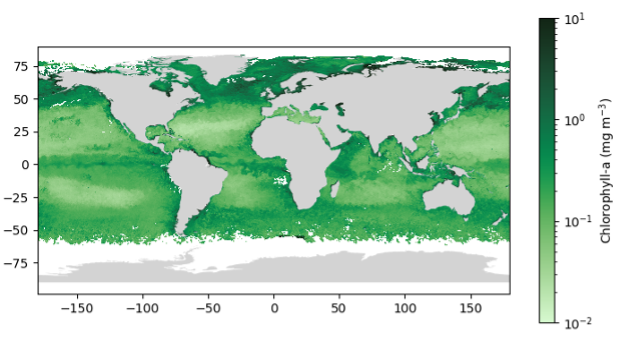
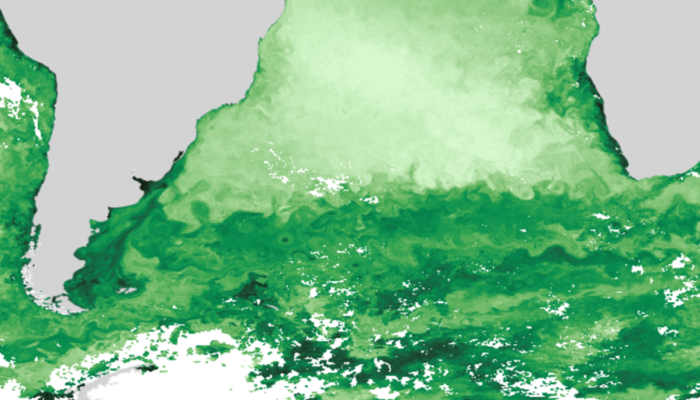
Satellite ocean colour chlorophyll-a records suffer from gaps in the data due to clouds (e.g. gaps in the tropics and mid latitude regions) but also due to the polar winter (e.g. large gaps in the high latitude Southern Ocean). (Credit: Daniel Ford generated from ESA OC-CCI data).
Multiple methods have been developed to fill the data gaps due to clouds, using statistical gap filling techniques or more complex neural network approaches. However the data gaps due to the polar winter persist. These gaps make the exploitation of the chl-a records more challenging or can result in assumptions about the chl-a concentration during the polar winter to be made. For example, in efforts to reconstruct the global ocean CO2 sink, these data are often manually filled with fixed values, or chl-a is avoided as an input variable thereby explicit biological signals within the interpolation are omitted.
An unlikely synergy: Biogeochemical Argo observations provide the key wintertime observations
Gap filling these polar winter observations is not a trivial task, as the high latitude winter months lead to very few research cruises venturing into the stormy seas. Therefore, chl-a observations that could act as a constraint on any gap filling approach are limited from research cruises. However, the Biogeochemical Argo (BGC-Argo) array can make these much needed observations during the polar winter.
In a new study published in Earth System Science Data, Ford et al. (2026) present a global gap filled satellite chlorophyll-a climate data record spanning 1997 to 2024 which uses the BGC Argo chl-a as an observational constraint. Missing polar winter data were filled using relative changes observed in wintertime BGC-Argo chl-a, anchored to satellite observations from the preceding autumn or following spring in each hemisphere. A key component of a climate data record are the provided uncertainties, which have been explicitly modified to account for gap filling procedures, thus ensuring consistency to the underlying climate data record standards. These data are available on Zenodo at monthly 0.25 degree resolution.
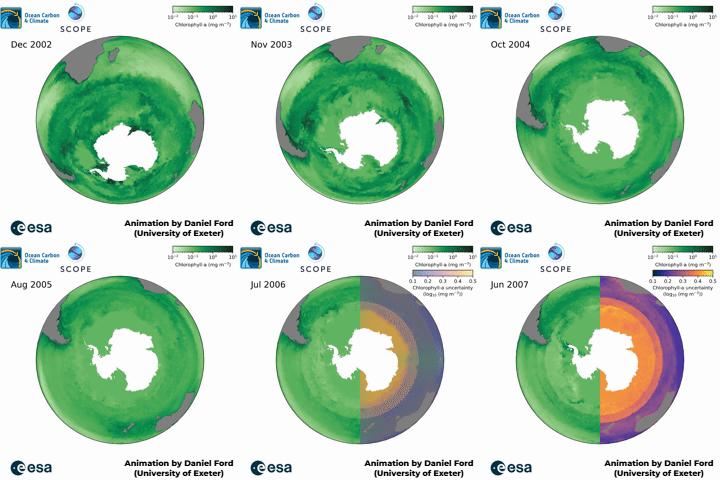
Animation of the data record generated in Ford et al. (2026), showing the missing observations filled in the polar winter around the Southern Ocean. The animation also shows the uncertainty fields that have been maintained during the filling procedures. The full animation can be seen on Ocean Carbon for Climate (credit: Daniel Ford)
This work was funded by the European Space Agency through the projects Ocean Carbon for Climate (OC4C) and Satellite-based observations of Carbon in the Oceans: Pools, Fluxes and Exchanges (SCOPE). Support was also provided by the OceanICU project.