Those of you who are active in proposal writing might know the programme Water4All Partnership – Water Security for the Planet. It is a funding programme for scientific research in freshwater with the goal to address urgent water-related challenges. The programme is co-funded by the European Union within the frame of the Horizon Europe programme …[Read More]
Editorial
Public engagement in science: how to position ourselves?
The recent student protests against the war in Gaza reminded all of us that being a member of the academic community requires us to reflect upon our role in society. In Switzerland, the university occupations (see SwissInfo) led to several open letter-type reactions from academic staff, either supporting the protests or on the contrary, recalling …[Read More]
Call for Blog Contributions: The HydroData Chronicles
We’re thrilled to announce the launch of our newest blog series dedicated to exploring the fascinating world of hydrological datasets. Join us on this exciting journey as we uncover the hidden stories within hydrological data. By highlighting cutting-edge research, insightful analyses, and captivating data, we aim to shed light on the intricacies of hydrology and …[Read More]
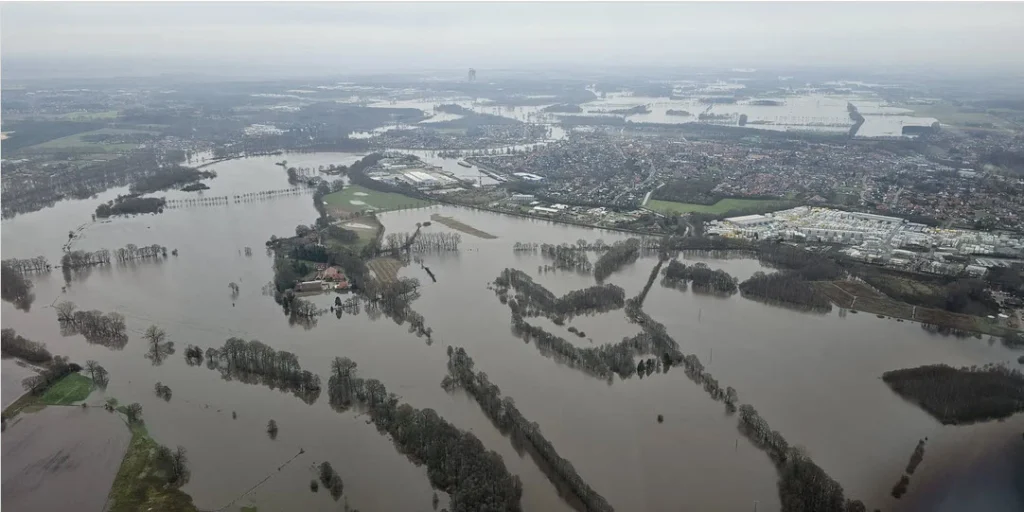
Communicating science to the public – an example after the recent floods in Germany
After the wet December 2023, the year 2024 started with widespread flooding in parts of Europe. Flooding during winter times is not unusual but brings particular challenges in terms of spatial extent, and the impact on people can be exacerbated when flooding comes with very low temperatures. The exceptionally wet and warm winter necessarily triggers …[Read More]
May the year-end be Exceptional, not only hydrologically!
What a hydrological year it has been! From the winter drought and flash floods detailed in Matano and Avanzi‘s blog post to the remarkably warm and wet November 2023, Europe has witnessed a range of extraordinary weather phenomena. In the Alpine region, the convergence of warm and wet weather resulted in numerous rain-on-snow events (see …[Read More]
Interdisciplinary research within hydrology
Interdisciplinary research within hydrology has become a major task for hydrologists. But what are the main advantages and challenges reflecting to break the academic silos? What is interdisciplinary water research? Interdisciplinary research activities within human-water research have increased in recent years, not only in terms of research proposals and requests from funding agencies (such as …[Read More]
How far can we take the DORA rules?
DORA stands for Declaration on Research Assessment, also known as the San Francisco Declaration on Research Assessment. The declaration was developed back in 2012 during the Annual Meeting of the American Society for Cell Biology in San Francisco and has become a worldwide initiative since then. The country where you are currently reading this post …[Read More]
How has ChatGPT changed the way you teach hydrology?
Have you ever used ChatGPT to teach hydrology? If so, when did you start? I opened my account on openai.com in November 2022, out of curiosity, to test GPT-3 (Generative Pretrained Transformer generation 3). This was shortly before ChatGPT was launched (30 November 2022). Now, I even have a paid account to speed up the …[Read More]
New spheres of scientific publishing
Many of you have noticed that EGUsphere went online, the new preprint repository hosted by EGU, as a service for the entire geosciences community. This repository can be used by any geoscientist to deposit their preprint even those that are not submitted to Copernicus journals. If you submit a preprint, your manuscript will receive a …[Read More]
World Water Day 2023
Today is the World Water Day, held every year on 22 March since 1993 to celebrate water and to raise awareness of the lack of access to safe water for a large part of the world population. It is also the start of the UN 2023 WATER CONFERENCE (22-24 March), “a once-in-a-generation opportunity to unite …[Read More]