Why should you care about hydrothermal alteration in volcanic systems?
When people think of volcanoes, they imagine large, devastating eruptions and lava streams gushing from the summit of an edifice. However, even when volcanoes are not visibly ‘active’, there can be more lurking below the surface. Hydrothermal alteration is one of the important and often less-talked-about culprits that changes dome-forming rocks and minerals from within. It can occur in parallel with other processes, and, therefore, it might flow under the radar. As a matter of fact, one in five historical volcanic collapses recorded since 1500 AD have been caused by hydrothermal alteration. Good thing that today’s post will cover the whys, hows and know-how of hydrothermal alteration.
What is hydrothermal alteration?
Hydrothermal alteration is a product of magmatic and meteoric interaction inside the volcanic structure. It occurs when hot hydrothermal fluids, concoctions made up of magmatic volatiles and groundwater, come into contact with host rocks. Minerals get dissolved, and incorporated into the fluid, thereby changing the chemical and mineralogical composition of volcanic rocks. Additionally, a hydrothermal system depends on faults and fractures that transport hot fluids through permeable lithology. The surface expression of hydrothermal activity can be documented in the form of crater lakes, fumaroles, hot springs, and mineral deposits at the volcanic summit. As temperature decreases further away from the heat source, mineral phases incorporated in the fluid will precipitate. All of these changes act in spatiotemporal cycles, waxing and waning microstructural integrity of the volcanic rocks. Physical property changes that arise from hydrothermal alteration can influence the behaviour of volcanoes. Therefore, hydrothermal alteration can quietly re-engineer a volcano from the inside, turning rocks into weak, clay-rich masses or overpressurised caps. Rock weakening, fluids, and pressure strongly influence where and how a volcano collapses or explodes.
What does hydrothermal alteration do?
Primary lithology and mineralogy are among the determinators of how alteration will affect physical and mechanical behaviour. Dense, coherent lavas typically retain higher strength due to low porosity and their tight-knit structures. Because of the lack of permeable pathways, it is harder for fluid to penetrate the rock and alter it. In contrast, fragmented rocks such as breccias and pyroclastic deposits with higher porosity can more easily facilitate hydrothermal fluids. With the added caveat that pyroclastic rocks can sometimes undergo welding/cementation, resulting in increased strength and compaction.
A more common process in volcanic environments is argillic alteration that weakens rocks via clay formation and leaching. Depending on the mechanisms involved, both porosity-increasing and porosity-decreasing are documented in dome-forming materials. Hydrothermal fluids often dissolve original feldspar and mafic phases, replacing them with weak clays (e.g., smectite, kaolinite), thereby increasing porosity and reducing strength, stiffness, and cohesion. The result is a ”rotten rock”, a mechanically compromised rock mass, which can fail under relatively low stress. These altered zones can form laterally continuous, mechanically weak layers that act as slip surfaces. Because they are often buried beneath more competent rocks, they may remain undetected until a sudden failure/collapse occurs. On the other hand, precipitation that fills pores and fractures reduces permeability but might either decrease or increase strength. While this may locally strengthen the rock, it also shuts off permeable pathways. The resulting isolation can allow pore pressures to build up beneath sealed caps, increasing the likelihood of explosive behaviour. The destabilisation caused by the impact, therefore, depends not only on whether rocks are weakened, but also on how altered zones interact with fluid flow and stress distribution across the volcano.
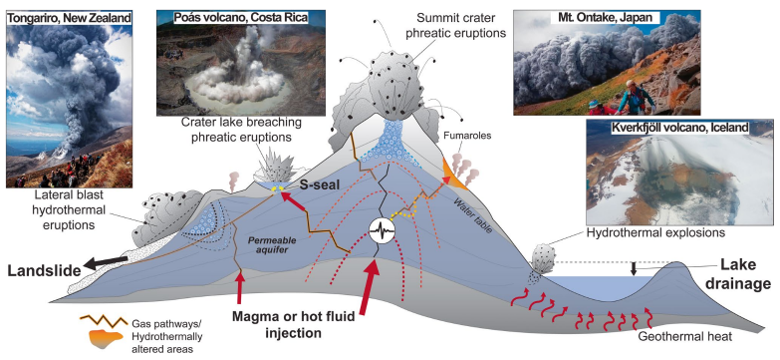
A schematic of eruption styles in volcanic settings, showing potential trigger mechanisms (e.g., magma/fluid injection; landslide; sulphur sealing; lake drainage). Source: Montanaro et al. (2022)
How to detect and measure hydrothermal alteration on site?
Detecting and quantifying hydrothermal alteration is difficult because different methods tell a part of the alteration story, and data interpretation depends on resolution, surface exposure, and integration with field or laboratory data.
Electromagnetic methods such as resistivity and magnetotellurics are effective for mapping conductive, fluid-rich, clay-bearing zones and delineating hydrothermal flow structures, including clay caps and upflow regions. However, they do not identify alteration mineralogy on their own.
Aeromagnetic inversion can map subsurface altered volumes to depths highly dependent on the setting (at Mt. Ruapehu ~500 m), because hydrothermal alteration commonly destroys ferrimagnetic minerals and lowers magnetization; however, magnetic lows are not uniquely diagnostic because some fresh fine-grained lavas can show similarly low susceptibility.
Hyperspectral imaging is highly effective for mapping surface mineralogy and alteration styles, and newer models can also predict density, porosity, stiffness, and strength from spectral fingerprints, but the method is restricted to exposed surfaces and can be hidden by tephra, snow, ice, vegetation, or supergene weathering.
Muon tomography adds a different constraint by imaging internal density variations and tracking short-term density changes linked to hydrothermal dynamics, making it a useful complement to resistivity, magnetics, and laboratory rock-property data rather than a replacement for them.
Alteration intensity can be estimated from secondary mineral assemblages, geochemical indices such as CIA, and rock magnetic parameters, but CIA is best treated cautiously because its interpretation can be biased by protolith, grain size, sediment recycling, and metasomatic overprint, unless paired with petrography and broader geochemistry.
Together, electrical, magnetic, hyperspectral, and muon datasets can reveal altered, saturated, mechanically weak zones that often cluster on steep flanks and around domes. There has been an increasing number of case studies exercising a multidisciplinary approach, that are more informed and accurate in constraining hydrothermal alteration and detangling its complicated influence.
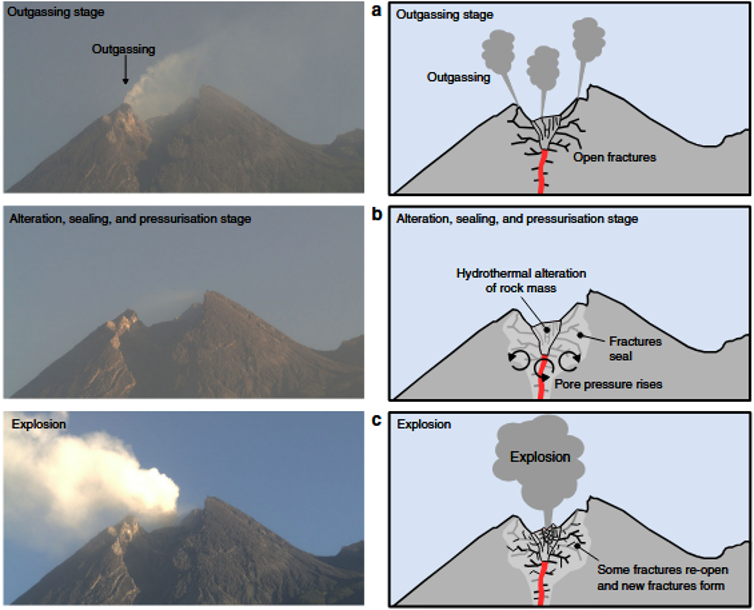
An example of what hydrothermal alteration does to Merapi volcano. Source: Heap et al. (2019)
All of the colours of the alteration rainbow
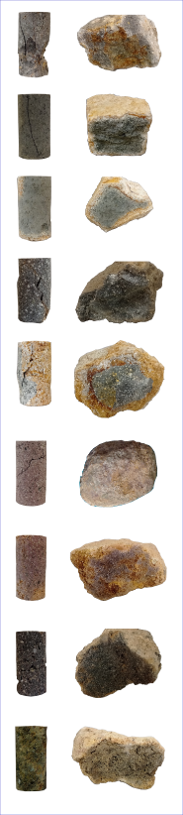
Highlighting heterogeneity in altered volcanic rocks from La Soufrière de Guadeloupe.
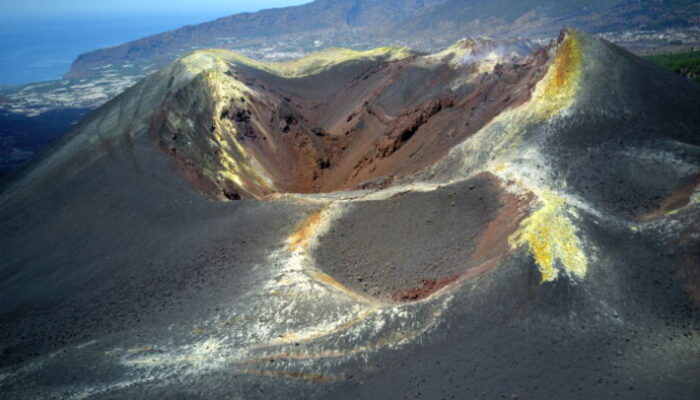
Hydrothermal alteration is often described in terms of mineralogical “zones,” each associated with distinct conditions, temperatures, and fluid compositions. These zones can be visually recognisable by colour, offering clues for interpreting subsurface processes.
- Argillic clay-dominated alteration often appears as pale, soft, and earthy material—whites, creams, and light grays. Advanced argillic zones, containing minerals like alunite and kaolinite, may display bleached, bright white, or even have pinkish hues.
- Silicic alteration is one of those processes that can increase rock strength. It can include locally vuggy silica with white, grey to bluish tones due to quartz enrichment.
- Propylitic alteration, characterised by chlorite, epidote, and calcite, commonly gives rocks a greenish colour and is usually associated with greater strength and structural integrity than clay-rich zones.
- Iron oxides appear red, orange, and yellow because of the presence of hematite and goethite. Be warned that these hues can be telling of either hydrothermal oxidation or surface weathering.
- Neon green and bright yellow surface sulfur precipitates can be markers of active degassing, but they are better treated as fumarolic surface products than as a primary alteration facies.
These variations are not solely aesthetic—they provide field geologists with some macroscopic clues about the alteration state of the volcano. It goes without saying that colourful rocks are not a foolproof method of determining alteration. They are fun and CAN BE indicators.
Some outstanding questions
Heterogeneity and sampling: Anyone who has climbed a volcano can tell you – volcanoes are a hot mess! With so many different alteration zones, host rocks, and phases, saying that volcanoes are heterogeneous is an understatement. And how do you sample an area like that? Which samples do you prioritise? The most fragile-looking ones or the most volumetrically abundant? Additionally, if you are dealing with a degassing volcano, acessing and sampling active, deep-seated hydrothermal systems will be technically difficult, leaving gaps in real-time observation.
Scale and complexity: There is definitely a disconnect between well-constrained, sample-scale laboratory measurements and edifice-scale numerical models that require input parameters. The scarcity of petrophysical properties for altered volcanic rocks limits large-scale stability modelling, and simplified cross-sections often fail to capture the true heterogeneity of alteration zones. One of the more exercised approaches in recent history has been the use of 3D models that investigate the impact of alteration on dome stability. Even if conceptualised, these types of models show how far alteration can damage a volcanic edifice, and coupled with appropriately upscaled physical and mechanical input parameters, they are creating a new era for hydrothermal research.
Spatiotemporal evolution: The time and space scales of alteration are poorly understood and difficult to constrain, with estimates ranging from years to thousands of years based on stratigraphy and radiometric dating. Superimposed alteration zones make it difficult to determine whether different mineral assemblages represent discrete events or varying conditions along the system, leaving their relative chronology unresolved. Drill cores from geothermal fields such as Irruputuncu (Chile) and Los Humeros (Mexico) can provide rare windows into alteration at depth, but these still account for a few boreholes and may not fully capture spatial variability. At Los Humeros, there are no clear trends between alteration facies and intensity, which might coincide with multiple hydrothermal events, of no avail in detangling a single alteration history.
Literature and figures for those who want to learn more:
- Siebert, Lee, Tom Simkin, and Paul Kimberly. Volcanoes of the World: Third Edition. University of California Press, 2010.
- Montanaro, Cristian, Emily Mick, Jessica Salas-Navarro, et al. ‘Phreatic and Hydrothermal Eruptions: From Overlooked to Looking Over’. Bulletin of Volcanology 84, no. 6 (2022): 64. https://doi.org/10.1007/s00445-022-01571-7.
- Sanchez, Rachelle, Gabor Kereszturi, Antonio M. Álvarez-Valero, Mercedes Suárez, Geoff Kilgour, and Georg Zellmer. ‘Timescales and Processes of Hydrothermal Alteration at Te Maari Tongariro, New Zealand: Insights Utilizing Petrographic and Mass Balance Techniques’. Journal of Volcanology and Geothermal Research 473 (2026): 108570. https://doi.org/10.1016/j.jvolgeores.2026.108570.
- Ní Nualláin, K. D., C. E. Harnett, A. Hrysiewicz, M. J. Heap, T. R. Walter, and M. Rosas-Carbajal. ‘From Alteration to Avalanche: A 3D Framework for Exploring Hydrothermal Weakening of Lava Domes’. Journal of Volcanology and Geothermal Research, 16 February 2026, 108566. https://doi.org/10.1016/j.jvolgeores.2026.108566.
- Pereira, Maria Luísa, Vittorio Zanon, Isabel Fernandes, Lucia Pappalardo, and Fátima Viveiros. ‘Hydrothermal Alteration and Physical and Mechanical Properties of Rocks in a Volcanic Environment: A Review’. Earth-Science Reviews 252 (2024): 104754. https://doi.org/10.1016/j.earscirev.2024.104754.
- Heap, Michael J., and Marie E. S. Violay. ‘The Mechanical Behaviour and Failure Modes of Volcanic Rocks: A Review’. Bulletin of Volcanology 83, no. 5 (2021): 33. https://doi.org/10.1007/s00445-021-01447-2.
- Mathieu, Lucie. ‘Quantifying Hydrothermal Alteration: A Review of Methods’. Geosciences 8, no. 7 (2018): 245. https://doi.org/10.3390/geosciences8070245.
- Heap, Michael J., Valentin R. Troll, Alexandra R. L. Kushnir, et al. ‘Hydrothermal Alteration of Andesitic Lava Domes Can Lead to Explosive Volcanic Behaviour’. Nature Communications 10, no. 1 (2019): 5063. https://doi.org/10.1038/s41467-019-13102-8.
(This post was reviewed by Samira Yalla, whose thoughts and comments helped improve the clarity of the article. I am thankful that she took the time and effort to provide feedback)