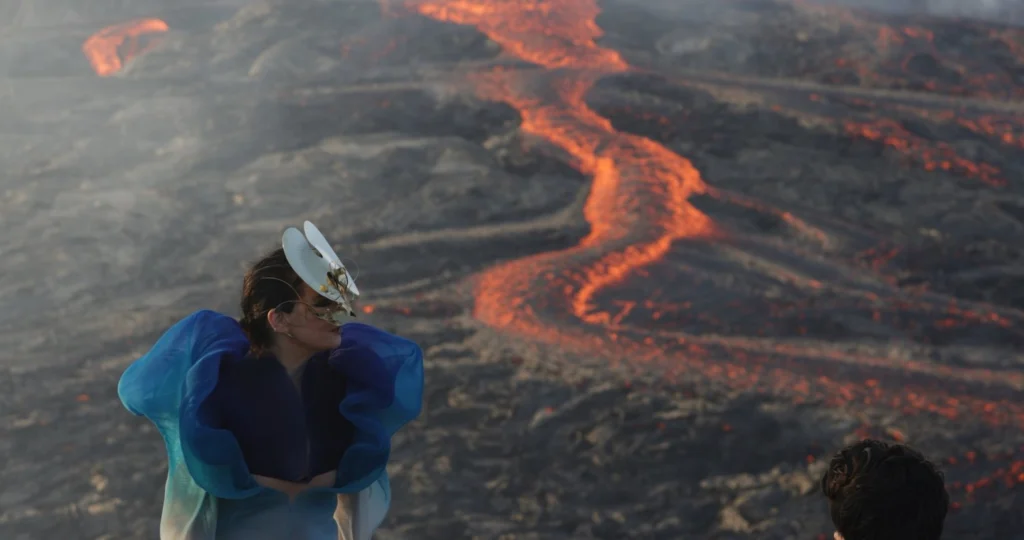
- Iceland is pure geology. When I travelled there in 2015, it felt like stepping into another world: surreal, raw, and unforgettable. Geology wasn’t just something to observe or study: in Iceland, it’s something you inhabit. The landscape doesn’t just sit there, it feels alive. It hums, it shifts, it speaks. And whether you’re a geologist or not, you can’t help but listen. To make the experience even more immersive, my friends and I put together the perfect playlist: Icelandic artists like Of Monsters and Men, Sigur Rós, Kaleo, and, of course, the one and only Björk.
Arguably Iceland’s most iconic artist, Björk often draws on the island’s geologically active terrain as metaphor and mood. Across her ten studio albums, two stand out for how deeply they connect human emotion with natural processes: Biophilia (2011) and Vulnicura (2015). Biophilia is analytical and curious, framing natural forces through scientific-like lenses. Vulnicura, in contrast, is raw and personal, using geological metaphors to chart the emotional devastation of heartbreak.
As a music enthusiast myself, I took a deeper dive into these two albums to explore how Björk turns Earth’s dynamic processes into sound and story, literal and symbolic. Put either album on (or both!) and come along for the ride.
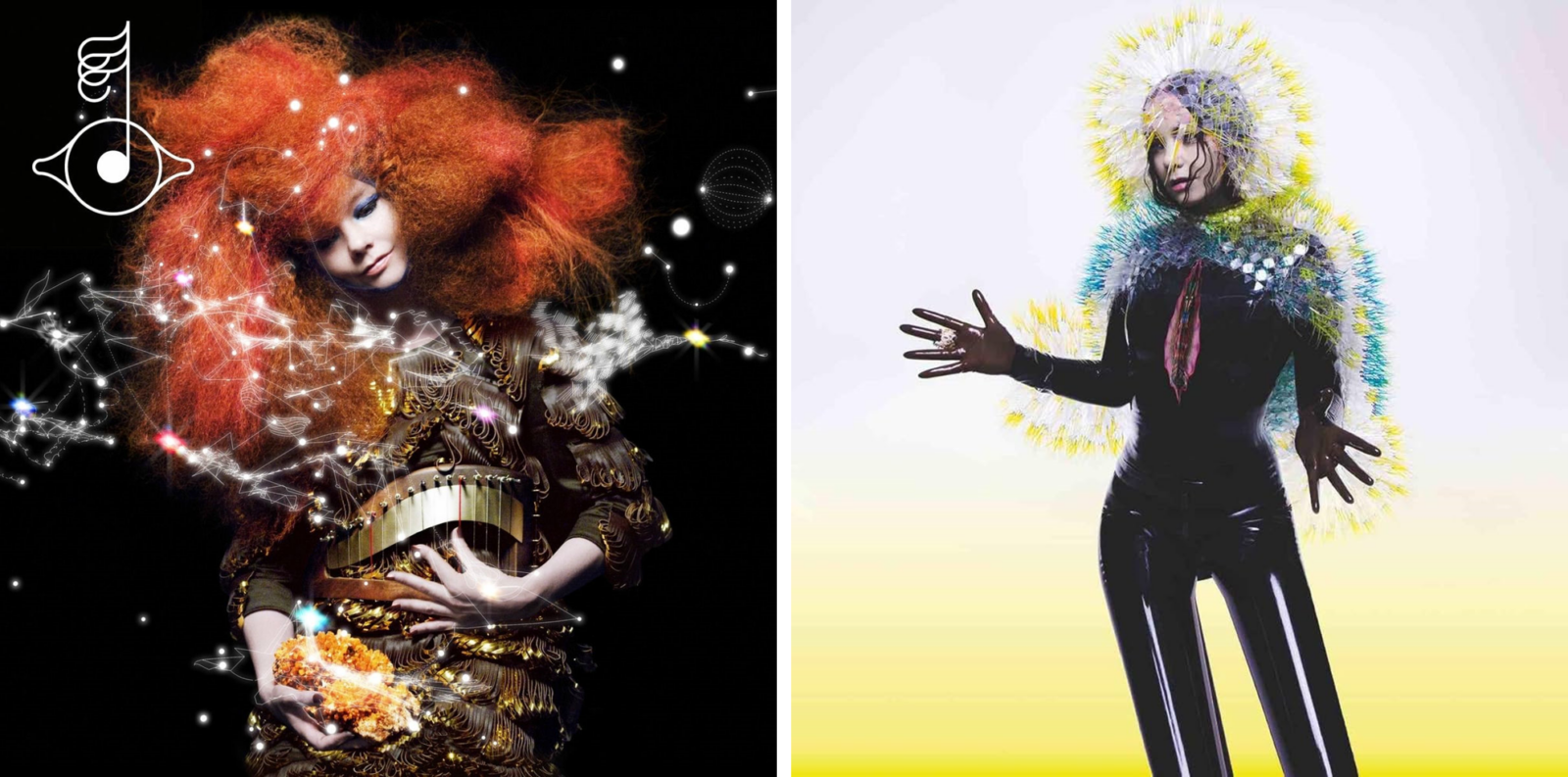
Biophilia and Vulnicura album covers (both photographed by Inez van Lamsweerde and Vinoodh Matadin)
Biophilia (2011)
Biophilia is largely characterised by its exploration of the interconnections between nature, technology, and music. Björk blends scientific concepts with artistic imagination, using nature, especially geological and cosmic forces, as metaphors for human experience.
The clearest example appears in “Mutual Core,” where tectonic activity becomes a striking analogue for the emotional push and pull of a relationship. ‘As fast as your fingernail grows / The Atlantic ridge drifts’ and ‘My Eurasian plate subsumed’ directly reference the movement of Earth’s crust. The song unfolds through images of earthquakes and volcanic eruptions, likening emotional instability to the violent energy beneath our feet. Lines like ‘I shuffle around the tectonic plates in my chest’ and ‘Try to match our continents / To change seasonal shift’ reframe intimacy through geological language, emphasising connection, dissonance, and the effort of emotional realignment.
The metaphor culminates in the chorus, where she pleads for openness and vulnerability in a moment of collision or fusion: ‘Our mutual core / Blurs into one.’ It’s one of the rare moments in pop music where geology isn’t just symbolic, it becomes the narrative’s very foundation. In the music video, visuals of lava flows, shifting sands, and erupting rocks mirror the song’s central metaphor: the emotional force of relationships compared to plate tectonics. Here geology is approached with a curious, analytical gaze.
Other tracks on Biophilia also incorporate geological or deep-time imagery, though less directly. ‘Crystalline’ takes crystal growth as a metaphor for creativity, building musically from sparse simplicity to intricate, geometric complexity, much like minerals forming under pressure, ‘growing slomo’. ‘We chisel quartz / To reach love’ uses the act of shaping minerals as a metaphor for the emotional effort required to nurture deep connections.
Meanwhile, ‘Dark Matter’ delves into the unknown, conjuring the vastness of deep space alongside the hidden layers beneath Earth’s surface. Björk uses astrogeology as a haunting reflection on the limits of human perception, linking the cosmic and the subterranean in a single sonic gesture. The music video incorporates actual imagery from space missions and CGI to narrate the journey of Voyager 1, the unmanned NASA spacecraft launched in 1977 to explore the outer solar system. Now the most distant human-made object from the Sun, Voyager 1 travels through the outer reaches of interstellar space, bearing silent witness to both beauty and cosmic desolation.
Vulnicura (2015)
In stark contrast, Vulnicura offers a raw, deeply personal journey through heartbreak, grief, and the slow process of healing. Björk turns inward, but the landscapes around her remain powerfully geological. The emotional terrain unfolds across lava fields, black sand beaches, and shadowy subterranean spaces, each echoing the intensity of her inner world. Unlike the analytical curiosity that drives Biophilia, here geology isn’t used to understand the world, it’s used to endure it.
In ‘Black Lake’, filmed among the cracked lava fields of Lakagígar in Vatnajökull National Park, volcanic imagery becomes a powerful metaphor for emotional rupture. The barren cliffs and fissured ground, scarred by one of Iceland’s most devastating eruptions, mirror the singer’s inner collapse. Lines like ‘My soul torn apart / My spirit is broken’ resonate with the fractured landscape, suggesting that grief can be as shattering as tectonic movement. Though the lyrics don’t name geological features directly, the imagery, both visual and verbal, unmistakably transforms the desolate terrain into a stage for mourning and fragmentation.
‘Stonemilker’, the opening track, presents a softer metaphor. Filmed on Grótta Beach in Reykjavík, the 360° video surrounds the viewer with a black-sand horizon, evoking openness and vulnerability. The title suggests erosion — the slow smoothing of stone by water — a fitting symbol for the song’s quiet plea for emotional reconnection. Just as nature reshapes landscapes over time, Björk seeks healing through patience and presence. Here, geology becomes a quiet backdrop, not a subject but a texture that reflects the emotional weight of the music.
In ‘Mouth Mantra’, the focus shifts to the internal. Inspired by Iceland’s lava caves, the visuals plunge into surreal, organic spaces, in twisting, fleshy, cave-like formations that blur the line between body and Earth. The song explores trauma and voice, as if the body itself were a wounded terrain shaped by unseen forces.
Either as a scientific metaphor or as an emotional landscape, geology is a vital language in Björk’s creative universe, shaping not just the stories she tells, but how we feel her work through sound, image, and atmosphere. Volcanic eruptions, tectonic drift, and the slow violence of geological time become tools for expressing intimacy, rupture, transformation, and resilience. By drawing parallels between seismic activity and emotional states, Björk collapses the boundary between the physical and the psychological, the planetary and the personal. What begins as a meditation on Earth’s deep structures becomes a reflection of the human interior, as if the ground beneath us and the emotions within us were somehow the same. In her hands, geology is never just backdrop: it is a living, breathing presence, one that fractures, shifts, and ultimately reshapes how we understand grief, connection, and change.
A final treat: while the lyrics of ‘Sorrowful Soil’, a track from Björk’s most recent album Fossora (2022), don’t directly reference geological themes, the connection between art and geology is once again present. The music video was filmed during the Fagradalsfjall eruption in August 2022, placing Björk amid an active, transforming landscape. Set against this living geological event, the song — a solemn meditation on mortality and maternal lineage — takes on a deeper resonance. Once again, Björk anchors her voice within the elements, allowing nature’s most powerful forces to shape the emotional and visual language of her work.
(This post was reviewed by Agata Poganj, whose thoughtful suggestions and insightful comments helped improve the clarity and overall quality of the article. I sincerely appreciate her time and valuable feedback.)