Let’s get the joke out of the way first, because I made it to myself more than once while finishing this piece: “explosive inside, effusive outside” is a fairly accurate description of the average Early Career Researcher trying to hold it together inside the current state of academia. Calm, composed, professionally cheerful on the surface; a small pyroclastic flow of funding anxiety, precarious contracts, growing responsibilities for the lowest payslips and looming deadlines going off somewhere just beneath it. It turns out this is also, with slightly more rigour and considerably less existential dread, a pretty good description of a silicic volcanic dome.
That’s the idea I want to walk you through here: that the rocks we’ve spent decades sorting into two tidy boxes, effusive and explosive, might be telling us a much messier, much more interesting story about what’s actually happening a few hundred meters below a volcano’s surface.
Two boxes that were never quite big enough
Ask any volcanology student to describe eruption styles, and they’ll give you the same answer I did as an undergraduate: effusive eruptions ooze, explosive eruptions blow. Effusive eruptions build lava domes and flows, slowly, with low viscosity and relatively low gas escape. Explosive eruptions, the drama queens, fragment magma into ash and pyroclasts and throw them into the sky, sometimes with fatal consequences for the communities who live nearby. Different processes, different products, different hazards, different chapters in the textbook.
The trouble is, real volcanoes keep refusing to read the textbook.
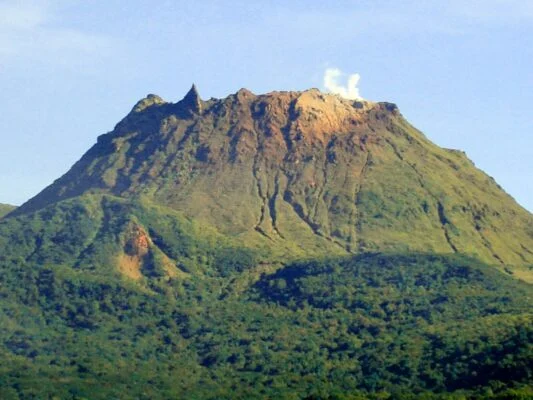
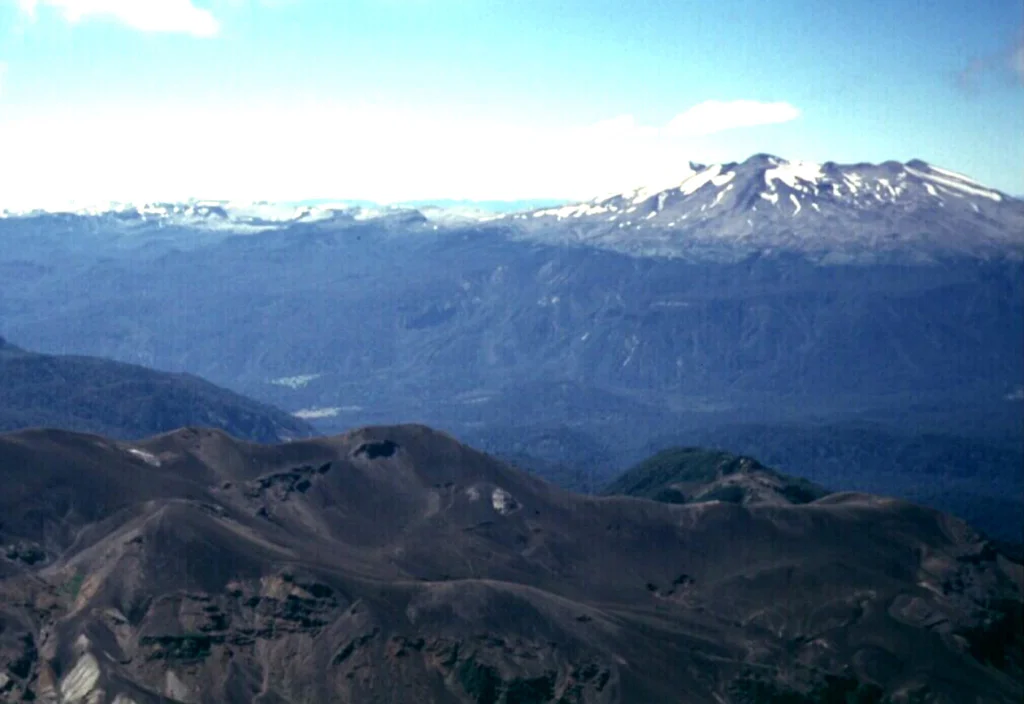
At Soufrière Hills volcano, and famously at Mount Saint Helens, we’ve watched the same volcano swing from one eruptive style to the other, sometimes with years separating the two phases. That’s already awkward for a strict effusive/explosive dichotomy, but it’s still explainable as two genuinely separate processes happening one after another. What’s much harder to explain away is what we’re now seeing at volcanoes like Cordón Caulle: effusive and explosive activity happening simultaneously, in the same eruption, in the same conduit. Not consecutive chapters. The same page.
Either these volcanoes are unusually indecisive, or our two boxes were never quite the right shape to begin with.
Rethinking the boundaries: cryptic fragmentation
In 2020, Dr Fabian Wadsworth and collaborators proposed a mechanism that offers a way through this. They suggested that fragmentation, the violent shattering of magma into ash and pyroclasts that we normally associate exclusively with explosive eruptions, doesn’t only happen deep in a conduit at high intensity. It can also happen much shallower, and with a much lower intensity. They call this phenomenon cryptic fragmentation: fragmentation that leaves no obvious explosive signature at the surface, because it’s quiet enough that the resulting pyroclasts never get launched anywhere outside.
In classical, high-intensity fragmentation, the story is familiar: magma shatters, volatiles exsolve and escape, ash and pyroclasts are ejected from the conduit and into the atmosphere, and eventually into your stratigraphic column. Cryptic fragmentation follows the same opening scene but the ending is completely different. Because the intensity is lower, the freshly formed pyroclasts aren’t ejected out at all. They simply stay where they were made, plastered against the conduit walls, and start sticking to each other.
That sticking-together process is called sintering: the agglomeration and welding of pyroclastic particles into a new, denser magma that looks remarkably similar to both ignimbrites and lava domes.
That last observation is really the whole engine of this research. If sintered, cryptically fragmented pyroclasts can end up looking like dome rock, then some of what we’ve confidently filed under “effusive” for decades might actually be the product of an explosive process in disguise.
The question we couldn’t stop asking
Once you see that possibility, you can’t really unsee it, and it collapses into three deceptively simple questions:
Could cryptic fragmentation and sintering be at the origin of both effusive and explosive eruptions? In other words, are dome rocks and ignimbrites products of the same underlying process? And if they are, should we start reinterpreting effusive eruptions as the visible outcome of an invisible, explosive, cryptic process?
I’ll admit these questions made me a little nervous to ask out loud, let alone in front of a room at EGU. If the answer turns out to be yes, it doesn’t just tweak a diagram in a textbook; It reshapes how we read the deposits of famous historical eruptions and some of the best-monitored active volcanoes on Earth. That’s a lot of reinterpretation to ask people to sign up for. So, the sensible next step wasn’t to speculate further. It was to look for the evidence and be honest about whether it was actually there.
It was. It’s everywhere, in fact. Other researchers have already documented lava-like ignimbrites. We found evidence for ignimbrite-like lavas: dome rocks that still carry the fingerprints of a clastic, fragmented origin, even though on the outside they present as perfectly ordinary effusive lava.
Reading a spectrum, not a boundary
The complication, and the reason this evidence has been easy to overlook for so long, is that sintering isn’t a switch. It’s a spectrum. At one end you have loose, unsintered particles: ash and pyroclasts fresh out of a cryptic fragmentation event, barely touching each other. At the other end, you have fully sintered material that looks, for all practical purposes, exactly like ordinary lava, with almost nothing left to betray its clastic past.
That’s the problem with strongly sintered rock: the more advanced the sintering, the more the original fragmented texture gets overprinted and erased. Paradoxically, the textural evidence for sintering is best preserved precisely where sintering was least complete or efficient. Push it far enough, and the evidence genuinely disappears. But, and this is the encouraging part, not always, and not completely.
We assembled a collection of more than 100 samples from over 15 volcanoes worldwide, deliberately spanning as much of the sintering spectrum as we could find. And at every single stage of that spectrum, we found evidence of a clastic origin. At the least-sintered end, particles are only just bonding at discrete contact points, leaving the rock porous, permeable, and still somewhat crumbly. In more advanced sintering, residual porosity outlines distinct magma blobs that have welded together, sometimes with subtle differences in groundmass texture between them, a hint at their separate origins. And at the fully sintered end, where the texture is essentially indistinguishable from lava, the clearest remaining proof of a clastic past is a clast of different composition or texture embedded within the mass.
It’s worth pausing on why these compositional and textural differences show up at all. The pyroclasts formed during a cryptic fragmentation event aren’t necessarily all made at once. The fragmentation events can span a range of timescales, which naturally produces local variation in the composition and texture of the clasts involved. That same process also explains another feature we kept running into: the significant presence of broken phenocrysts scattered through the sintered rock, which we found in more than 80% of the dome rocks we examined for this study.
Taken together, this body of evidence, particle-contact textures, blob-shaped residual porosity, embedded clasts of differing composition, and pervasively broken phenocrysts build a strong case that most of the silicic dome rocks we looked at carry characteristics that have historically been attributed only to explosive material.
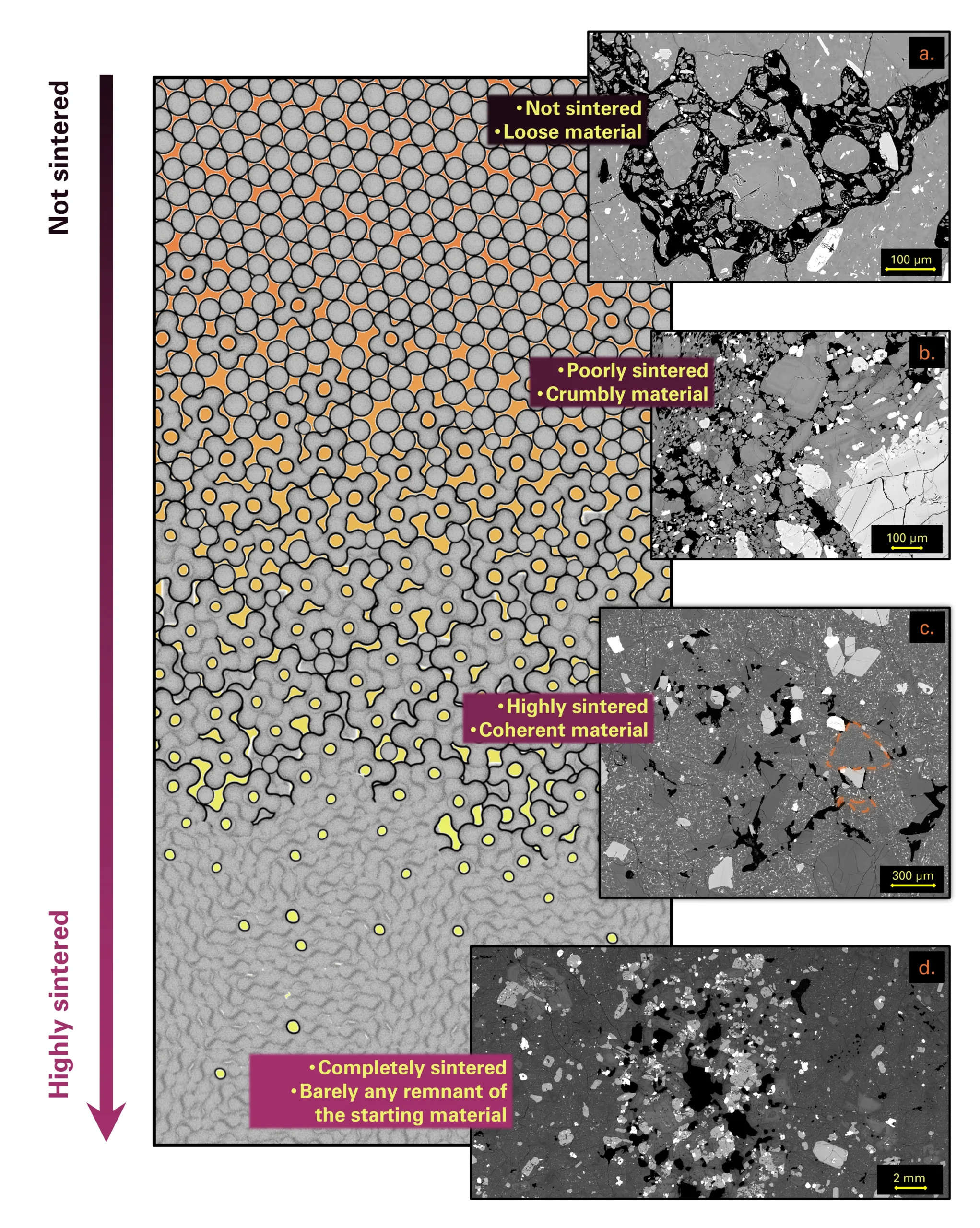
The sintering spectrum from non-sintered to extremely sintered material. The more rocks are sintered, the fewer relic textures are visible.
Why this matters more than it might first appear
If most dome rocks show explosive fingerprints, then the line we’ve drawn between effusive and explosive volcanism isn’t as sharp as we’ve assumed. It may be a much more gradual transition than a hard boundary, one that’s been easy to miss because sintering does such a thorough job of erasing its own history.
That has real consequences. Eruption forecasting, hazard models, and our physical understanding of conduit processes all currently rest, to some degree, on the assumption that effusive and explosive behaviour are driven by meaningfully different mechanisms. If a substantial share of what we call “effusive” dome-building is actually the surface expression of a cryptic explosive process happening just below our feet, that assumption needs revisiting and genuine re-examination, volcano by volcano, sample by sample.
Which is really the point of this piece. This isn’t a call to overturn everything we know about silicic volcanism overnight. It’s a call to go back and look again, carefully, and with the sintering spectrum in mind, at samples we may have filed away too quickly. If you have material sitting in a drawer from an old expedition, labelled confidently as an effusive product, it might be worth pulling it back out. Check the pores. Check the phenocrysts. Check the edges of the clasts. It may well turn out to be an explosive rock that simply learned, over time, to look effusive.
Which, as I said at the start, might be the most relatable thing a rock has ever done.
Further Reading:
The cryptic fragmentation and sintering paradigm:
- Wadsworth, F.B., Llewellin, E.W., Vasseur, J., Gardner, J.E., Tuffen, H., 2020. Explosive-effusive volcanic eruption transitions caused by sintering. Sci. Adv. 6, eaba7940. https://doi.org/10.1126/sciadv.aba7940
- Wadsworth, Fabian F. B., Llewellin, E.W., Castro, J.M., Tuffen, H., Schipper, C.I., Gardner, J.E., Vasseur, J., Foster, A., Damby, D.E., McIntosh, I.M., Boettcher, S., Unwin, H.E., Heap, M.J., Farquharson, J.I., Dingwell, D.B., Iacovino, K., Paisley, R., Jones, C., Whattam, J., 2022. A reappraisal of explosive–effusive silicic eruption dynamics: syn-eruptive assembly of lava from the products of cryptic fragmentation. Journal of Volcanology and Geothermal Research 432, 107672. https://doi.org/10.1016/j.jvolgeores.2022.107672
Sintering and Art:
- Wadsworth, F.B., Llewellin, E.W., Rennie, C., Watkinson, C., 2019. In Vulcan’s forge. Nature Geosci 12, 2–3. https://doi.org/10.1038/s41561-018-0283-5
- Wadsworth, Fabian Ben.B., Llewellin, E., Rennie, C., Watkinson, C., Mitchell, J., Vasseur, J., Mackie, A., Mackie, F., Carr, A., Schmiedel, T., Witcher, T., Soldati, A., Jackson, L., Foster, A., Hess, K.-U., Dingwell, D., Hand, R., 2022. Using obsidian in glass art practice. Volcanica 5, 183–207. https://doi.org/10.30909/vol.05.01.183207