Everyone wants something from Arrakis. The Emperor wants control, the great houses want spice, and the Fremen would quite reasonably like everyone else to leave. I would settle for a geological map. Preferably with a few cross-sections, although I realise that asking someone to carry a seismic survey across sandworm territory might complicate the risk assessment.
Frank Herbert’s Dune gives us a planet whose geology is impossible to ignore. Sand buries infrastructure, rock offers refuge, and water determines which futures are possible. Yet between the prophecies, political betrayals and very large worms, one question tends to disappear beneath the spectacle: where did all that sand come from?
It sounds less exciting than controlling the universe. Bear with me. Answering it takes us from mountain building to sediment transport, and eventually to the uncomfortable possibility that making Arrakis greener would dismantle the system everyone is fighting over. If this is not cooler than controlling the universe, I don’t know what im doing wrong.
Herald of the Change
Dune began among real dunes (is not a joke). In 1957, Frank Herbert visited coastal Oregon to investigate efforts to stop drifting sand by planting grasses. The article remained unfinished, but the idea grew: dunes were constantly changing, and controlling them could transform an entire ecosystem. Soon, Herbert imagined a planet where the desert itself drove the story. As Veronika Kratz’s study of his archival material explains, the connection runs through the practical science of controlling moving sand, not simply an admiration for desert scenery.
In Dune (1965), Arrakis is a harsh desert world whose spice, or melange, is essential to interstellar travel and imperial power. While rival factions fight to control it, the Fremen survive through their knowledge of an environment where water is worth more than gold.
The important observation was that dunes move, and that vegetation can change how they move. Herbert expanded that relationship into a world where organisms, water and landscape evolution are inseparable. To understand Arrakis, we therefore need to start with the ground beneath the characters’ feet (Ideally before it eats them).
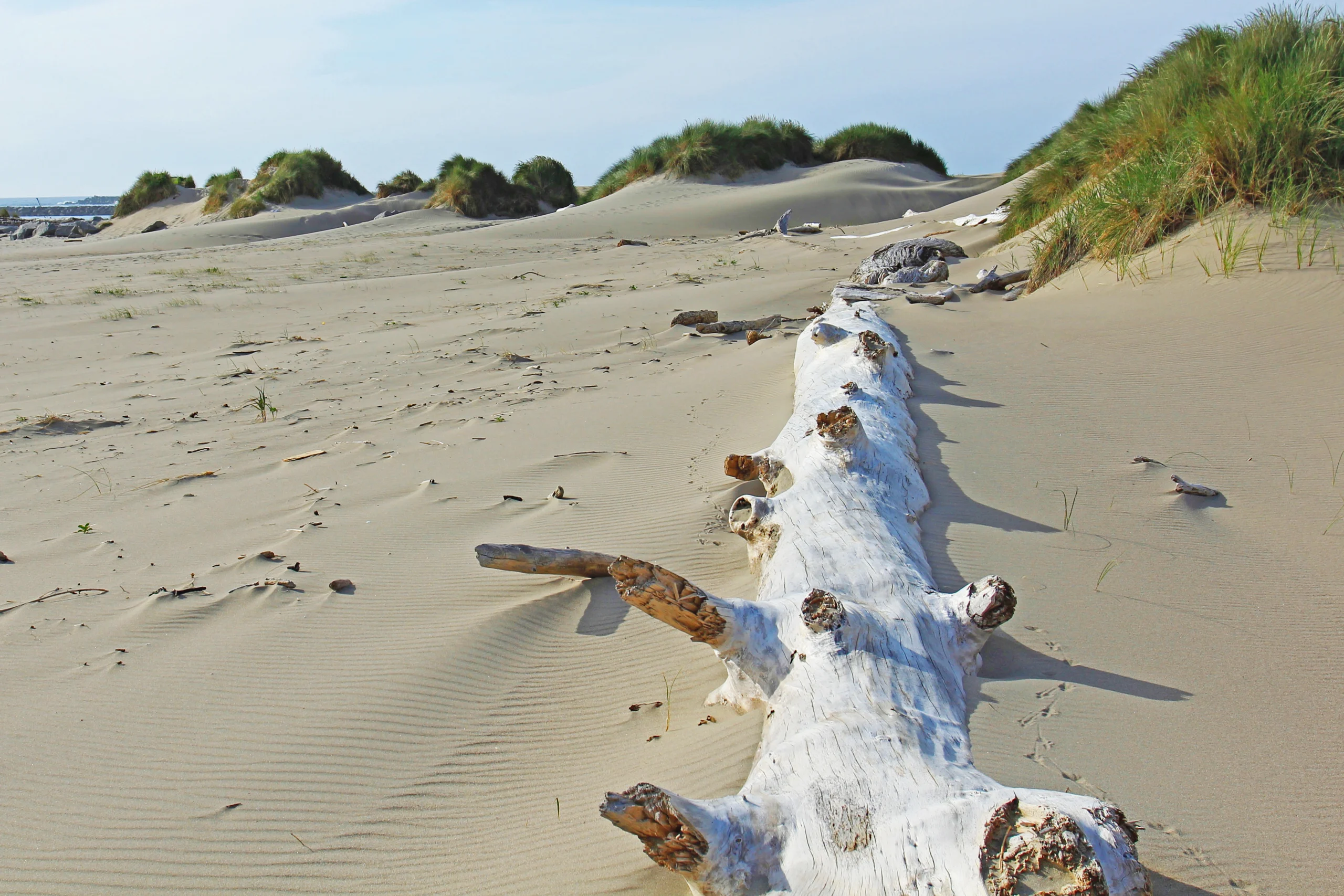
Dune from Lane, Oregon, United States. Here Frank Herbert got the inspiration for Dune (1957).
A time of quiet between the storms
First, a desert is defined by aridity, not by an obligation to look like a screensaver. Rocky plains, exposed mountains and salt flats belong there too. Herbert’s Arrakis has this variety: its sand seas sit alongside rocky uplands and the mountain barriers.
Those rocks matter because sand needs a source. Wind is very good at sorting and transporting loose grains; it does not conjure them into existence. Weathering breaks down rock, and erosion carries the resulting material away. On Earth, rivers, glaciers and waves commonly supply the sediment that wind subsequently reworks. Even in arid regions, occasional flows of water can accomplish substantial erosion and transport.
The landscape that inspired Herbert illustrates the connection beautifully. According to the US Forest Service’s account of the Oregon dunes, sediment derived from the Coast Range travelled through rivers and coastal processes before winds carried it inland. The dunes are one stage in a much longer geological journey.
For Arrakis, that suggests several possibilities. Its sands could include material eroded from exposed bedrock, recycled from older sedimentary rocks, or inherited from earlier, wetter environments. These are geological hypotheses, not an established reconstruction of Herbert’s planet. We would need mineralogy, sedimentary structures and ages to distinguish them. Apparently, prescience does not replace fieldwork.
The salt flats offer another tempting clue. On Earth, evaporite minerals precipitate as saline waters become concentrated by evaporation. If Arrakis’s salt flats formed similarly, they would record water moving through the landscape, perhaps in shallow basins or through groundwater evaporation. They would not, by themselves, prove that an ocean once covered the planet.
Yes, I have found a way to bring salt into Dune. You knew this was coming. I love salt. (Is this a good moment to ask for a salt tectonics post-doc? For Lisan al-Gaib)
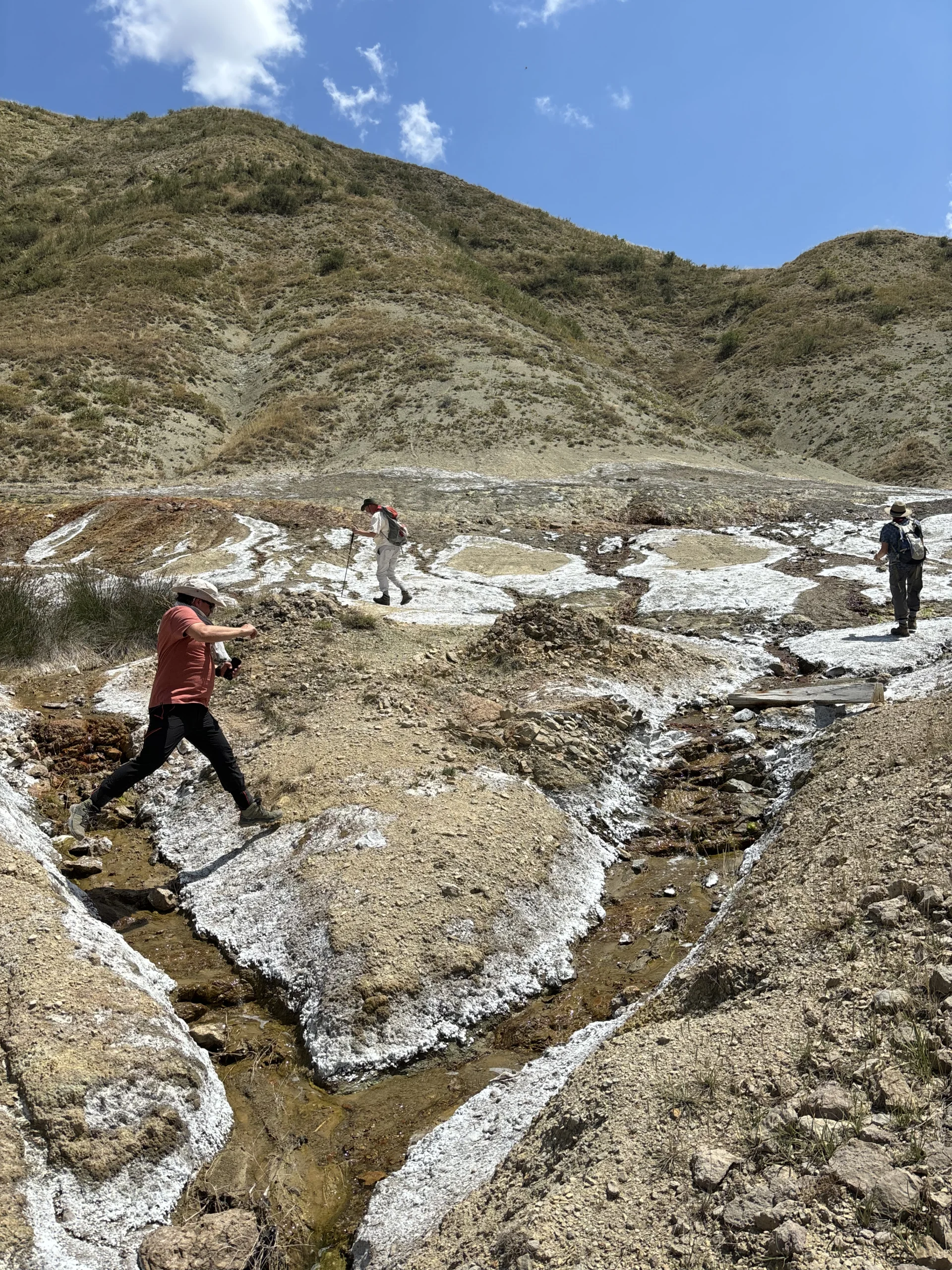
Salt crusts from a small stream in Sivas Türkiye. Photo by Manel Ramos (aka me, this was so cool! Newly form salt!).
Beginnings are such delicate times
Now look up from the sand. How did Arrakis acquire the relief that supplies sediment and shelters its settlements?
On Earth, tectonic deformation can raise mountain ranges and create adjacent basins where sediment accumulates. The geometry of faults, the resistance of different rocks and the history of uplift all influence what erosion can remove and where that material goes. The Mojave Desert provides a real example of these interactions: its landscape reflects tectonics, volcanism, weathering and changing climatic conditions acting together.
We can ask similar questions of the Arrakis mountains without confidently drawing a subduction zone beneath. Could its relief reflect faulting and uplift? Could resistant rocks have survived while surrounding material was stripped away? How much of the landscape is inherited from an earlier geological regime? A loot of questions, I know, but at this moment you should know that I’ve read/watch Dune unimaginable times, and I’m asking myself these questions.
A mountain barrier alone cannot tell us whether a planet has active plate tectonics. Nor does a dry surface establish that its interior is inactive. Herbert gives us enough to pose a geodynamic problem, but not enough to solve the mantle circulation (went too deep?). I would be suspicious of anyone claiming otherwise, even with very blue eyes.
What we can infer physically is that relief would influence surface processes. Mountain barriers redirect airflow, while low-lying areas can collect sediment. Uplift, erosion and deposition would therefore help determine where sand becomes available and where it accumulates, even if the detailed tectonic history remains unknown.
That gives Arrakis two overlapping histories: the construction and erosion of its rocky landscape, and the repeated rearrangement of the sediment draped across it. A dune crest can move while the bedrock beneath it preserves a much older story.
My road leads to the desert
A dune migrates because its grains travel through it. In a simple case with wind blowing predominantly from one direction, sand moves up the windward slope, accumulates near the crest and avalanches down the steeper slip face. Repeated often enough, this transfers the dune downwind.
Much of that transport occurs through saltation, the hopping motion of wind-blown grains. Their impacts dislodge other grains, while finer dust can remain suspended and travel farther. A sandstorm is therefore not a uniform airborne wall of identical particles, however convenient that might be for the visual-effects department.
Dune shape reflects wind direction, sediment supply and surface conditions. Change those conditions and you change the landscape. The desert is doing something measurable between dramatic appearances by Paul Atreides.
For a particularly satisfying example, we need a brief excursion to a galaxy far, far away… In a 2013 study, Ralph Lorenz and colleagues used satellite images and field observations to track a dune near the Star Wars I: The Phantom Menace set of Mos Espa in Tunisia. The buildings provided fixed reference points; the approaching dune moved at roughly 15 metres per year over the observation period.
The film set became a measuring instrument for its own potential burial. An excellent contribution to geomorphology, thanks George Lucas.
That rate cannot simply be transferred to Arrakis, where gravity, atmospheric conditions and sediment properties would need to be specified. But the principle carries over: settlements and transport routes occupy a surface that can reorganise around them. The Fremen’s attention to terrain makes geological sense, even before we add the worms.
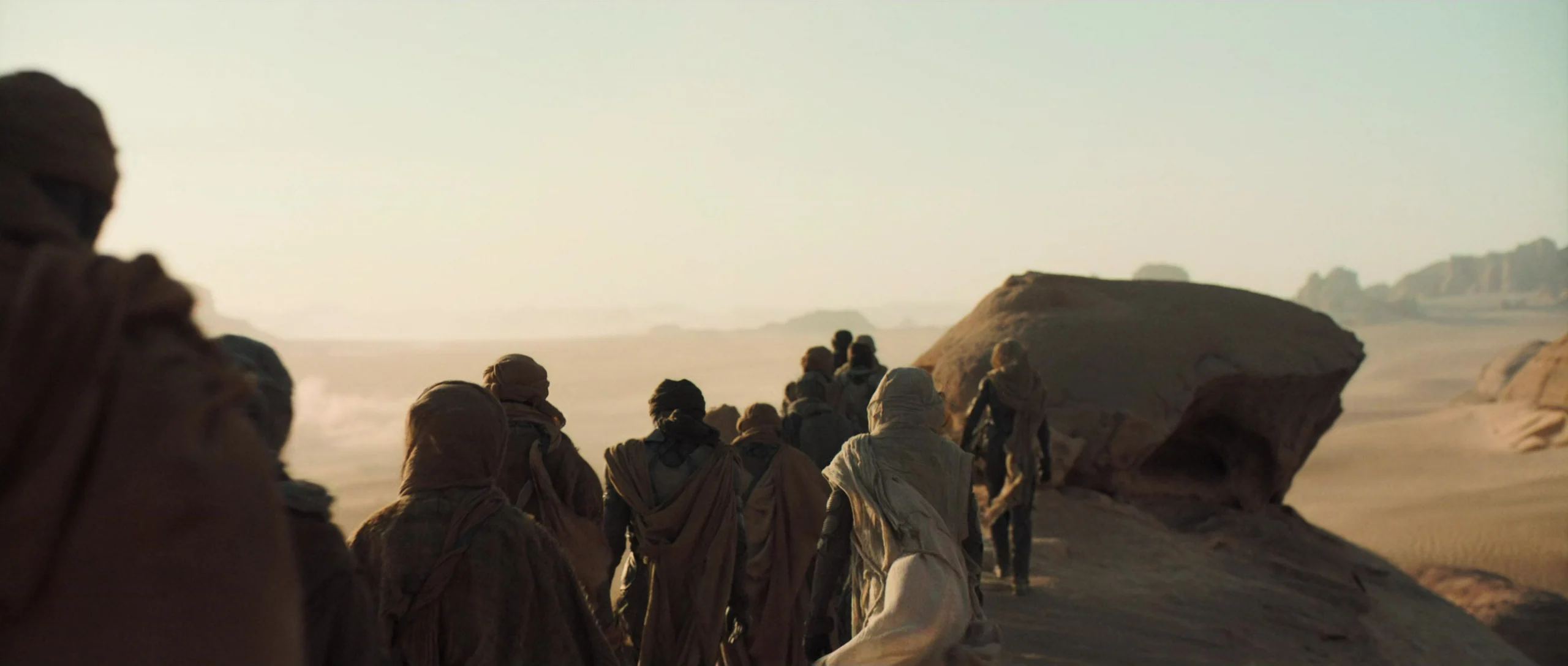
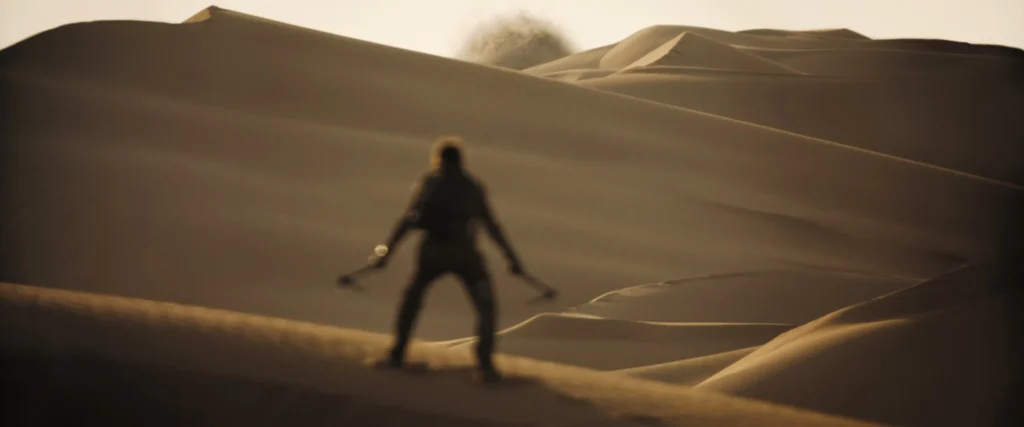
My road leads to the desert, final shot of Dune part one (2021).
Bless the Maker and His water. Bless the coming and going of Him. May His passage cleanse the world. May He keep the world for His people
Here Herbert introduces his most consequential fictional mechanism. In Dune, particularly Appendix I, “The Ecology of Dune”, the sandtrout stage (the baby) of the sandworm (Shai-Hulud) life cycle locks away water, helping maintain the dry conditions required by adult sandworms. The worms and spice belong to this interconnected system.
The distinction matters: water is sequestered, not simply erased from existence. Within the fiction, organisms help maintain the environment on which their own life cycle depends. The exact biology is invented, but the broader idea of life modifying its physical surroundings is entirely familiar.
The Fremen’s ambition to transform Arrakis therefore raises a geological question as well as an ecological one. What happens to sediment transport when you change water availability and vegetation cover?
We can explore part of that question on Earth. Plants can trap moving grains and stabilise dunes, altering where sand is deposited and which habitats persist. In Oregon, introduced European beachgrasses have stabilised foredunes and restricted the movement of sand inland, changing the naturally mobile landscape and its native communities.
We have arrived back at Herbert’s starting point, with a complication. Stabilising sand may protect infrastructure, but it can also remove the conditions that specialised organisms need. A greener dune is not automatically a healthier dune.
On Arrakis, the stakes are fictional and much larger. Widespread wetting would threaten the worms and the spice cycle. The Fremen’s desire for a more habitable world collides with an imperial economy dependent on the existing desert. Who gets to decide which landscape should survive, and whose needs count in that decision?
None of this means that the Fremen should accept deprivation to keep the spice market happy. The spice must flow. It means that transforming a planet involves consequences extending well beyond the first successful garden.
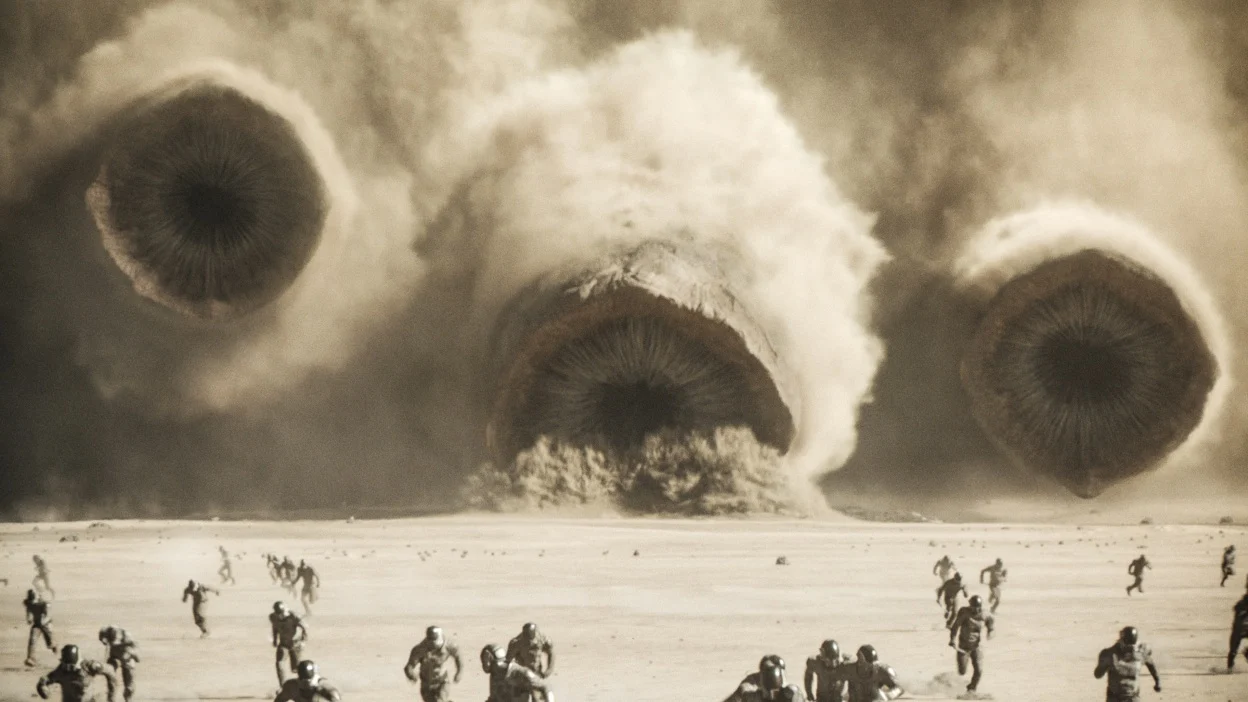
Sandworms wishing a good morning to the Harkonens. From Dune part two (2024).
Fear is the mind-killer
The geological appeal of Dune lies in those connections. Mountains supply sediment, winds redistribute it, and organisms change the conditions under which it moves. Human ambitions enter a system that already has a history, rather than an empty surface waiting for improvement.
Herbert began with people trying to stop moving dunes. His fictional world asks what happens when that ambition expands to an entire planet, and when the people promising a better future depend on processes they may not fully understand.
I would still like that geological map. Before deciding how to transform Arrakis, someone should establish what lies beneath the sand, where its water is stored, and which parts of the landscape are still changing.
By now, you might be wondering: “So, what are you trying to tell us?” Fair question. Part of the answer is simple: I love Dune.
It remains one of my favourite fictional universes, on the page and on screen. The way it connects geology, ecology, politics and power makes its world feel extraordinary and, sometimes, uncomfortably familiar.
Yes, I bought the LEGO set. Yes, I read the books. Yes, I have five tickets booked for the opening week of the third film. Five. The headings in this post are quotes and tracks of the Hans Zimmer soundtrack from Dune, and I have a tattoo of a Muad’Dib riding Shai-Hulud on my arm. I even wrote a chapter about Dune for a book in Catalan (which you can check out here). It’s actually my birthday today, and as a gift, I’m offering this grain of sand of my love for Dune and geology (feel free to wish me a happy birthday, or better yet, invite me to an IMAX premiere, flight included please). So, you get the idea.
But beyond giving me another excuse to geek out about sandworms, this post is an invitation to stay out there. The next time a book, a film or even a soundtrack transports you somewhere, pause and ask a few questions. How did those mountains form? Where has the water gone? How does the landscape shape the lives of the people who inhabit it? Why do the Great Houses put profit above the health and well-being of the people they rule? Why?
Fiction does not need to get every detail right to spark a good (scientific) question. And looking closely at an imaginary planet can make us more curious about our own. For me, that is part of the appeal of Dune: behind the sandworms and the spice is a world where the environment shapes everything, and changing it has consequences.
So, whether you came for the geology or stayed for the fan confession, I’ll leave you with my favourite quote from Dune. Read it as a closing thought for this post, or take it into your own life. That part is up to you:
I must not fear. Fear is the mind-killer. Fear is the little-death that brings total obliteration. I will face my fear. I will permit it to pass over me and through me. And when it has gone past I will turn the inner eye to see its path. Where the fear has gone there will be nothing. Only I will remain.
Ya Hya Chouhada!
Shot from Dune part two (2024). If you know you know.
Herbert, F. (1965). Dune. Chilton Books.

Kratz, V. (2023). Frank Herbert’s ecology, Oregon’s dunes, and the postwar science of desert reclamation. ISLE: Interdisciplinary Studies in Literature and Environment, 30(3), 637-656. https://doi.org/10.1093/isle/isab026

Lorenz, R. D., Gasmi, N., Radebaugh, J., Barnes, J. W., & Ori, G. G. (2013). Dunes on planet Tatooine: Observation of barchan migration at the Star Wars film set in Tunisia. Geomorphology, 201, 264-271. https://doi.org/10.1016/j.geomorph.2013.06.026

National Park Service. (n.d.). Aeolian (dunes) landforms. https://www.nps.gov/subjects/geology/aeolian-landforms.htm

National Park Service. (n.d.). Arid and semi-arid region landforms. https://www.nps.gov/subjects/geology/arid-landforms.htm

Oregon Department of Fish and Wildlife. (n.d.). Coastal dunes. Oregon State Wildlife Action Plan. https://swap.oregon.gov/key-habitat/coastal-dunes/

Ramos, M. (2026). Fer una muntanya d’un gra de sorra: Dune i el poder del desert. In Espòiler! Ciència i ficció en els mons imaginaris. Rosa dels Vents.

Stoffer, P. W. (2004). Desert landforms and surface processes in the Mojave National Preserve and vicinity. U.S. Geological Survey Open-File Report 2004-1007. https://doi.org/10.3133/ofr20041007

U.S. Forest Service. (2025). Oregon Dunes National Recreation Area. Siuslaw National Forest. https://www.fs.usda.gov/r06/siuslaw/about-area/oregon-dunes-national-recreation-area

U.S. Geological Survey. (n.d.). Eolian processes. https://pubs.usgs.gov/gip/deserts/eolian/

U.S. Geological Survey. (n.d.). Mineral resources in deserts. https://pubs.usgs.gov/gip/deserts/minerals/

Yechieli, Y., & Wood, W. W. (2002). Hydrogeologic processes in saline systems: Playas, sabkhas, and saline lakes. Earth-Science Reviews, 58(3-4), 343-365. https://doi.org/10.1016/S0012-8252(02)00067-3