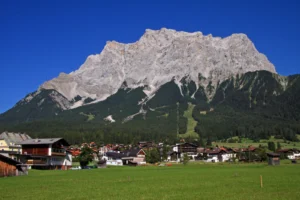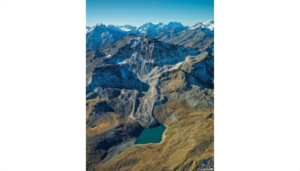
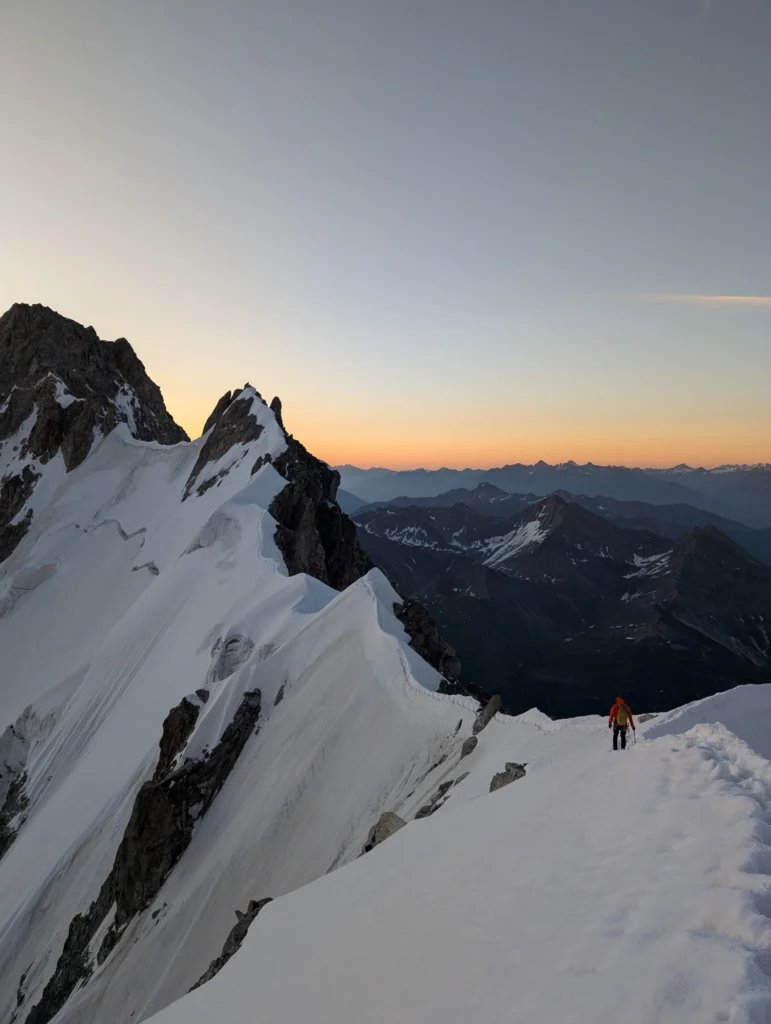
Climate warming is reshaping both glaciers and permafrost. Although historically studied as separate fields, the two are closely connected through features such as ice aprons. Ice aprons are thin, non-flowing ice patches attached to steep rock walls that often extend cirque glaciers to higher elevations (Fig. 1). We can think of ice aprons as icy barnacles clinging to the steep flanks of a mountain, insulating the rock underneath. Their existence highlights the presence of bedrock permafrost, which is maintained through the preservation of continuous, multi-annual sub-zero temperatures at the ice apron – bedrock interface. Yet, rising air temperatures drive ice apron degradation, and their loss enhances thermo-hydro-mechanical feedbacks in the rock slope. Apart from elevated rockfall activity, even larger rock slope failures may occur as a consequence of the loss of ice aprons.
Ice aprons keep our mountains rock-solid
What happens when ice aprons disappear? My co-authors and I set out to see how rocks could keep their balance when the ice that keeps them glued in place and shields them from summer heat melts away. To find out, we reconstructed the 2024 rock slope failure at the Platteikogel, a permafrost-affected rock slope in the Austrian Alps, and investigated the feedback processes triggered by the loss of ice aprons (located at 46°52’14.2″N 10°50’46.2″E, above the Kleiner Vernagtferner in the Öztal Alps, Tyrol, Austria, Fig. 2).
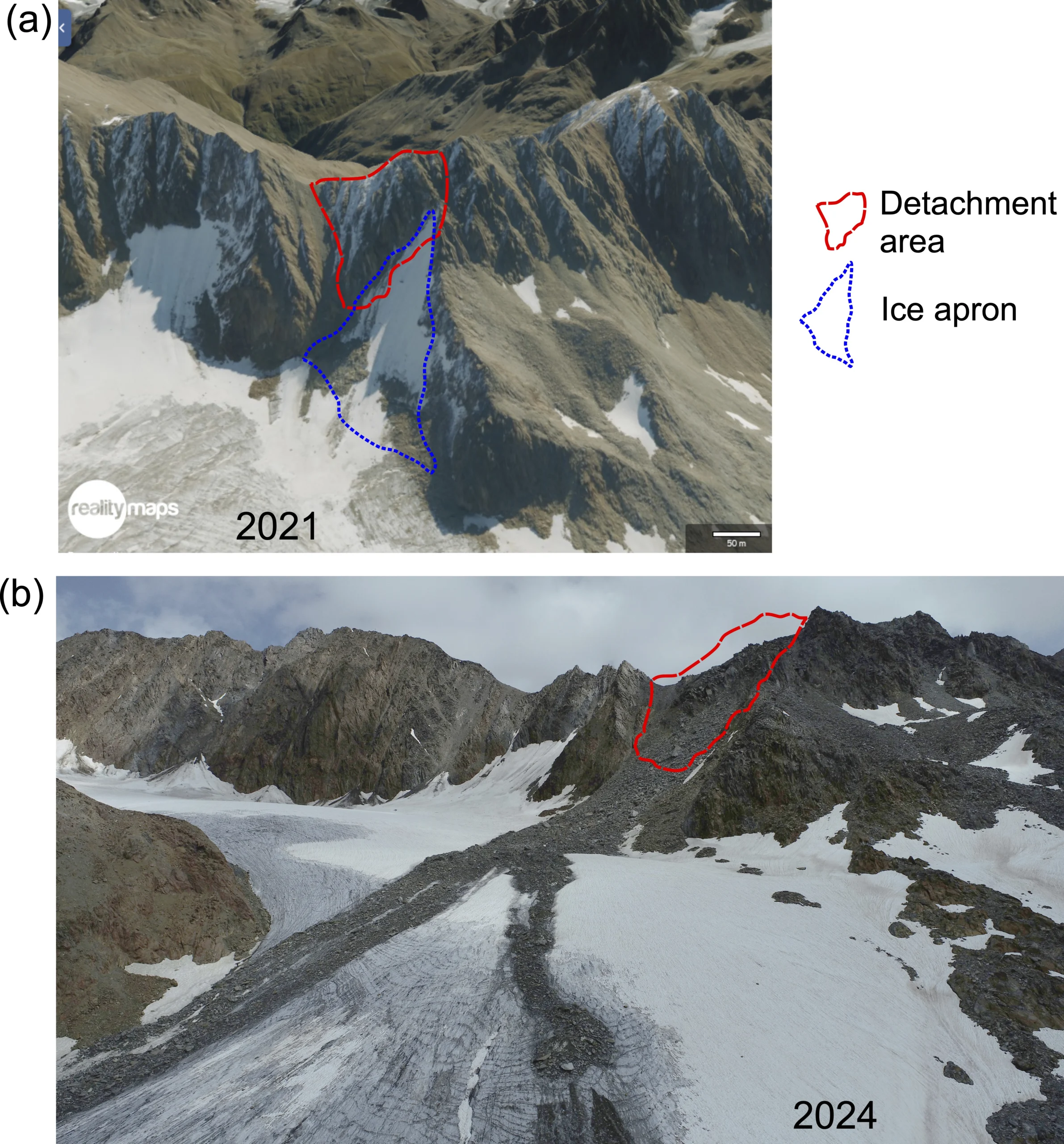
Figure 2. (a) Pre-failure rock slope state and ice apron on the NW mountain flank of the Platteikogel in 2021. Source is the interative webmap: AlpSenseRely – RealityMaps. Note that rockfall deposits cover the lower area of the delineated ice apron. (b) Failed rock slope with deposits on the glacier of the Kleiner Vernagtferner underneath in 2024. Photograph taken on 24 July 2024, 1:01 PM (Felix Pfluger).
Vanishing ice aprons affect how bedrock permafrost, water flow paths, and rockfall activity interact with one another:
(i) Ice apron loss intensifies permafrost warming. Ice aprons act as thermal semi-conductors, transferring winter cold into bedrock while buffering summer warming by maintaining temperatures at the ice–rock interface below 0°C. Their loss exposes dark rock surfaces (low albedo) to radiative heating and sensible atmospheric warming, and thereby accelerates permafrost degradation (Fig. 3).
(ii) Ice apron loss alters hydrogeologic conditions. Ice aprons form impermeable, frozen seals on rock surfaces, restricting both water infiltration and drainage. Their loss facilitates surface water infiltration into the bedrock, and while drainage remains limited in frozen zones, this potentially generates transient hydrostatic pressure and thereby destabilizes the rock slopes. (iii) Ice apron loss promotes rockfalls. Through intensified near-surface bedrock temperature gradients, weathering processes like ice segregation are enhanced, thereby promoting rockfall release. The transition from ice to ice-free rock surfaces is evidently marked by an increase in rockfall activity observed.
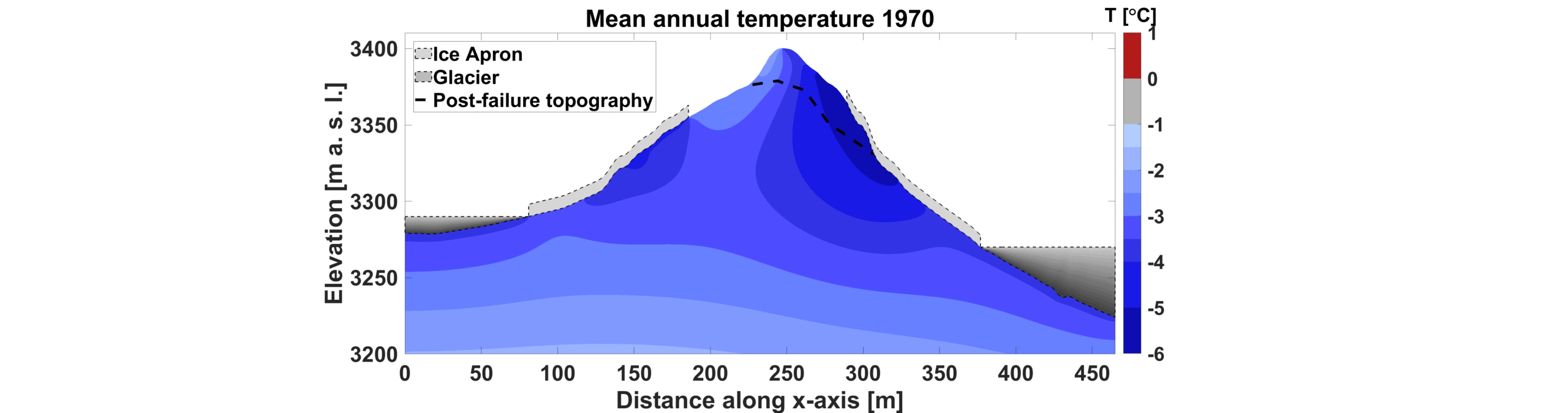
Figure 3. Conductive heat transport simulation of the Platteikogel, 3400 m a.s.l., Austrian Alps – 2D profile. Rising air temperature and top-downwards retreat of ice aprons show intensified bedrock temperature warming from 1970 to 2023. Note that on the southern aspects, ice aprons retreated faster, and warming was more pronounced subsequently due to radiative warming of rock surfaces (credit: Pfluger et al., 2026).
Without ice aprons, previously stable rock slopes are more likely to fail
These processes collectively reduce rock slope stability by weakening resisting forces and enhancing driving forces. The 2024 Platteikogel rock slope failure demonstrates how observed ice apron loss contributes to the preparation of a larger, sudden failure (50,000 m³, equivalent to 20 Olympic swimming pools). Warming of bedrock permafrost reduced the shear strength of ice-filled fractures, weakening the overall stability of the rock slope. At the same time, the observed rockfall activity (multiple smaller events) altered stress conditions and slope geometry, contributing to the eventual larger rock slope failure. In addition, infiltrating surface water might have built up transient pressure within the rock mass, further destabilizing the slope. Our mechanical modeling study, incorporating the aforementioned effects, suggests distinct slope responses to elevated, transient water pressure, smaller rockfall releases, and thermal warming – magnitudes in decreasing order (Fig. 4). While single factors may be capable of destabilizing rock slopes, their superposition clearly demonstrates an elevated impact in failure preparation.
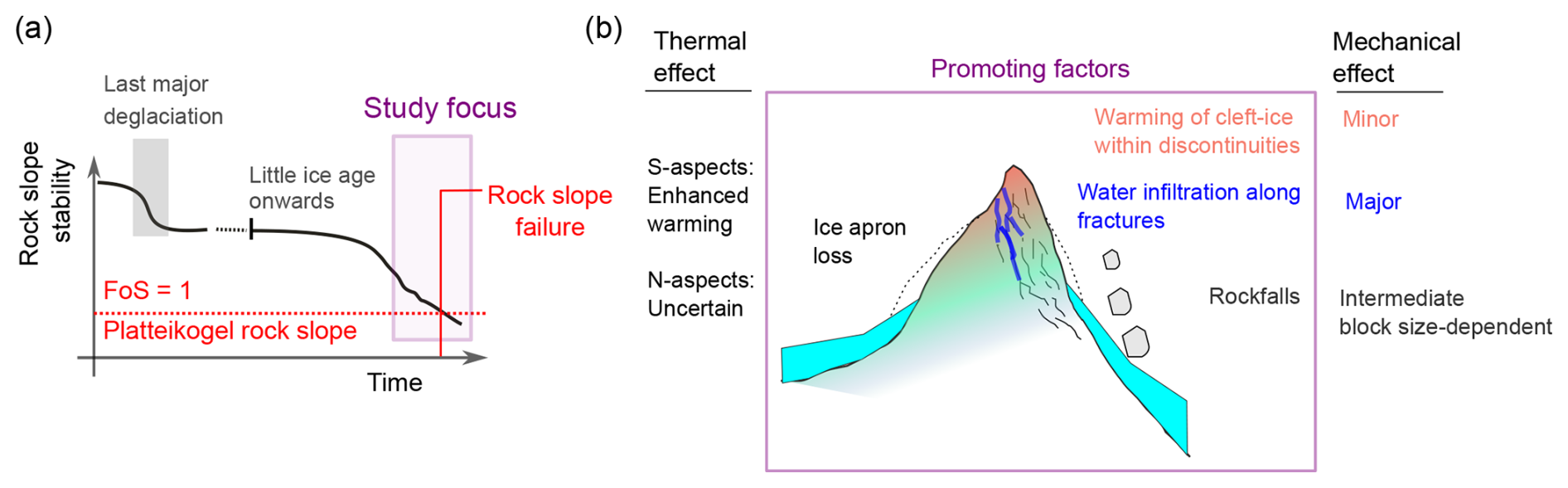
Figure 4. (a) Conceptual model of rock slope stability. Ice apron loss poses a negative, non-linear effect on rock slope stability. FoS is the factor of safety, which is the ratio of resisting to driving forces. Rock slope failure occurs when FoS is less than 1. (b) Sketch showing the findings of the mechanical simulations as demonstrated for the case of the Platteikogel rock slope failure. S- and N-aspects refer to slope orientation and its influence on radiative heating of rock surfaces (credit: Pfluger et al., 2026).
In the coming decades, ice aprons on steep rock slopes above 3000 m in the European Alps are expected to undergo substantial area loss, exposing potential source zones for future rock slope failures.
Given the considerable challenge of anticipating the location of cryospheric hazards in vast and remote alpine terrain, today’s ice aprons delineate areas that are likely to become localized hotspots of future rockfall activity and possibly even large slope failures.
– Further reading
Pfluger, F., Weber, S., Barbosa, N., Hofmeister, F., Leinauer, J., Wegmann, P., and Krautblatter, M.: How ice apron loss and permafrost degradation promoted the Platteikogel rock slope failure: a thermo-mechanical reconstruction, Earth Surf. Dynam., 14, 601–634, https://doi.org/10.5194/esurf-14-601-2026, 2026.
References
Ravanel L, Guillet G, Kaushik S, et al. Ice aprons on steep high-alpine slopes: insights from the Mont-Blanc massif, Western Alps. Journal of Glaciology, 69 (277), 1275-1291, doi:10.1017/jog.2023.15, 2023.
Kaushik, S., Ravanel, L., Magnin, F., Yan, Y., Trouve, E., and Cusicanqui, D.: Effects of topographic and meteorological parameters on the surface area loss of ice aprons in the Mont Blanc massif (European Alps), The Cryosphere, 16, 4251–4271, https://doi.org/10.5194/tc-16-4251-2022, 2022.
Edited by Mirjam Paasch and Mack Baysinger