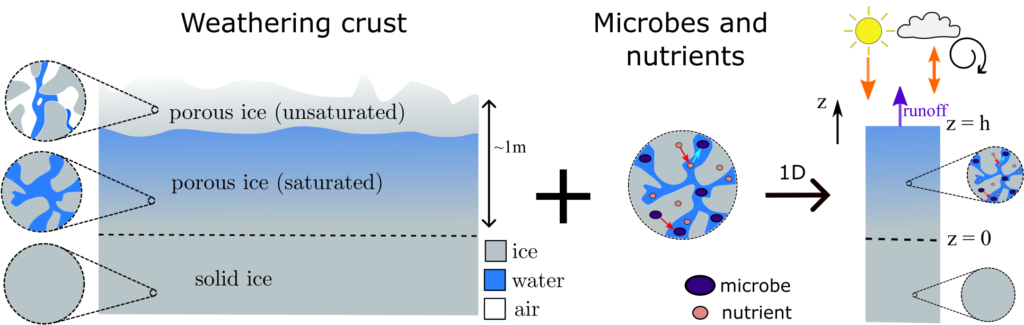
The weathering crust of ice sheets or glaciers is a layer of porous ice, bordering on impermeable ice below and influencing the meltwater storage and production. This physically complex environment harbors a wide range of microorganisms that themselves affect the weathering crust and contribute to darkening of ice surfaces. The two factors – microbial community and ice structure – and their respective impacts on the melting of ice sheets and glaciers are difficult to separate in field experiments which is why modeling of this environment is beneficial. A model is a simplified representation of a real-world system or process in mathematical terms, that allows scientists to test different scenarios.
I talked to Dr. Tilly Woods, a postdoc at Ludwig Maximilian University Munich, to understand the importance of simple models. Tilly teamed up with Prof. Ian Hewitt of Oxford University to develop a model of the weathering crust and microbial activity on ice sheets during her PhD, and I wanted to hear more about how she explored this landscape using the power of mathematics.
Why is it interesting and important to develop models like the weathering crust/microbial activity model even if they are very simple at this stage?
Tilly: I think the really cool thing about having models for fairly complicated physical/biological processes is that within a mathematical model you have the power to turn on and off different processes that you might not be able to in reality. That really helps identifying what the most important biological or physical processes are.
If you have a model that accounts for two different processes and you turn one of those off and you get results looking much the same, then that tells you that the process you turned off is not the one that is having such a big impact, as the process that you’ve left in. So these models are very cool from a process-understanding perspective. Models also give us the power to make projections about the future, for example looking at different climate scenarios, but also on smaller scales too.
We can play with lots of different versions of reality that you couldn’t do in the real world because you can’t change what the weather is, for example.
We can play with lots of different versions of reality that you couldn’t do in the real world because you can’t change what the weather is, for example.
So you can use models to find which factors are most important and which ones we should maybe focus on?
Tilly: Yes, and if you use relatively simple models to work out which factors are important and which aren’t, that can also help you inform what factors you can leave out and which ones you should definitely keep in more complicated, larger scale models. For example, smaller-scale models help find the factors that have to be included into a bigger ice sheet model of, say, the entire Antarctic ice sheet. Leaving parts out is really important if you want to have a model that you can actually run in a sensible time on a computer.
Can you explain the model that you developed?
Tilly: The model that we’ve got of the weathering crust is a combination of two parts: there is a thermodynamics aspect that describes the ice and the water and how the temperature of the ice evolves, with ice melting to water and water freezing to ice. As a result of all of this the thickness as well as the porosity of the weathering crust change. We can then solve the temperature of the ice below the weathering crust, the porosity of the ice in the weathering crust and the saturation, so how much of the pore space is filled up with water. Actually, in the version of the model that we combine with the microbes, we simplify things a bit and assume that the whole weathering crust is completely filled up with water, so the saturation is always 1. The thermodynamics part is driven by the surface energy balance, so the solar radiation, the turbulent heat fluxes and longwave radiation and that determines how much melting happens at the surface of the ice (e.g. glacier ice algae).. The crucial thing that we needed to include in the model is that some of the solar radiation can penetrate below the surface of the ice and provides an internal heat source hence subsurface melting that produces the porous weathering crust structure. So, we have melting at and below the surface, as well as freezing, happening in response to how the weather conditions change. We have a version of the model where the water can flow through the weathering crust but again when combining it with the microbes, we ignore that bit but that would be something cool to think about in the future.
The second part is the population dynamics model for the microbes and nutrients. We simplify the microbes and nutrients as much as we can. We have a single type of microbe that represents all microbes you might find and a single type of nutrient that represents all nutrients or maybe the limiting nutrient. We model these microbes and nutrients as floating around the water in the weathering crust. We don’t account for any that are stuck to the surface of the ice (. The microbes grow in response to there being nutrients and water and in response to the shortwave radiation penetrating below the surface of the ice, so that is another reason why we need this subsurface shortwave radiation. When they have these three things, then the microbial abundance increases. There is some sort of background concentration for microbes and nutrients stored within the ice, representing what is frozen in from last year for example. When the ice melts then those microbes and nutrients get released into the water, so that is a source of microbes and nutrients. Similarly, when the water freezes, they get frozen back in.
We stick these things together: the evolution of the microbes and nutrients coupled to the evolution to the ice and water. In particular we allow the absorption of radiation and the albedo to depend on how many microbes there are. We could also make it depend on nutrients but haven’t done that in the examples so far. And then we can investigate some of the feedbacks that are associated with the microbes in the weathering crust. The model at the moment is completely one dimensional, we look at one column of the weathering crust, like an ice core. The solutions that we get out are the distribution of microbes with depth, and similarly for temperature and porosity.
Perhaps the most interesting result is that the structure of the weathering crust, as well as the amount of melt and runoff, depends on whether microbes are present in the system.
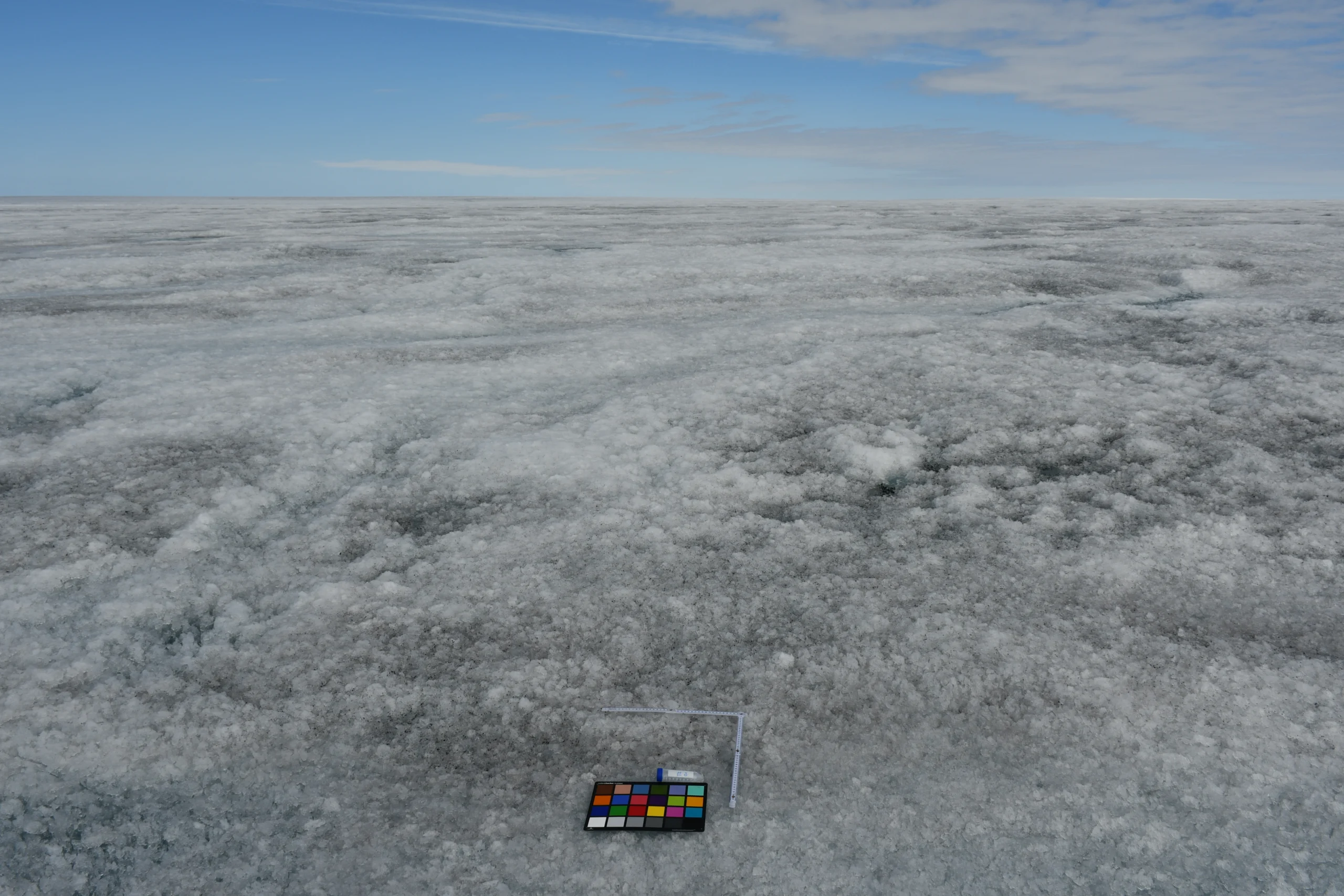
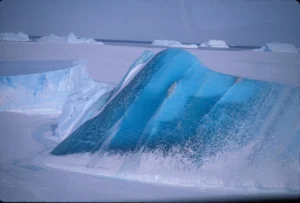
Fig 2a: The ice surface of the south-western Greenland Ice Sheet in August 2025. Sediments, microbes and meltwater lead to darkening of large areas of the ice. Picture Credit: Mirjam Paasch
Did you get feedback from microbiologists on this model and how it could be used after you published it?
Tilly: There was some feedback that we got about other processes that we could include as a next step in the biology that could perhaps make it more useful. But people seemed to be excited about that we could quantify to a certain extend what impact the microbes themselves might be having on the albedo in these places because it is very hard to distinguish how much of albedo change is due to the presence of meltwater or the weathering crust or the presence of the microbes themselves. We could just add in the microbes or completely remove them to see what the difference is in a way that is hard to do in reality.
There are various parameter values in the model that represent the microbial growth rate, the way in which microbes consume nutrients, for which we used values that are informed by bits of literature but still very vague. If you change them a bit you get quite different answers quantitatively, although qualitatively we still see the same things. To be as useful as the model could be you need better knowledge of what the numbers that go into the model are. That would hopefully be something that comes from the biologists.
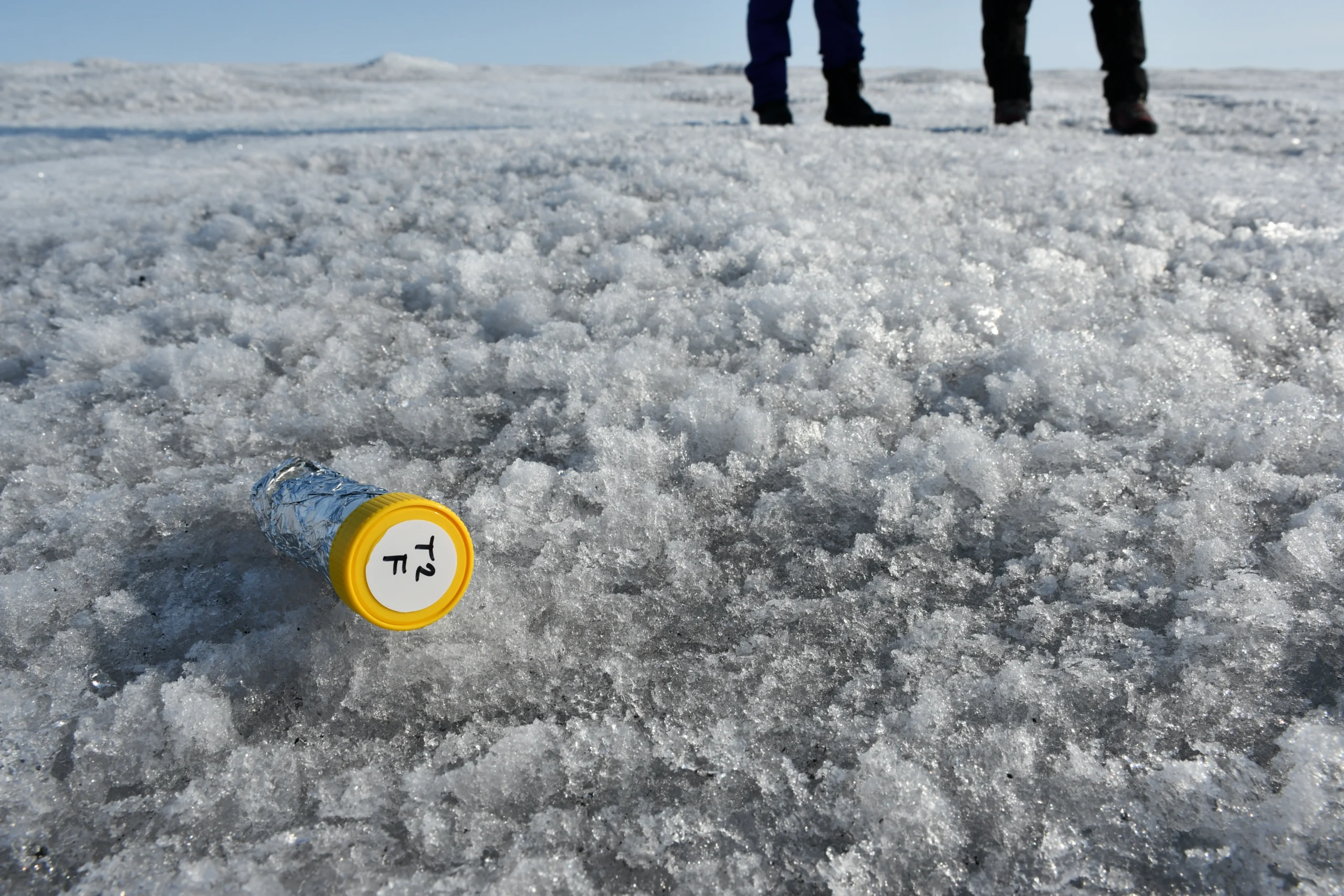
Fig 2b: The ice surface of the south-western Greenland Ice Sheet in August 2025. Sediments, microbes and meltwater lead to darkening of large areas of the ice. Picture Credit: Mirjam Paasch
What would be the next step in this model to develop it further?
Tilly: I think what would be cool to do, for the version of the model that we have with the microbes, is to connect it to meltwater flow. For now, we don’t get any transport of microbes across surfaces. We have a one-dimensional weathering crust model that does account for flow through the weathering crust but is still one dimensional, so you don’t get any sort of surface structure. And what the surface looks like is really important for the microbes in terms of what the albedo is and the transport of the microbes downstream of the glacier and so on. I would like to extend the model to horizontal spatial dimensions. That would be a bit difficult because if we include all the vertical info that we have at the moment and then also the horizontal and if we have the ice and the microbes that would make something that is computationally expensive to use. It would be cool to develop a simplified model that captures the key aspects of what is going on vertically and then integrate that out. We could have a model that has one or two dimensions over a surface to look at a distribution of microbes and weathering crust either along a single line from the terminus up glacier or looking at a whole 2D surface but ignoring all the fine details of what is going on in the vertical but informed by our current 1D model so we can capture the key aspects.
What is your advice for chemists or biologists when working with modelers? How can we communicate in a way that is useful for both sides?
Tilly: I’d say the key thing from both parts is to listen to what the other side has to say. In my experience the modeler always wants to make things as simple as possible and my experience from talking to biologists is that things aren’t that simple and there are lots of complicated processes going on. And looking into all the details of these complicated processes is the interesting and exciting thing from a biology side. It is important to appreciate that not all processes can go into a model because that is really hard and then creates a model that is difficult to use. So thinking about what the most important processes are and maybe having a wish list of what is the really, really most important thing and then the next important one, so the modeler can go along the list and put in or take out parts as need be. And as a team the main thing is to figure out what the question that we want to answer is and that makes it easier for both parties to figure out what the important parts from their side are. I think it’s great having conversations between people with very different backgrounds. I’m slowly getting a bit more aware of what goes on in the biology side of things and it seems very impressive to me!
This interview has been edited for length and clarity.
So does the modeling side for biologists! Thank you so much for your time and explanations Tilly! And all the best for your current and future projects!
- Read the paper featured in this blog post here: Woods, T. and Hewitt, I.J.: A model of the weathering crust and microbial activity on an ice-sheet surface (2023)
- More detail is provided in Tilly’s thesis: Woods, T.: Mathematical modelling of ice-sheet surface melt [PhD Thesis] (2024)