
It took almost two years to write this blog post – not because the challenges described below are rare, but because the scarcest resource for parents in academia is uninterrupted time. Academic careers are built on time: time to think, to meet collaborators, to develop the next research proposal, and to finally get that paper across the finish line. Parenthood demands that same resource: time to navigate sick days, daycare drop-offs and pick-ups (if you’re fortunate enough to have childcare), and simply to be present when your children need you.
With family and career competing for the same resource (time!), it is well established that parenthood can shape academic careers, often with disproportionate impacts on women (Zheng et al., 2022). Although awareness of these challenges is growing, meaningful change is still needed. In geosciences, extended field campaigns and frequent conference travel create additional hurdles for parents. Here, we share first-hand experiences from biogeoscientists navigating research, fieldwork, and parenthood, highlighting the structural barriers we encounter. We also reflect on where change is needed and how both institutions as well as individuals can help make academia more inclusive, one step at a time.
The Motherhood Penalty in Academia (Marie Arnaud)
I feel privileged to live in a country where we have maternity and parental leave. On top of that, we are entitled by law to work one hour less per day when we are pregnant or when pumping milk at work. I have decided to fully embrace motherhood (working part-time, breastfeeding, and pumping for as long as I want). At the same time, I find great fulfilment as a scientist working on blue carbon ecosystems. Yet, I realized I was anxious about not being productive enough and felt that I had less time than before. Yes, it was my choice to embrace motherhood and reduce my working hours, but this was also legally permitted. Why did I feel anxious? After thinking about it a lot, I realized that the time I was allowed to take for my child was rarely or only vaguely considered in assessments of my work and that will penalise my career.
Assessors for promotions, prizes, and funding mostly lack clear guidelines and only vaguely take maternity or parental leave into account. Even legally mandated accommodations, such as reduced hours during pregnancy or time for pumping milk, are often simply ignored. You can mention these circumstances, but there are no clear guidelines on how they should be considered. So, the “choice” comes with a professional cost.
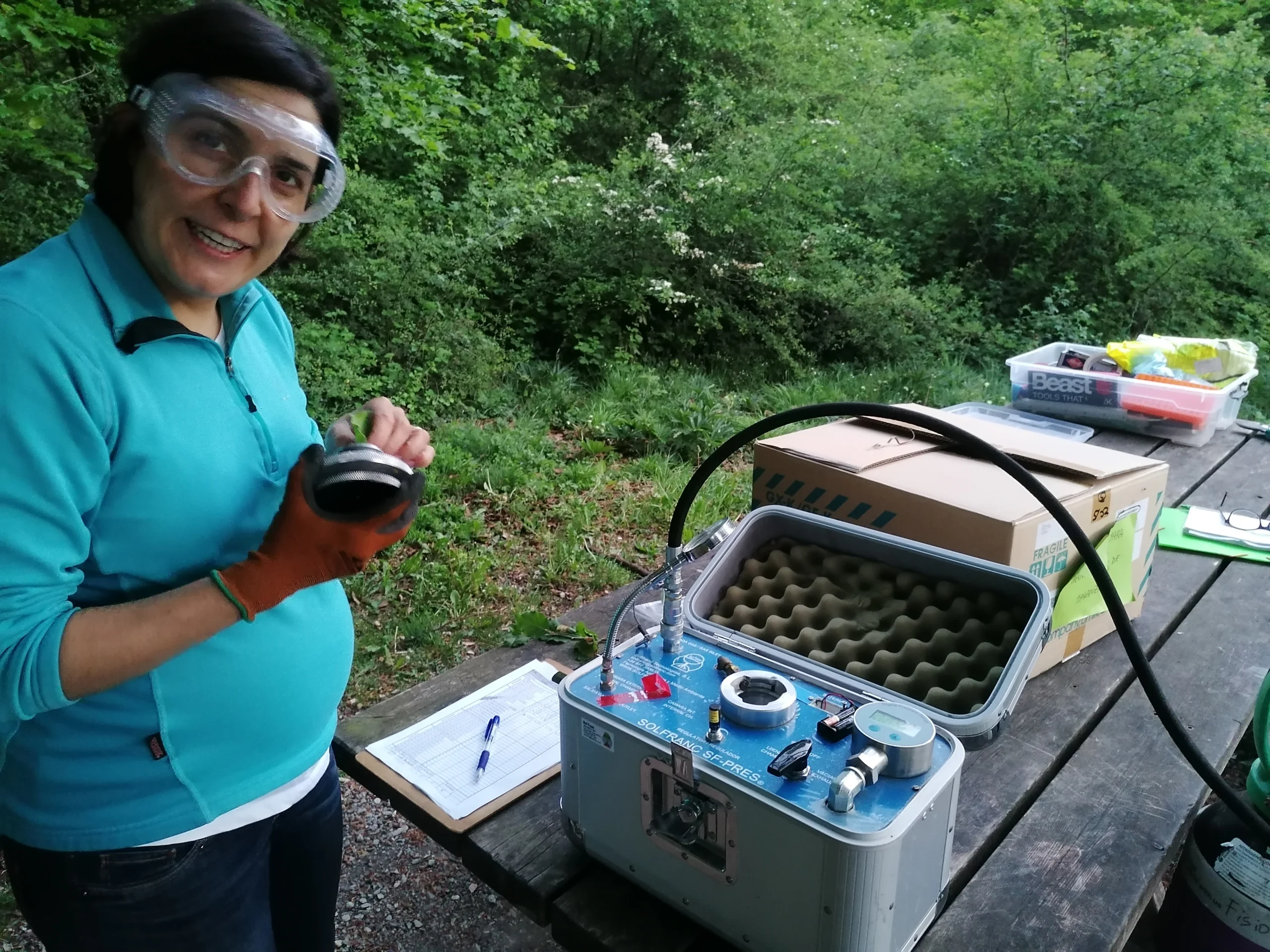
Teresa E. Gimeno conducting plant ecophysiological measurements in the field during her pregnancy.
How parenthood is perceived by colleagues (Christoph Keuschnig)
Parenthood and academic careers are not supposed to conflict. In practice, for many researchers, they still do. My partner and I were both finishing our PhDs when our child was born. It was the right decision, and even if the timing looked chaotic from the outside, we chose it consciously. What we hadn’t anticipated were the structural and cultural obstacles that would follow.
When I imagined becoming a father, one thing felt non-negotiable: I would take paternity leave. What I didn’t know was that this right is not a given across Europe. The policies vary enormously, and in several countries it simply doesn’t exist in any meaningful form. In the end, my supervisors were wonderful, and we found a workaround. But I was lucky, and luck is a poor substitute for policy.
Another thing that caught me off guard was the reactions of colleagues. There was a quiet expectation that as a father, work would always come first, and when it didn’t, that raised eyebrows. And yet when mothers had to step back from research or left academia for unpaid care work, that was met with quiet acceptance. I expected that in academia, a world built on questioning assumptions, this particular assumption would have been challenged more thoroughly. It hasn’t been. So I try not to let things pass. When a colleague makes an offhand remark about a postdoc “losing focus” after having a child, I say something. Norms shift one conversation at a time. And where direct peer conversation feels insufficient, bringing the issue to supervisors or senior researchers can be a deliberate strategy, one that turns academia’s hierarchical structures into a lever for change, rather than a barrier to it.
Parenting and field work: the weather is not the only driver of field campaigns anymore (Teresa E. Gimeno)
Data collection in the field has been and still is a fundamental task for advancing our field, biogeosciences. In my case, that involves organising campaigns when plants are active, that is, when it is not cold, but also not too hot, or too wet, or too dry. On top of that, I have to coordinate with teammates and adapt to the availability of technical resources, but the weather used to be what drove it all. That was until I was pregnant. Earlier in my career, I had worked with colleagues who were pregnant or had young children. Back then, I took for granted that those colleagues needed more time and space, and it was up to the rest of us to do the heavy lifting (literally). Why, then, when it was my turn, was I not capable of letting others do the hard work? Instead, I found myself doing measurements before dawn, ca. six months pregnant, hiking to locate new field sites while enduring nausea and later, pumping milk in the back of a dirty van surrounded by samples. Looking back, I realise that I only did all this because I was terrified of being judged or looking “weak”. I am still not sure where that fear comes from, but I know that it should not be like that. Balancing fieldwork with caring for children is not easy. More flexibility when it comes to booking accommodation and transportation to allow researchers to bring their children and an accompanying person would be helpful. Regarding fieldwork during pregnancy, the support of our HR departments, through efficient and discreet communication and occupational health and safety (OH&S) protocols that explicitly incorporate the risks associated with fieldwork during pregnancy, would be helpful to allow pregnant women to step back without feeling judged or being left behind.
… want to hear more examples about how children support fieldwork or experiences on attending conferences with young children? Stay tuned for part II of this series.
This article was written by Sinikka Lennartz, Teresa Gimeno, Marie Arnaud, Christoph Keuschnig, Robyn Pickering and Lisa Wingate. It was edited by Pedro Brito and Franziska Lechleitner.
Publications cited:
Zheng X., Yuan H., and Ni C. (2022) How parenthood contributes to gender gaps in academia. Elife 11, e78909, https://doi.org/10.7554/eLife.78909.