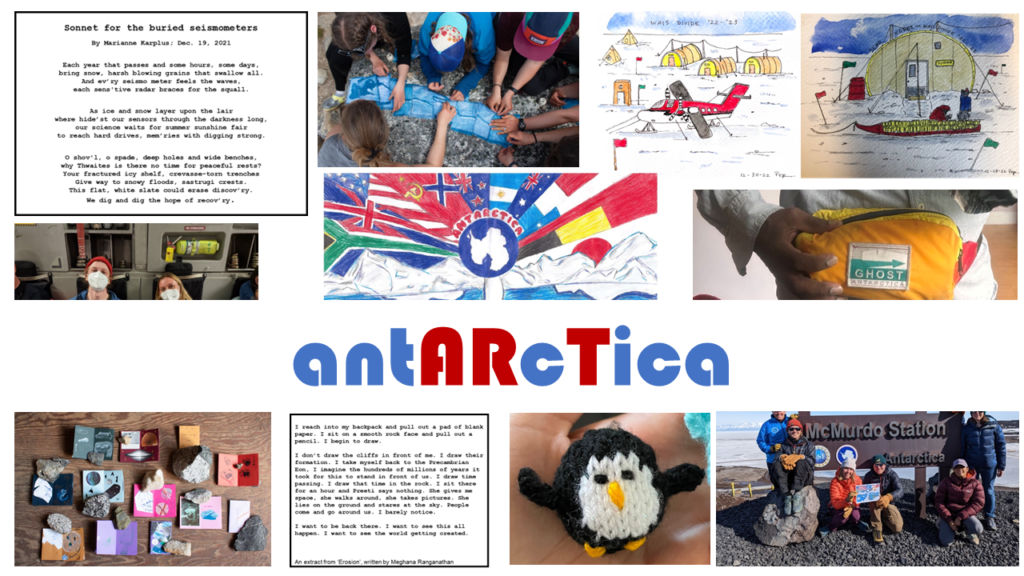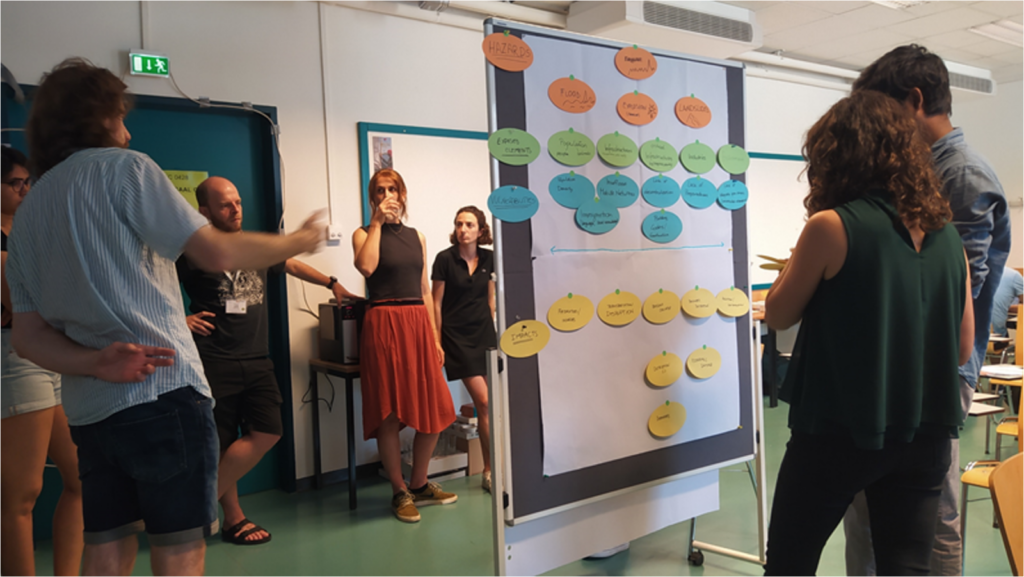
The European Geosciences Union (EGU) is a multidisciplinary organization, encompassing various fields within the geosciences. Each field is represented by its own Division, within which a number of volunteer roles exist. These roles include the President and Deputy President, a Programme Group Chair, Science Officers, Early Career Scientist Representatives, and an Outreach Team. Every year …[Read More]
Latest posts
Natural Hazards
When ten years of research come to an end – The final Panta Rhei Symposium
On the 10th and 11th of July 2023, the final symposium for the scientific decade, “Panta Rhei – Everything Flows: Change in Hydrology and Society” of the International Association of Hydrological Sciences (IAHS), took place at the German Research Centre for Geosciences (GFZ) in Potsdam. During these two days, 150 hydrologists, engineers, social scientists and …[Read More]
Geomorphology
A Day in the Life – Rachel Oien
This blog post is part of our series: “A day in the life of a geomorphologist” for which we’re accepting contributions! Please contact one of the GM blog editors, Emily or Emma, if you’d like to contribute on this topic, or others. by Rachel P. Oien, Glacial Geomorphologist, Postdoctoral Fellow, University at Buffalo, NY (Remotely …[Read More]
GeoLog
Far over the Misty Mountains cold, to dungeons deep and caverns old: the geology of the Lord of the Rings.
“He loved mountains, or he had loved the thought of them marching on the edge of stories brought from far away; but now he was borne down by the insupportable weight of Middle-earth.” J.R.R. Tolkien (1955) Return of the King ‘The Lord of the Rings‘ by J.R.R. Tolkien is one of the most famous english-language …[Read More]
Cryospheric Sciences
Did you know… about worms surviving in permafrost for at least 46000 years?
Lately permafrost makes the news more and more because of its enormous carbon stocks and its vulnerability to climate change. While permafrost greenhouse gas budget calculations are complex and harbour an ever-growing research community, its microbial ecology is still on the rise. A recent star are tiny roundworms that survived frozen in permafrost for 46’000 …[Read More]
Geodynamics
The Sassy Scientist – Thesis SOS: AI or just more pepperoni?
Are you sitting there, staring at your screen, miraculously waiting for your thesis to write itself? Ever wondered if AI could be your ultimate wingman **sorry, I meant wingbot** when tackling that master’s or Ph.D. thesis? Well, it must be your lucky day because Eric is asking Could AI actually help me write my master’s/ …[Read More]
GeoLog
GeoRoundup: the highlights of EGU Journals published during September!
Each month we feature specific Divisions of EGU and during the monthly GeoRoundup we put the journals that publish science from those Divisions at the top of the Highlights roundup. For September, the Divisions we are featuring are: Climate: Past, Present & Future (CL), Earth and Space Science Informatics (ESSI) and Hydrological Sciences (HS). They …[Read More]
Stratigraphy, Sedimentology and Palaeontology
Survivors! Resilience and adaptations of freshwater ostracodes in ancient Lakes Petén Itzá (northern Guatemala) and Chalco (central Mexico) to climate and environmental changes over the last 80,000 years
The North American Tropics hosts lakes of diverse origins and limnological characteristics, which are located along a broad altitudinal gradient, from 0 to 5675 masl. The region possesses several ancient lakes that have accumulated sediments continuously, in some cases for >400,000 years. Study of those lake deposits has enabled scientists to infer past climate …[Read More]
Nonlinear Processes in Geosciences
Nonlinear Processes in Earth System Dynamics
Earth System Dynamics (ESD) is an open-access EGU journal focussing on an interdisciplinary view of the functioning of the Earth system and global change. Due its broad focus, ESD receives submissions of relevance to several different EGU divisions. Here, I would like to highlight five thought-provoking ESD papers that cover topics spanning environmental governance, extreme …[Read More]
Geodynamics
Dual inward dipping subduction: A Christmas Cracker Model
A recent research finds that dual inward dipping subduction framework, after considering thermal dependent deformation mechanisms, can pull apart the middle overriding plate (Lei and Davies, 2023), just like pulling Christmas crackers from both ends! Dual inward dipping subduction (DIDS) occurs when the overriding plate is decoupled with two subducting slabs dipping towards each other. …[Read More]