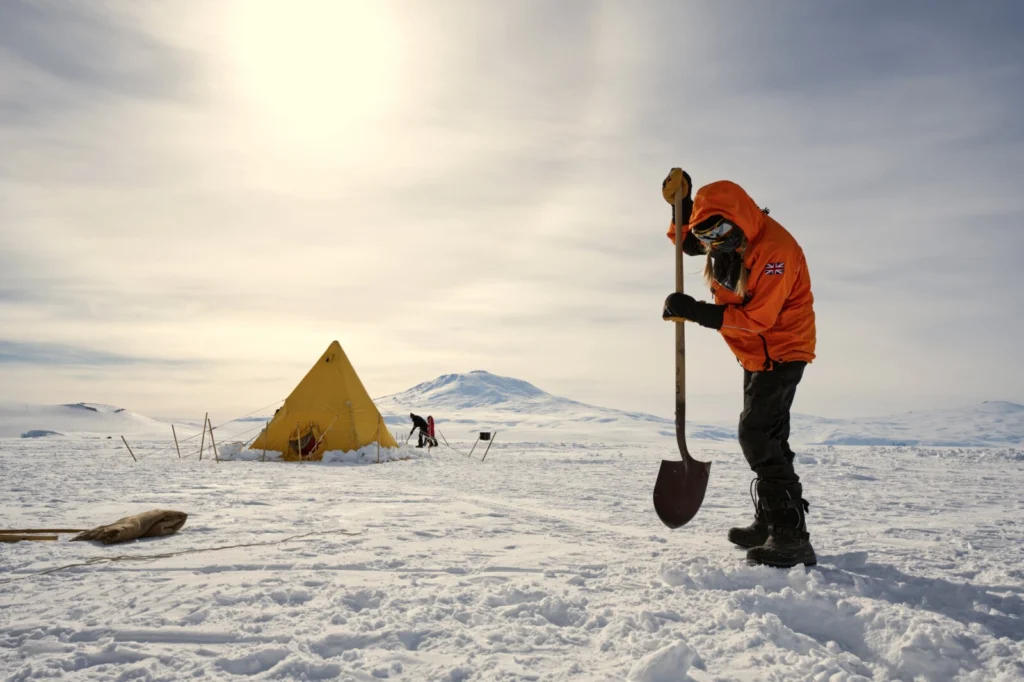
If you look at the maps in Figure 1, you will quickly see that sea ice is present in both polar regions (Arctic at the top, Antarctic at the bottom). Despite this apparent similarity, some differences exist between Arctic (in the Northern Hemisphere) and Antarctic (in the Southern Hemisphere) sea ice. We provide a brief explanation of two key differences in this post. Geography The first main diff ...[Read More]
If you didn't find what you was looking for try searching again.
Geodesy
EGU Campfire Geodesy – Share Your Research – Sixth Edition
We all welcome you around our sixth EGU Geodesy Campfire to listen to two exciting talks by Eva Börgens and Jesse Reusen. The Geodesy EGU Campfire Events “Share Your Research” give (early career) researchers the chance to talk about their work. Below you can find detailed descriptions about their talks. We will have time for networking after the presentations. Please join us on Zoom on Octo ...[Read More]
GeoLog
Glacial lake outburst floods: What we know about this destructive ice hazard
Glacial lake outburst floods are among the most concerning consequences of retreating glaciers in mountain ranges around the world. Although the phenomenon isn’t a new one, it has increasingly become the focus of research efforts in the last two decades, with many scientists seeing these floods as an emblematic symptom of climate change. This blog sheds some light on this lesser-known geological e ...[Read More]
Seismology
Seismology Job Portal
On this page, we regularly update open positions in Seismology for early career scientists. Do you have a job on offer? Contact us at ecs-sm@egu.eu Please, note that other available research positions are displayed on the EGU Jobs Portal. Latest open positions: Scientist – Passive Seismic Imaging Institute: GFZ Helmholtz Centre (Potsdam, Germany) Starting: — Duration: 2 Years De ...[Read More]
Geodynamics
The Sassy Scientist – Knowns Unknown
We have dealt with impostor syndrome before. Not only on this weekly column, but elsewhere in the EGU blog too. Time and time again early career researchers seem to think their peers are much smarter, promptly neglecting that everyone else has the same feelings. From the bottom of her early-career crisis, Shion asks: How do I convince myself that I know something (even if just a little bit) about ...[Read More]
GeoLog
GeoPolicy: Building stronger and more diverse communities at the science-policy interface
There are numerous reasons why we should want to build stronger and more diverse scientific communities. Greater inclusivity leads to innovation, expands the pool of ideas, broadens perspectives, and encourages more people to engage. Strong and diverse scientific communities allow us to go beyond the information we can produce on our own and scale our research outcomes. But one reason not often ci ...[Read More]
Geodesy
Celebrating and Recognizing Our Postdocs: Beyond Postdoc Appreciation Week
With Postdoc Appreciation Week coming to a close, we wanted to know a little bit about postdocs in Geodesy and Geosciences! To see how their life-work balance situation and outlook on their professional future is, we put together a short survey. If you are unfamiliar with Postdoc Appreciation Week, here is a quick summary: Initially, it was an initiative by the National Postdoc Association in the ...[Read More]
Geochemistry, Mineralogy, Petrology & Volcanology
Motherhood in Geochemistry, Mineralogy, Petrology & Volcanology Sciences
Are you a mother in the fields of Geochemistry, Mineralogy, Petrology or Volcanology? Are you about to become a mother soon or have you just started to consider it? How many times have you considered it but thought that it wasn’t the right time? Starting a family can be challenging as it is, but juggling between starting one while managing a career in Academia can be frustrating and hard, especial ...[Read More]
GeoLog
GeoPolicy: Top 10 science for policy resources recommended by the EGU’s Science for Policy Working Group
EGU’s Science for Policy Working Group aims to promote greater collaboration between the geoscientific community and policymakers, highlight policy-relevant outputs from EGU scientists, and support evidence-based policy. Not only does the Working Group support EGU’s policy activities but it also provides individual members with relevant information and opportunities through the EGUR ...[Read More]
GeoLog
To accept or not accept: what makes a good scientific editor
Researchers and those in academia sooner or later come across the scientific editor: the gatekeeper of scientific journals. The editor plays a key role in the publishing process, working closely with authors and reviewers to implement an unbiased peer-review process that upholds rigorous standards. They are often experienced scientists and experts in their field who ensure that the published resea ...[Read More]