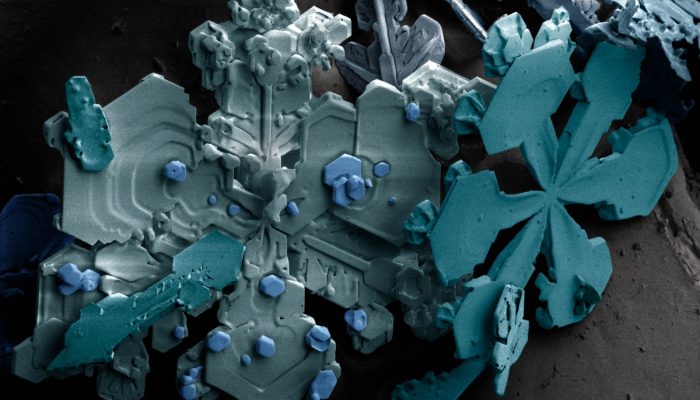
Words on Wednesday aims at promoting interesting/fun/exciting publications on topics related to Energy, Resources and the Environment. If you would like to be featured on WoW, please send us a link of the paper, or your own post, ERE.Matters@gmail.com *** Citation: Scott, S., Driesner, T. & Weis, P. Geologic controls on supercritical geothermal resources above magmatic intrusions. Nature Commu ...[Read More]
If you didn't find what you was looking for try searching again.
Cryospheric Sciences
Karthaus Summer School 2015
After a train, the London Underground, another train, a flight, three more trains and a taxi (shared with people I had met on my way); I had arrived in a small Alpine village in the very north of Italy. The reason for this rather convoluted journey? To attend the Karthaus Summer School on ice sheets and glaciers in the climate system. I’m pleased to say it was definitely worth the trip getting the ...[Read More]
Seismology
Who are you? An EGU Seismology Division Visibility Survey
When a PhD student publishes a new paper, of course he/she would like that other scientists will read the work. However, in a busy academic world with many institutional obligations, it might be hard to promote the work and the research you are performing. Social media and blogs, however, can play an important role in research visibility and therefore we can help you! As Early Career Scientists of ...[Read More]
GeoLog
GeoTalk: Talking about ‘ocean burps’ with James Rae
Trying to understand the reasons behind the global warming of our climate is a never ending quest for scientists across the geosciences. Scientists often rely on deciphering past change to help us understand, and perhaps predict, what might happen in the future. Many will be familiar with the common saying ‘the past is the key to the future’. This is exactly what James Rae, a research fellow at th ...[Read More]
Geology Jenga
A new tool for the interpretation of palaeomagnetic data
As part of my PhD research, I spent quite a lot of time at the Fort Hoofddijk (informally known as The Fort) – the palaeomagnetic laboratory of the University of Utrecht (in the Netherlands). For a little insight into what carrying research out in a 19th Century bunker, housed within the grounds of the botanical gardens of the University of Utrecht is like, take a look at this blog post that ...[Read More]
Cryospheric Sciences
Image of the week : formation of an ice rise
Deglaciation and formation of an ice rise with the ice-sheet model BISICLES. The simulation starts with an ice sheet in steady state that overrides a topographic high in the bed, close to the calving front. The sea level is then forced to rise steadily with 1 cm per year during 15 thousand years, and the simulation goes on until the ice sheet reaches steady state. The animation below shows that t ...[Read More]
Green Tea and Velociraptors
Crocodiles feeling the heat of extinction
New research on crocodiles shows that a combination of changing sea levels and temperatures were responsible for driving their biodiversity over millions of years. Living crocodiles are threatened by climate change, with 10 out of 23 species at a high risk of extinction. As ectotherms, animals which require external sources of heat to function, they are sensitive to changes in temperature. With 2- ...[Read More]
Soil System Sciences
Soil facts
As part of the activities of the International Year of Soils, FAO has published the following Soil Facts. Contribute with your comments!
GeoSphere
Geology Photo of the Week #47
This week’s photo is another mineralogy themed one. This photo shows beautiful, yet also flattened crystals of the mineral natrolite that has grown in an acicular habit from a central point making them look sort of like little snowflakes. Natrolite is a relatively common hydrated sodium, aluminum silicate mineral (Na2Al2Si3O10 · 2H2O) that often forms within the void spaces of igneous rocks ...[Read More]
GeoLog
Imaggeo on Mondays: The organisation of a river system
The picture shows the Elbe Rivervalley, one of the major rivers of Central Europe. It was taken from the Bastei Bridge close to Rathen, which towers 194 meters above the Elbe River in the state of Saxony in the south-eastern Germany. This region belongs to the national park known as Saxon Switzerland. Together with the Bohemian Switzerland in the Czech Republic, the Saxon Switzerland National Park ...[Read More]