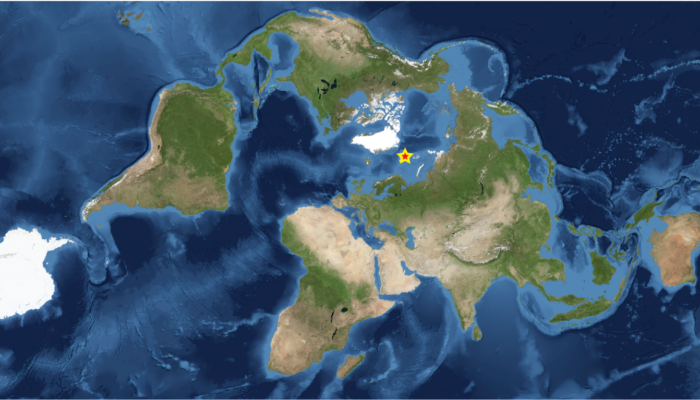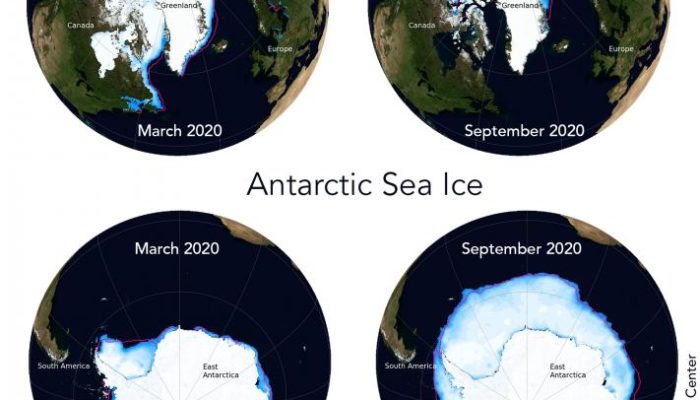
More pancakes in the future – that sounds like a very good New Year’s Eve resolution for Sunday brunches, but it could also be a development of the most tasty looking sea ice shape in the Arctic. Let’s find out more! Arctic Sea Ice The growth and melt of Arctic sea ice follows a seasonal cycle. In the springtime, under the midnight sun, the sea ice begins to melt until it reaches its m ...[Read More]
If you didn't find what you was looking for try searching again.
GeoLog
How to EGU22: Five ways you can help us make a greener EGU22!
For several years, EGU has committed – both in terms of resources and research – to helping to create a cleaner and greener environment. As our biggest event of the year (EGU22) soon approaches, nearly 10,000 people are expected to travel to Vienna for the week-long conference. An event of this scale can of course impact the environment any number of ways. The good news? Even the small ...[Read More]
Geochemistry, Mineralogy, Petrology & Volcanology
Volcanoes and social media make us (more?) crazy
Many people are drawn to danger and behaviors that can harm their health or finances. Dangerous activities include the attraction that humans have always had towards natural events, such as volcanic eruptions, or towards gambling, adventure, challenging travels or physical activities without the ability or the necessary preparation. In today’s life many people face risks, however these risks ...[Read More]
GeoLog
GeoTalk: Meet Anita Di Chiara, the Union-level Early Career Scientist Representative!
Hi Anita. Thank you for joining us today! Before we jump in, could you tell us a bit about yourself and your career? I am a postdoctoral researcher between the INGV in Rome and Scripps Institution of Oceanography. I am from Palermo, in Italy, and did my PhD in Rome; then I lived in Brazil, the UK, and the US during my past four postdoctoral projects. I work as a paleomagnetist to refine our unders ...[Read More]
Cryospheric Sciences
Women of Cryo VI: Women and Glaciers in the Chilean Andes (Part II)
In Chile, gender imbalance in science mirrors the international context, even though the Americas have been recognised as a region where women’s representation in science has increased, compared to other countries (UNESCO 2015 statistics and this study). However, Chile still has one of the lowest ratios of women participating in STEM (33.1%), followed by Mexico and Peru, as shown in this study. In ...[Read More]
GeoLog
How to EGU22: Making your presentation accessible to all!
The last couple of years have changed the way we communicate with each other – both in our professional and personal lives. The pandemic has inspired many of us to experiment with and embrace new digital ways of working, catching up with family and friends, networking, and more! This is also true for the way we share scientific research. In the digital world though, we’re sometimes mor ...[Read More]
Geodynamics
Join in our Mag-netZ !
For better or for worse, online seminars have stealthily become part of our routine. This week, Daniele Thallner from the University of Florida, “attracts” our attention to a seminar series on geomagnetism and geodynamo modeling — Mag-netZ! The 2022 season of the MagNetZ seminar series is live! The MagNetZ (Magnetic NetworkZ) online seminar series was started in early 2020 to serve as ...[Read More]
Cryospheric Sciences
Highlighted Paper – Meteorites in Antarctica
A Belgian-Dutch team of scientists created the first-ever “treasure map” that shows where in Antarctica meteorites are likely to be found. Meteorites are samples from space that fall as stone-like material on the surface of the Earth. Once recovered, meteorites provide crucial information on the formation and evolution of our Solar System. First meteorite finds in Antarctica December 1969, Yamato ...[Read More]
GeoLog
The ECS Connectivity Group explores modern ways to connect and communicate
We find ourselves in an ever-changing world of new platforms and apps, and yet, communication can often still be difficult. And this is particularly true for a large organisation like EGU. Even when we consider just the Early Career Scientists (ECS) representatives of each division, this still includes more than 20 representatives and their teams. Add to this the fact that representatives are spre ...[Read More]
Geodynamics
The Sassy Scientist – Seminar Yoga
Chairing conference sessions, organising social events, writing on the EGU blog site: extra-curricular activities can help rounding up our scientific and academic identity. But let’s face it, they take up time and they can be stressful. Seynabou has been (surely very democratically, as it always happens) appointed as group meetings organiser but finds herself in high waters: Help!? I am in charge ...[Read More]