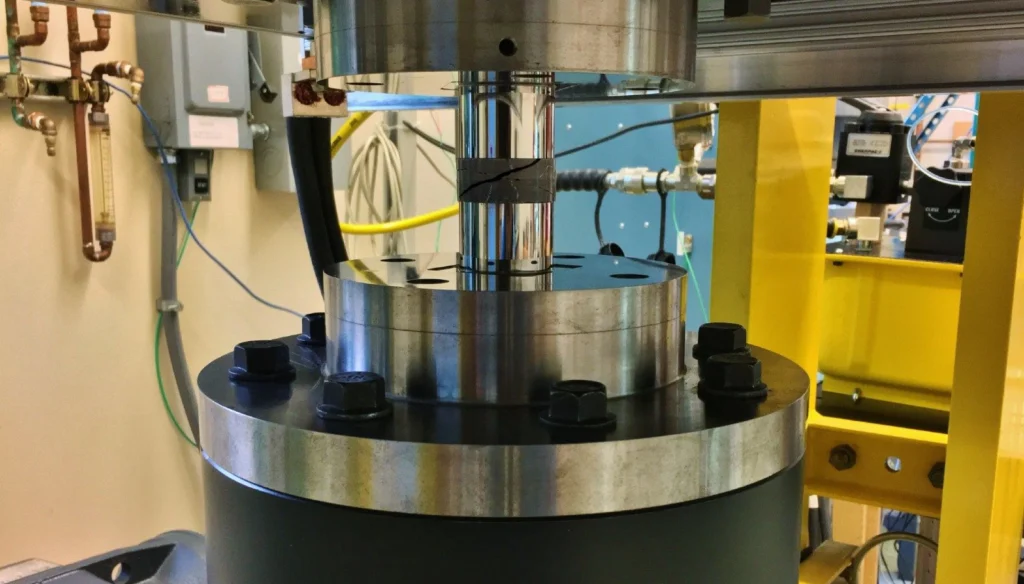
Are you going to the EGU General Assembly in Vienna next week? If so, read on for a quick guide to navigating the week: Where to start, what to see and how to meet people and enjoy yourself! After all, the meeting is as much about the opportunities meet scientists from all over the world as it is about the science itself. How on Earth do I know what is going on?! The EGU General Assembly is a mass ...[Read More]
If you didn't find what you was looking for try searching again.
GeoLog
Imaggeo on Mondays: In the belly of the beast
Conducting research inside a volcanic crater is a pretty amazing scientific opportunity, but calling that crater home for a week might just be a volcanologist’s dream come true, as Alexandra postdoctoral researcher at the Institut de Physique du Globe de Strasbourg, describes in this week’s Imaggeo on Mondays. This picture was taken from inside the crater of Mount St Helens, a stratovolcano ...[Read More]
Tectonics and Structural Geology
Features from the field: Strike Slip Faults Classification
A strike slip faults is a fault on which most of the movement is parallel to the fault strike (Bates and Jackson, 1987). The term ‘wrench fault’ is also popularized in some researchers. Sylvester (1988) suggest not using wrench fault term for defining strike slip fault as general term because wrench fault was defined by Anderson (1905) as deep seated, regional and vertical faults. Many major strik ...[Read More]
GeoLog
GeoTalk: How are clouds born?
Geotalk is a regular feature highlighting early career researchers and their work. In this interview we speak to Federico Bianchi, a researcher based at University of Helsinki, working on understanding how clouds are born. Federico’s quest to find out has taken him from laboratory experiments at CERN, through to the high peaks of the Alps and to the clean air of the Himalayan mountains. His innova ...[Read More]
GeoLog
Geosciences Column: The dangers of an enigmatic glacier in the Karakoram
Nestled among the high peaks of the Karakoram, in a difficult to reach region of China, lies Kyagar Glacier. It’s trident-like shape climbs from 4800 to 7000 meters above sea level and is made up of three upper glacier tributaries which converge to form an 8 km long glacier tongue. Until recently, it’s remoteness meant that studying its behaviour relied heavily on the acquisition of data by satel ...[Read More]
GeoLog
Imaggeo On Mondays: Halo
One of the main perks of being a geoscientist is that, often, research takes scientists all around the globe to conduct their work. While fieldwork can be hard and challenging it also offers the opportunity to see stunning landscapes and experiencing unusual phenomenon. Aboard the Akademik Tryoshnikov research vessel, while cruising the Kara Sea (part of the Arctic Ocean north of Siberia) Tatiana ...[Read More]
Cryospheric Sciences
Image of the Week — Microbes munch on iron beneath glaciers
The interface between a glacier and its underlying bedrock is known as the subglacial zone. Here lie subglacial sediments, the product of mechanical crushing of the rock by the glacial ice. Despite their lack of sunlight, nutrients and oxygen, subglacial sediments host active and diverse communities of microorganisms. What we (don’t) know about subglacial microorganisms The past few decades ...[Read More]
GeoLog
March GeoRoundUp: the best of the Earth sciences from around the web
Drawing inspiration from popular stories on our social media channels, as well as unique and quirky research news, this monthly column aims to bring you the best of the Earth and planetary sciences from around the web. Major story While the March headlines might not have been dominated by a particular story, the state of the Earth’s climate has definitely been the overarching theme of the month. ...[Read More]
Geomorphology
Report from the Spring School on “Statistical analysis of hyperspectral and high-dimensional remote-sensing data using R”, Jena, Germany, March 13-17, 2017
The Spring School on “Statistical analysis of hyperspectral and high-dimensional remote-sensing data using R” was organized by the GIScience group lead by Prof. Alexander Brenning and two researchers from his GIScience research group, Patrick Schratz and Dr. Jannes Münchow. The school brought together a diverse group of 28 researchers (e.g. geoscientists, forestry, environmental studies) at differ ...[Read More]
GeoLog
Imaggeo on Mondays: Lava highway in Kanaga Island
On a rare sunny day, Mattia Pistone (a researcher at the Smithsonian Institution in Washington DC) was able to capture this spectacular shot of Kanaga, a stratovolcano in the remote Western Aleutians, which is usually veiled by thick cloud. The Western Aleutians form a chain of 14 large and 55 small volcanic islands, belonging to one of the most extended volcanic archipelagos on Earth (1900 km), s ...[Read More]