The 2018 General Assembly took place in Vienna last month, drawing more than 15,000 participants from 106 countries. This month’s GeoRoundUp will focus on some of the unique and interesting stories that came out of research presented at the Assembly. Mystery solved The World War II battleship Tirpitz was the largest vessel in the German navy, stationed primarily off the Norwegian coastline as a fo ...[Read More]
If you didn't find what you was looking for try searching again.
Cryospheric Sciences
Image of the Week – Why is ice colourful?
When you think of glacier ice, what colour first springs to mind? Maybe white, blue or transparent? Well, glacier ice can, in fact, be mesmerising and multi-coloured! Our image of the week shows thin sections of glacier ice under polarised light. These sections were cut from block samples of two Alpine glaciers in Switzerland (Chli Titlis and Grenzgletscher). In these images the individual ice c ...[Read More]
GeoLog
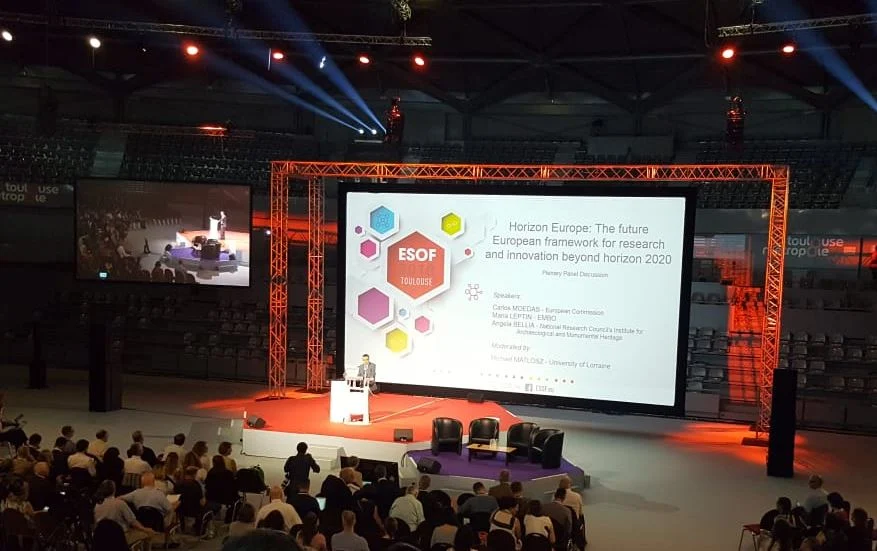
GeoPolicy: Scientific research in a changing European Union
Scientific research in a changing European Union The 2018 EGU General Assembly was a huge success. Not only was it the biggest yet (with over 15,000 participants) but it also held a large variety of Short Courses, Townhalls and Union Symposia that gave the scientists attending a chance to step out of their comfort zone and learn about something other than their area of expertise. One example of su ...[Read More]
GeoLog
A flood of attention: extreme weather and digital media
In June 2016, Paris was transformed. The River Seine burst its banks, submerging some of the nearby roads; floodwater lapped at the tops of street lamps and traffic lights. The event marked the the worst flooding in Paris for more than 30 years. When a flood event hits a major city, numerous researchers are keen to collect data for their work. However, Rosa Vicari, a PhD student at the the École d ...[Read More]
GeoLog
Imaggeo on Mondays: Iceland’s original birch forest
Iceland is a country of dramatically rugged landscapes. The region is home to sweeping valleys and mountain ranges, dotted with lava fields, large glaciers, hot springs and impressive waterfalls. The territory is also notoriously treeless. As of 2016, forests only made up 1.9 percent of Iceland, according to the Icelandic Forest Service. However, about a thousand years ago the country’s landscape ...[Read More]
Cryospheric Sciences
Image of the week — Making pancakes
It’s pitch black and twenty degrees below zero; so cold that the hairs in your nose freeze. The Arctic Ocean in autumn and winter is inhospitable for both humans and most scientific equipment. This means there are very few close-up observations of sea ice made during these times. Recently, rapidly declining coverage of sea ice in the Arctic Ocean due to warming climate and the impending likelihood ...[Read More]
Geomorphology
Diving under the scientific iceberg
written by: Anne Voigtländer, Anna Schoch, Elisa Giaccone, Harry Sanders, Richard Mason, Johannes Buckel At the EGU General Assembly international researchers from all earth science communities gather and share their most recent endeavors. This year, we, a group of European young geomorphologists, tried a new session format to address challenges we all face in our research, ranging from inaccessib ...[Read More]
Geodynamics
New faces for 2018 – 2019
We found some bright new faces at the EGU GA this year, so we need to make some introductions! Both the Early Career Scientist Team and the Blog Team have expanded and it is my absolute delight to introduce to you our 2(!) ECS Representatives for 2018-2019 and our new addition to the blog team (also see this post if you have forgotten the other members of the blog team)! ECS Representatives Nico S ...[Read More]
GeoLog
Underwater robot shares ocean secrets
Buoyancy-driven drones are helping scientists paint a picture of the ocean with sound. Around the world, silent marine robots are eavesdropping on the ocean and its inhabitants. The robots can travel 1000 metres beneath the surface and cover thousands of kilometres in a single trip, listening in on the ocean as they go. These bright yellow bots, known as Seagliders, are about the size of a diver, ...[Read More]
Solar-Terrestrial Sciences
Report from the 2018 EGU General Assembly
Last week the 2018 General Assembly were held in Vienna. Gathering 15 075 scientists from 106 countries, this is the most important EGU event throughout the year. Summarizing what happened during the week is an impossible task, as a meeting like this is way more than the 666 individual sessions convened and the 11 128 posters presented during the week. However, in this post I will point to some of ...[Read More]