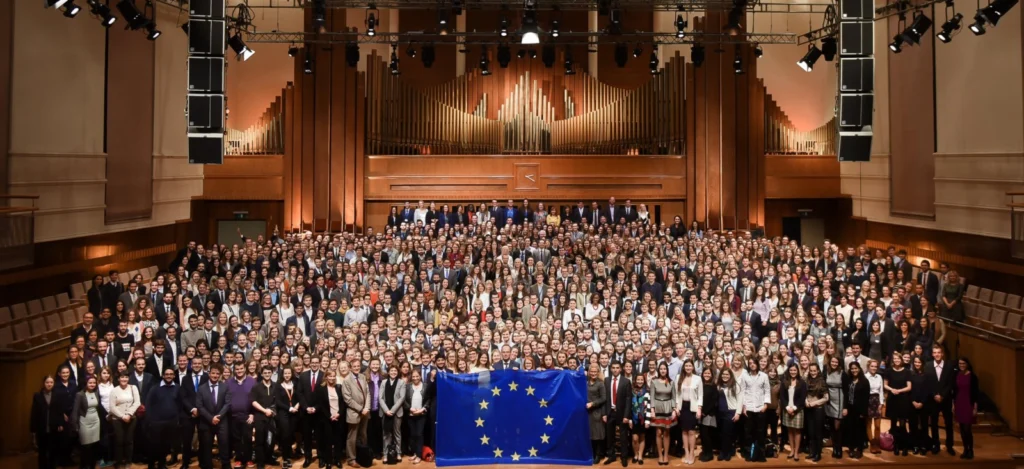
The EGU Early Career Scientists’ (ECS) Great Debates offer early career scientists at the EGU General Assembly the chance to network and voice their opinions on important topics in the format of round-table discussions. At the end of the debate, each table delivers a statement that summarises the discussion and recommendations. By publishing the results, we hope to highlight some of the needs of t ...[Read More]
If you didn't find what you was looking for try searching again.
Tectonics and Structural Geology
Meeting Plate Tectonics – Jean-Philippe Avouac
These blogposts present interviews with outstanding scientists that bloomed and shape the theory that revolutionised Earth Sciences — Plate Tectonics. Get to know them, learn from their experience, discover the pieces of advice they share and find out where the newest challenges lie! Meeting Jean-Philippe Avouac Prof. Jean-Philippe Avouac initially studied mathematics and physics during his underg ...[Read More]
Natural Hazards
Gaius Plinius Secundus and Sergey Soloviev, two names and awards.
The EGU has an award system in place aiming at recognising eminent scientists for their outstanding contribution in Earth, planetary and space science. There are different medals a researcher can be nominated to, including Division ones. Ah, before I forget: the deadline for this year nominations is 15 June! Don’t miss the chance to appoint an outstanding colleague. You can find more information o ...[Read More]
GeoLog
Imaggeo on Mondays: Our QUEST for innovative tools to understand changing environments and climates
The photo shown here shows typical sampling work underground. You can see Ola Kwiecien and Cinthya Nava Fernandez, researchers at Ruhr University Bochum in Germany, collecting dripwater in New Zealand’s Waipuna Cave as part of a four-year EU-funded monitoring programme. Our research aims at developing innovative geochemical indicators that we can use to quantify changes in the hydrological system ...[Read More]
Geodynamics
The Sassy Scientist – PhD angst
Every week, The Sassy Scientist answers a question on geodynamics, related topics, academic life, the universe or anything in between with a healthy dose of sarcasm. Do you have a question for The Sassy Scientist? Submit your question here. Iris asks: Will I ever finish my PhD? Dear Iris, Most researchers won’t admit to it publicly, but they all had doubts when trying to complete their PhD researc ...[Read More]
GeoLog
Games, games, games at the EGU 2019 meeting
At the EGU General Assembly 2019, more than 16,000 scientists came together in Vienna to present their research, discuss the latest advances in their field, and engage in workshops. On the Wednesday evening of the EGU conference, hundreds of researchers also came together to play geoscience-based games! Games can be great tools for geoscience outreach and education, as they have the ability to sim ...[Read More]
GeoLog
Challenging challenges in Earth science research at the EGU General Assembly!
At the EGU General Assembly 2019 last month, if you walked through the dark basement and the most distant hallways of the convention centre, into room -2.62 on Wednesday evening, you may have heard people introducing themselves followed by the words “… and I have a problem.” This may have sounded like a support group. In fact, if you had entered the room it would have been clear that you had just ...[Read More]
GeoLog
Imaggeo on Mondays: Sand and snow on the Tibetan Plateau
Roughly 50 million years ago, the Eurasian and Indian continental plates began to crash into each other, dramatically changing the landscape of modern-day Asia. The force of the collision caused the Earth to scrunch together at the zone of impact, subsequently forming the Himalayan mountain range. However, to the north of the crash, a stretch of the Earth uplifted without bunching up or wrinkling; ...[Read More]
WaterUnderground
Update on the groundwater situation in Cape Town
Post by Jared van Rooyen, PhD student in Earth Science at Stellenbosch University, in South Africa. When the Cape Town water crisis first emerged it took almost a year before active contingencies were put in place. Four major ideas were proposed: (1) Intense water restrictions for municipal water users, (2) greywater recycling facilities, (3) groundwater augmentation of water supplies, and (4) des ...[Read More]
Cryospheric Sciences
Image of the Week – The GReenland OCEan-ice interaction project (GROCE): teamwork to predict a glacier’s future
The GROCE project, funded by the German Ministry for Education and Research (BMBF), takes an Earth-System approach to understand what processes are at play for the 79°N glacier (also known as Nioghalvfjerdsfjorden), in northeast Greenland. 79°N is a marine-terminating glacier, meaning it has a floating ice tongue (like an ice shelf) and feeds into the ocean. Approximately 8% of all the ice contain ...[Read More]