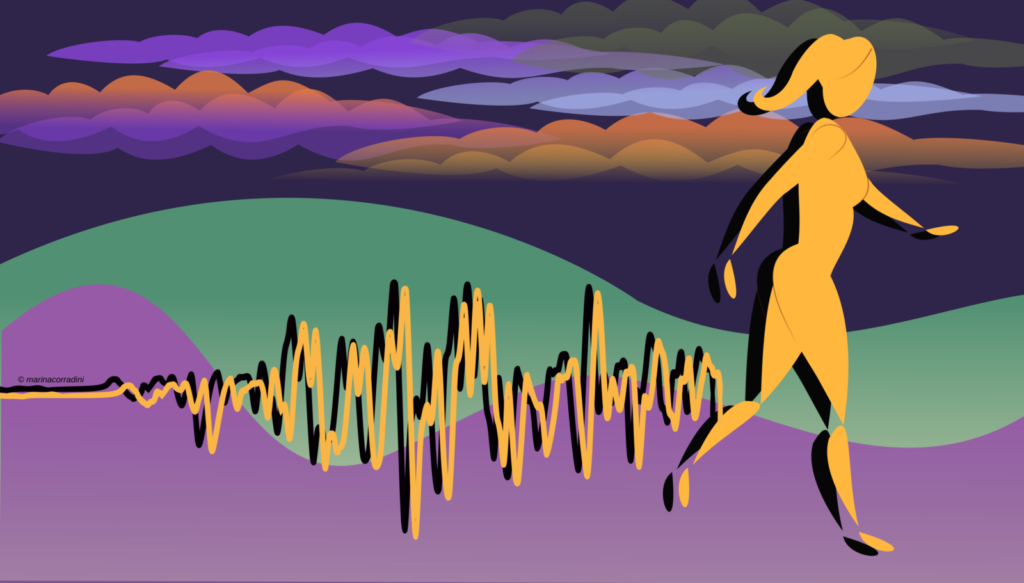
Technology has never been more at hand than at the time we are living. Smartphones and the many apps on the market are proof of this. As I recently discovered, there is also an app developed to learn about natural hazards and, as they claim, fight disasters! This app is called I-REACT, and it was born from a homonymous innovation project funded by the European Commission and developed by a consort ...[Read More]
If you didn't find what you was looking for try searching again.
Hydrological Sciences
Featured catchment series: The North is not forgotten!
This is the first post of “Featured Catchment”, a series of posts in the HS Blog that present experimental catchments across Europe and beyond. Here, the authors of the posts will explain the main characteristics (e.g., climate, geology, topography, land use) of their catchments, why hydrologic research is important in their study areas, describe the applied methodologies (field instrumentation an ...[Read More]
GeoLog
Weathering the storm from a research vessel
Fieldwork can take geoscientists to some of the most remote corners of the Earth in some of the harshest conditions imaginable, but stories from the field hardly make it into a published paper. In this blog post, Raffaele Bonadio, a PhD student in seismology at the Dublin Institute for Advanced Studies in Ireland, shares a particularly formidable experience in the field while aboard a research ves ...[Read More]
Tectonics and Structural Geology
Introducing our new blog team!
After three succesful first years of the Tectonics and Structural Geology blog, it is time to bring our platform to the next level! To provide you more frequent content over a wide range of topics, we invited some new people to join our team. We are still always on the lookout for new guest authors and/or team members, so let us know if you want to contribute! So, what will you be reading on our b ...[Read More]
Cryospheric Sciences
Image of the Week – Unravelling the mystery of the 2017 Weddell Polynya
The mysterious appearance and disappearance of the Weddell Polynya, a giant hole in the ice, has long puzzled scientists. Recent work reveals that it is tightly tied to energetic storms. Read on to find out more… The eastern side of the Weddell Sea is a region known for its low concentration of sea ice due to the presence of a seamount, an underwater plateau called the Maud Rise. The seamount infl ...[Read More]
GeoLog
Sharing & talking isn’t enough – we need a change in culture around mental illness
The EGU Early Career Scientists’ (ECS) Great Debates offer early career scientists at the EGU General Assembly the chance to network and voice their opinions on important topics in the format of round-table discussions. At the end of the debate, each table delivers a statement that summarises the discussion and recommendations. By publishing the results, we hope to highlight some of the needs of t ...[Read More]
Tectonics and Structural Geology
Meeting Plate Tectonics – Jean-Philippe Avouac
These blogposts present interviews with outstanding scientists that bloomed and shape the theory that revolutionised Earth Sciences — Plate Tectonics. Get to know them, learn from their experience, discover the pieces of advice they share and find out where the newest challenges lie! Meeting Jean-Philippe Avouac Prof. Jean-Philippe Avouac initially studied mathematics and physics during his underg ...[Read More]
Natural Hazards
Gaius Plinius Secundus and Sergey Soloviev, two names and awards.
The EGU has an award system in place aiming at recognising eminent scientists for their outstanding contribution in Earth, planetary and space science. There are different medals a researcher can be nominated to, including Division ones. Ah, before I forget: the deadline for this year nominations is 15 June! Don’t miss the chance to appoint an outstanding colleague. You can find more information o ...[Read More]
GeoLog
Imaggeo on Mondays: Our QUEST for innovative tools to understand changing environments and climates
The photo shown here shows typical sampling work underground. You can see Ola Kwiecien and Cinthya Nava Fernandez, researchers at Ruhr University Bochum in Germany, collecting dripwater in New Zealand’s Waipuna Cave as part of a four-year EU-funded monitoring programme. Our research aims at developing innovative geochemical indicators that we can use to quantify changes in the hydrological system ...[Read More]
Geodynamics
The Sassy Scientist – PhD angst
Every week, The Sassy Scientist answers a question on geodynamics, related topics, academic life, the universe or anything in between with a healthy dose of sarcasm. Do you have a question for The Sassy Scientist? Submit your question here. Iris asks: Will I ever finish my PhD? Dear Iris, Most researchers won’t admit to it publicly, but they all had doubts when trying to complete their PhD researc ...[Read More]