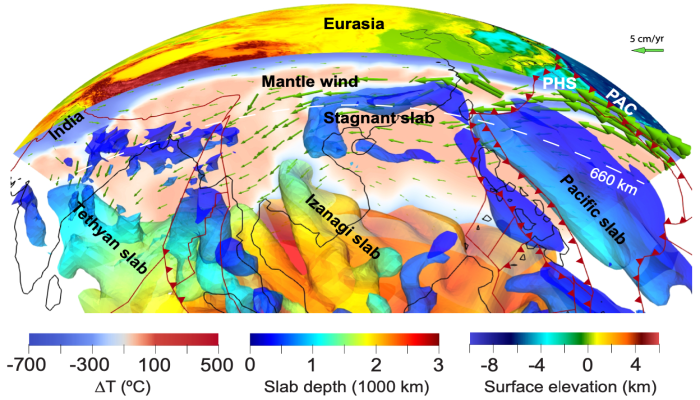
The Indian Ocean Geoid Low is an enigmatic phenomenon in geodynamics. Many brain-storming hypotheses have been proposed in the last few decades to explain this geoid low. One popular idea argues that the high density lower mantle slabs contribute to this geoid low. Recent discoveries have shown that low-density anomalies from the African LLSVP region could have a more substantial influence on crea ...[Read More]
WaterUnderground
AGU Hydrology Students talk JEDI, awards, and recognizing student success at AGU townhall
By David Litwin At the American Geophysical Union Fall Meeting in December 2021, the AGU Hydrology Section Student Subcommittee (H3S) convened a townhall “Coming Together After Being Apart…” where the AGU Hydrology Section leadership were available for questions from the community, updates on current activities, and plans for future section initiatives. The conversation seemed important to share w ...[Read More]
GeoLog
Imaggeo On Monday: Stands of Time
Within the heart of the Malagasy Hauts-Plateaux, the rolling grasslands are pitted by deep incisions locally referred to as lavaka (‘hole’ in Malagasy). These mass failure features provide vast quantities of terrestrial matter to local freshwater arteries, accounting for over 80% of the annual sediment load of the Betsiboka River. The collapse of the overlying laterite exposes a comparatively nutr ...[Read More]
Tectonics and Structural Geology
TS Must-Read – Caine et al., 1996 Fault zone architecture and permeability structure
Caine et. al. (1996) is a cornerstone paper which describes, compares and quantifies brittle fault zones and their permeability (fluid flow) properties from observations. Doing so, the paper initiates the accumulation of information on the permeability of brittle fault zones described previously (Randolph and Johnson 1989; Scholz 2019; Byerlee 1993). The study begins by defining fault zones as com ...[Read More]
Natural Hazards
Putting some pieces of the climate puzzle together, a chat with Jakob Zscheischler
The climate on our home planet is changing, and the effects of this change affect all of us at different levels starting from an enhancement of extreme weather events, a severe natural hazard. Climate change has several drivers, which in turn have complex interactions. Thus, it should not surprise us if climate science is a complex and interdisciplinary discipline with numerous players and great p ...[Read More]
GeoLog
GeoTalk: meet Alicia Fantasia, researcher in ancient Earth climates & ECS representative for SSP Division
Hello Alicia, thank you for agreeing to this interview! Before we dig in, could you tell us a little about yourself and your research? Hi Simon, many thanks for giving the nice opportunity to present my research activities. I am Alicia Fantasia and I was born in Switzerland. I have always been passionate about the Earth system, I am sensitive to current climate change issues, and … fascinated by d ...[Read More]
Geodynamics
The Sassy Scientist – The Nonsense Of Open Research
Enzo submitted his manuscript for review at one of those well-known, Earth science-niche journals. However, shortly thereafter he received an email by his editor that it was rejected. Reason being that not enough research was added in the manuscript. Furious, he bellows: When is my research open enough to be published? Dear Enzo, I know, right? It seems that over the past few years the need to giv ...[Read More]
Seismology
Earthquake Watch: Woods Point, Australia – September, 2021
Dee Ninis, an Earthquake Geologist and Seismologist from the Seismology Research Centre of Australia, outlines the 22 September 2021 Mw5.9 Woods Point, Australia earthquake for the first Earthquake Watch of the year. On 22 September, 2021 at 09:15 AEST (2021-09-21 23:15 UTC) a moderate earthquake of Mw 5.9 near Woods Point, Victoria, shook southeast Australia. Felt reports were received from as fa ...[Read More]
Cryospheric Sciences
A place called home?
Welcome to Kongsfjorden in Svalbard. The front of the glaciers terminating into the sea is an ecological hotspot, home to many marine animals, like kittiwakes, who love to hunt here. They feed on small fish and shrimp, which at marine-terminating glacier fronts are brought to the surface by upwelling glacial meltwater. Retreating glaciers lose their contact with the ocean As the planet warms these ...[Read More]
GeoLog
EGUsphere preprints: new pathways for discussion, sharing and feedback
After a long wait, EGU has this month launched our much-anticipated preprints – the newest feature of the Open Access repository EGUsphere. Now for the first time, authors can upload preprints to the online server, taking advantage of EGU’s pioneering public peer-review process, whilst preparing their papers for future release. Three different roads for preprints are available with EGUsphere: Prep ...[Read More]