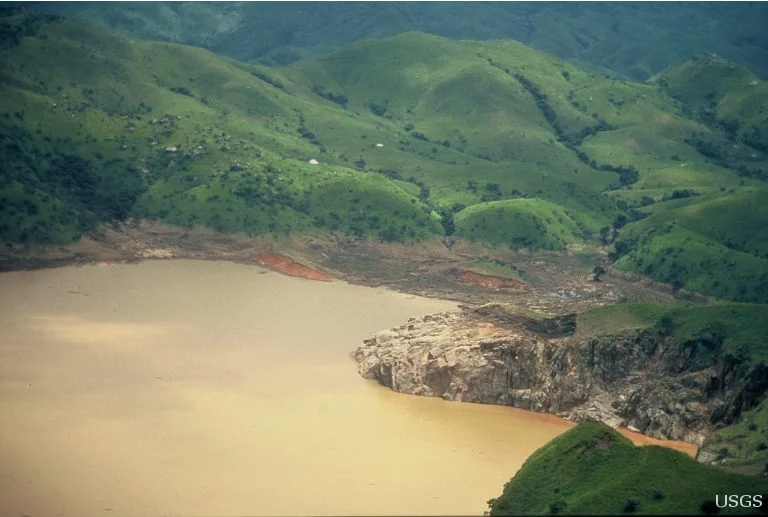
On the evening of August 21, 1986, an unusual stillness blanketed the green highlands of northwestern Cameroon. The local villagers in Nyos, Cha, and Subum were preparing for bed, totally unaware that the crater lake nearby had reached its breaking point. Without warning, a wave of gas burst from the lake and spilled over the volcanic crater rim and cascaded into the valleys. Unseen, heavy, and completely odourless, the cloud swept through the sleeping communities at highway speeds. By the time the morning sun rose over the mist, over 1,700 people and thousands of livestock lay dead…
What unfolded that night was a natural execution of an extraordinarily rare subterranean phenomenon known as a limnic eruption, or, in other words, a lake overturn. Lake Nyos had spent decades accumulating reservoirs of carbon dioxide in its depths, which act like a giant, pressurised soda bottle hidden in plain sight! When the physical balance holding the gas in solution finally snapped, the lake unexpectedly releasing millions of metric tons of suffocating gas into the atmosphere. The disaster has transformed our understanding of volcanic hazards, as it is proof that when geoscientists put their minds to unravelling subterranean mysteries, they may be able to ground a threat that could go off the charts.
The exact trigger that broke the lake’s equilibrium on that August night remains a subject of ongoing scientific study…
The components of disaster
To understand how a picture-perfect lake could become so deadly, one has to look beneath the African crust. Lake Nyos sits atop the Cameroon Volcanic Line, a chain of ancient volcanoes that stretch over hundreds of miles from the Atlantic Ocean into mainland Central Africa. Although the surface of Lake Nyos appears serene, deep mantle activity beneath the basin remains quite active.
Far below the lake bed, underground magma chambers leak subterranean gases non-stop, predominantly carbon dioxide. In typical active volcanic regions, these gases vent, without causing any harm, into the sky through cracks or steaming fissures. Beneath Lake Nyos, however, mineral-rich thermal springs saturated with dissolved gas discharge directly into the floor of the lake, almost 200 meters below the surface.
Under ordinary circumstances, tropical lakes experience something called mixing. As surface waters cool during rainstorms or colder seasons, they become denser and sink, consequently driving a cycle that circulates nutrients and keeps gas levels low throughout the entire water column. Lakes that mix regularly from top to bottom are referred to as holomictic. Lake Nyos, however, is meromictic, meaning its unique physical geometry, sheltered topography, and depth prevent the top and bottom layers of water from ever mixing naturally.
In the aftermath of the disaster, international scientific teams quickly realised that the threat was far from over.
For centuries, the gas sat trapped in the lake’s basin due to two -inevitable- physical principles: hydrostatic pressure and density stratification. At the bottom of Lake Nyos, the weight of the overlying water column exerts pressure that’s twenty times greater than the atmospheric pressure felt at sea level. Much like a still, unopened, and pressurised soda bottle, deep water can hold massive amounts of dissolved carbon dioxide without forming bubbles. The weight of the water column kept the gas trapped at the bottom, where the heavy, gas-rich fluid settled beneath a lighter surface layer. Thus, by the summer of 1986, these deep waters were dangerously close to their gas capacity: a disaster on a countdown.
Cracking open the bottle?
The exact trigger that broke the lake’s equilibrium on that August night remains a subject of ongoing scientific study, though scientists point to two likely candidates: Either a rockfall along the crater walls that may have plunged into the depths and forced a pocket of gas-saturated water upward, or heavy seasonal rainstorms may have chilled the surface water enough to disrupt the upper boundary. Regardless of what provided the initial spark, the chain reaction that followed was instantaneous and deadly.
When the massive gas cloud erupted from the lake surface, its physical weight dictated everything that happened thereafter. Because carbon dioxide is circa one and a half times denser than the surrounding ambient air, it did not dissipate into the upper atmosphere. Instead, it behaved like a heavy, invisible fluid that hugged the contours of the terrain and rolled down the natural river valleys surrounding the crater. As the gas swept over the villages, it displaced the oxygen in the air entirely, which led to the asphyxiation to any living being that breaths.
Reducing future risk
In the aftermath of the disaster, international scientific teams quickly realised that the threat was far from over. Subterranean springs continued to pump fresh carbon dioxide into the lake basin, recharging the hypolimnion, and setting the clock for a second catastrophic release. To neutralise this hazard, geoscientists designed what I think is quite the elegant remediation strategy: controlled artificial degassing.
Scientists traveled to the lake and installed plastic pipes extending over six hundred feet down into the gas-laden waters, anchored to floating platforms on the surface. The system relies entirely on fluid dynamics to operate continuously. To begin the process, water is mechanically pumped up through the pipe from the deep layer. As the gas-rich water ascends and the surrounding pressure decreases, carbon dioxide bubbles spontaneously form inside the tube. Because the mixture of water and expanding gas bubbles inside the pipe is much lighter than the dense lake water outside, the natural buoyancy pushes the fluid upward, creating a continuous, self-sustaining siphon that shoots a fountain of gas and spray high into the air without requiring a single watt of external electricity.
Over the past two decades, these degassing fountains have thankfully relieved the internal pressure of Lake Nyos, and have been keeping the deep waters below their critical gas saturation limits. To monitor the lake’s condition without hauling heavy lab equipment into the remote jungle, scientists developed innovative, low-cost monitoring techniques using underwater sound speed sensors. Because dissolved carbon dioxide speeds up the transmission of sound waves through water, measuring variations in acoustic speed allows researchers to calculate precise, real-time vertical profiles of dissolved gas concentrations across the entire basin.
While Lake Nyos and its nearby sister Lake Monoun have been stabilised through this clever engineering intervention, broader scientific attention has now shifted eastward to Lake Kivu, located along the border of Rwanda and the Democratic Republic of the Congo. Lake Kivu is over two thousand times larger than Lake Nyos and holds hundreds of billions of cubic meters of dissolved carbon dioxide alongside massive reserves of dissolved methane, with over two million people residing along its shores. Fortunately, energy extraction projects are currently harvesting Lake Kivu’s dissolved methane to generate electricity, simultaneously turning a severe geohazard into a significant power source while lowering the risk of another limnic disaster.