Attending conferences is a great way to widen your existing network, meet potential employers and grow your professional skills. At EGU26, there are lots of exciting and useful career networking opportunities, training and events, regardless of whether you attend virtually or on-site in Vienna!
Jobs and careers area, and pop-up events
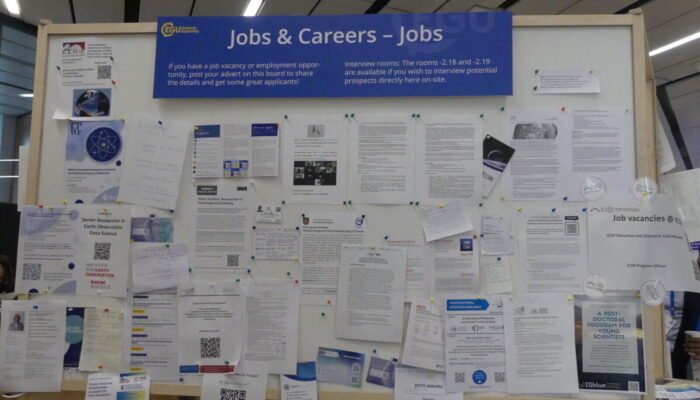
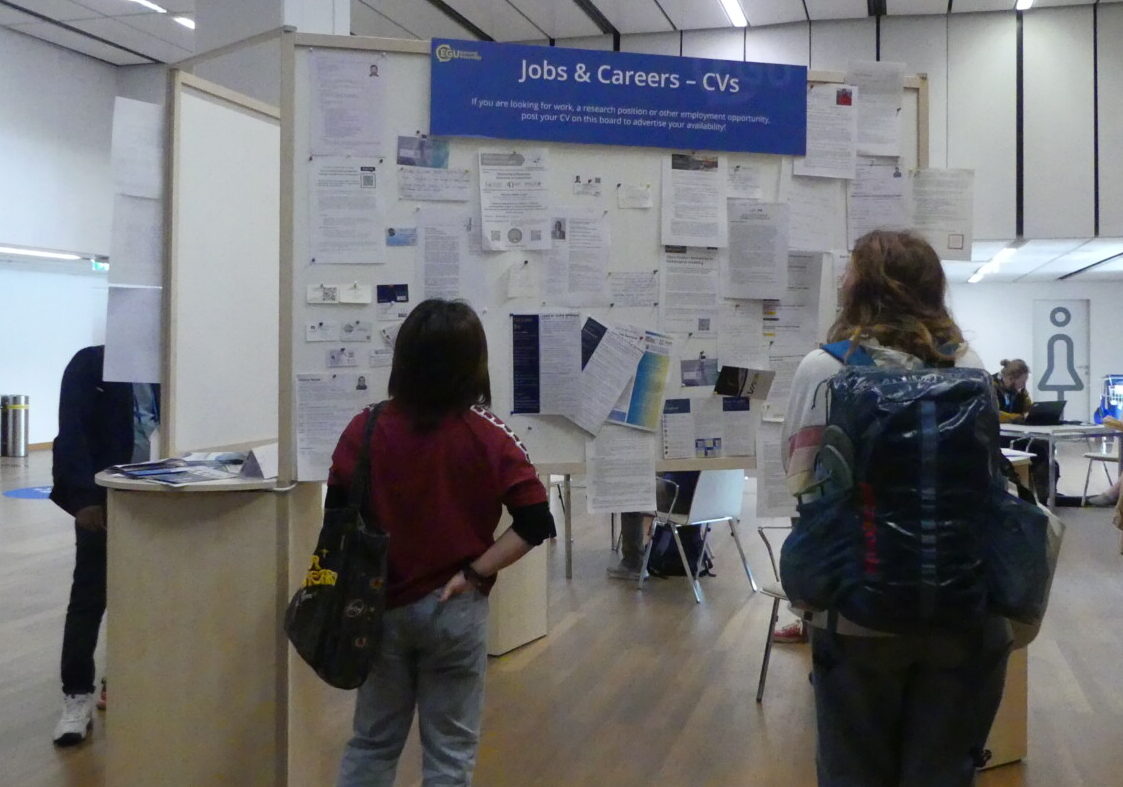
In the entrance foyer to Hall X2 on the Purple level are the Jobs and Careers boards in the Job spot, where you can post your CV, or find opportunities for training, networking or even employment. EGU26 also has a range of Pop-up networking events that you can organise during the week yourself, not limited to the Conference center. Want to host a session on CV writing for hydrologists in the Donaupark in the sunshine? Why not! Make sure you check back regularly throughout the week for updates.
Around the conference center there are several other resources you can use, from private interview rooms (Purple level -2.81 and -2.63, ask at the Info booth for help), the EGU Networking Zone (Red level, suite C, room 2.79 and on the Purple level, outside on terrace G) and a Business Lounge (Yellow Level to the left hand side after the entrance, beside the cafe).
Short Courses
SC3.9 Scared, but prepared: Present with confidence
Mon, 04 May, 16:15–18:00 (CEST) Room -2.62 (purple level)
Researchers are not only expected to conduct high-quality research, but also to communicate their findings effectively to both the scientific community and the public. This requires a skillset that is often not formally taught during academic training. Presenting your work and answering questions on stage can feel daunting and nerve-wracking. In this short course, we create a supportive environment to help you overcome these fears. Experienced and enthusiastic presenters will teach practical strategies to manage presentation anxiety and you can immediately put them into practice through short pitching exercises.
SC1.12 European Research Council (ERC) Funding Opportunities
Tue, 05 May, 08:30–10:15 (CEST) Room -2.41/42 (purple level)
The European Research Council (ERC) is a leading funding body at European level. It aims to support excellent, frontier research across all fields of science. The ERC offers various outstanding funding opportunities for investigator-driven projects, including grant budgets for individual scientists of up to €3.5 million. ERC calls are open to researchers around the world: all nationalities of applicants are welcome for projects carried out at a host institution in European Union member states or/and associated countries. The ERC is also quickly adapting to the constantly evolving research landscape, therefore at this session, the main features of ERC funding schemes will be presented, highlighting most recent changes implemented in the work programme and their effects in the evaluation. In addition, two invited speakers, an ERC grantee and a former member of the evaluation panel, will provide their own perspectives (as applicant and as evaluator) of the ERC evaluation process.
SC1.9 Psychological tools to preserve mental health while navigating the challenges of a research career
Tue, 05 May, 12:45–13:45 (CEST) Room -2.41/42 (purple level)
A research career is not only demanding, but also full of hidden challenges that can affect both success and mental well-being. This short course is designed to provide geoscientists at any stage of their career with practical, psychology-based tools to navigate these challenges. From time-management strategies to self-care practice and ugly truths, this course offers tips and insights for building resilience and balance into your research journey, may it be in or out of academia.
SC1.15 Managing Academia and parenting in society today
Tue, 05 May, 14:00–15:45 (CEST) Room -2.82 (purple level)
Building a successful academic career is challenging. Doing so while also raising a family can push you to your limits. Many early- and mid-career scientists grapple with balancing family life and academic responsibilities. The fear-of-missing-out dualism between family and academia causes an inner conflict and feeling of injustice and inadequacy. Families often find themselves confronted with what feels like a personal problem when, in reality, it is a shared societal issue. Modern families come in diverse forms, including dual-career parents, single parents, same-sex parents, and various shared parenting arrangements. This short course will share examples and experiences from a range of parents in academia, providing general advice, specific tips and a supportive environment to discuss challenges.
SC3.12 Meet the Editors: How to peer-review – Fundamentals & EGU’s model
Tue, 05 May, 16:15–18:00 (CEST) Room -2.82 (purple level)
This ‘Meet the Editors’ short course will allow you to talk directly to EGU journal editors and learn about the insider steps to writing, revising and submitting your manuscript, as well as about EGU’s public peer review and editorial process, from both sides – author and reviewer. The short course will also discuss ethical questions, such as your rights as an author and ethical responsibilities of peer review.
SC1.17 Invited to interview? Prepare for success with job applications and interviews in industry and academia
Wed, 06 May, 10:45–12:30 (CEST) Room -2.41/42 (purple level)
The job market in both industry and academia can be a very challenging environment, especially for those either just completing a course of study, or looking to change sectors. This short course aims to bridge this gap to employment by drawing on the experience of senior career workers in both industry and academia, as well as HR professionals, to provide specific advice for anyone who is in the process of submitting a job application or preparing for interview.
SC3.13 Get your writing right: A hands-on, participatory workshop to help improve writing skills
Wed, 06 May, 14:00–15:45 (CEST) Room 0.55 (yellow level)
Writing is difficult. Like most geoscientists, you might struggle, especially if your native tongue is not English. Writing is a skill best learnt by practice, lots of it, ideally with immediate peer feedback. It can also be a lonely job. In this hands-on, participatory workshop you will work on a writing task with colleagues, sharing inspiration and getting immediate feedback. The task illustrates in vivid fashion some key elements of writing.
SC1.8 Mentorship in Motion: Navigating the Career Ladder with Guidance and Growth
Thu, 07 May, 14:00–15:45 (CEST) Room -2.41/42 (purple level)
Mentoring in academia is a one-to-one connection and refers to a developmentally oriented relationship between a student or a less experienced colleague (the mentee) and a more experienced student or colleague (the mentor). While mentees gain guidance and confidence, mentors often discover new perspectives, sharpen their leadership skills, and find personal fulfillment in helping someone grow. Research shows that strong mentoring relationships play a key role in academic and career success, and contribute to a more connected, resilient scientific community. But not all mentoring experiences are positive. The quality of the relationship matters. This short course explores what effective mentoring looks like, how it can empower both parties, and how to recognize and avoid poor mentoring practices.
SC1.13 Careers inside and outside of academia: Panel discussion
Thu, 07 May, 16:15–18:00 (CEST) Room -2.41/42 (purple level)
Once you have completed your PhD a new challenge reveals itself: finding a position where you can apply your advanced skillset. This task is not always easy, and frequently a general overview of the available positions is missing. The academic pathway is often considered as the natural next step for scientists, however, in some fields, up to 70% of PhD graduates will go into work outside of academia. There are many different careers beyond academia which require or benefit from a research background, but often early career scientists struggle to make the transition due to reduced support and networking. In this panel discussion, scientists with a range of backgrounds give their advice on building a career. The panel will start by discussing common career questions, such as how to transition between academia and industry, and what are the pros and cons of a career inside and outside of academia. The session will then conclude with panellists answering questions from the audience.
SC1.5 Breaking Boundaries: Mastering Research Proposals – Insights and Strategies from a Global South Perspective
Thu, 07 May, 16:15–18:00 (CEST) Room -2.82 (purple level)
With a visible gap in opportunities between researchers in the Global South and the Global North, and with a decline in research budget across the globe, the ability to secure funding is important to stand out in academia. However, securing this funding or position still hinges on the strength of a research proposal. To address this need, we have designed a short interactive course dedicated to the art of writing strong research proposals for securing either a research position or proposal funding. This session will offer practical techniques and tips for creating compelling proposals and will include an open discussion. Additionally, we will provide insights from funding agencies based in Global South countries, highlighting the key elements they look for in proposals and opportunities.
SC1.6 Mind your head: How to navigate academic conflict
Thu, 07 May, 16:15–18:00 (CEST) Room 0.55 (yellow level)
Academic environments offer many opportunities for intellectual growth, development, and collaboration. However, like any community, conflict also appears. Disagreements may arise over co-authorship, mentoring expectations, department politics, or interpretations of research ethics. These situations are often complex and emotionally challenging. This Short Course helps scientists to recognize, understand, and navigate conflict in academic settings. We will also look at how conflict can lead to personal and professional growth when approached constructively.
SC1.14 Transferable skills: what are they and do I have them?
Fri, 08 May, 08:30–10:15 (CEST) Room -2.82 (purple level)
Anyone entering the job market or looking for a new job after academia will confront the phrase ‘transferable skills’. PhD candidates and scientists are advised to highlight their transferable skills when applying for non-academic jobs, but it can be hard to know what these skills are. This interactive workshop, will help identify your transferable skills such as big data analysis, communicating your findings, supervising, teaching, project management and budgeting and many more.
Meet exhibitors and experts
EGU26 has over 50 exhibitors attending the conference, from publishing houses to instrument developers, research institutes to consultancies. Find out who will be attending and what special sessions or talks they may be running by checking out the List of Exhibitors and the list of specific Pop-up Exhibitor Events. The exhibition is located in the entrance hall on the Yellow level, directly above the entrance on the Green level and in Hall X2 on the Purple level.
Exhibitors will be present during opening hours:
- Monday, 4 May to Thursday, 7 May 2026: daily from 10:00 to 18:00
- Friday, 8 May 2026: 10:00–13:00.
 Show you’re open to new opportunities

Regardless of whether you attend EGU26 on-site or virtually, your Copernicus profile offers the possibility to show you are in the market for a new job through the “Ask Me For My CV” sticker. Just enter the “My profile” section of the EGU26 homepage, click “Edit stickers” and enable the sticker via the toggle button!
Other resources
Don’t forget EGU has a range of resources on hand to help you with your career development year round. From tips on how to write a great CV from the ECS groups to Division and Union Level blog posts on a range of careers topics. We even have webinars for you to watch in preparation for the event on our YouTube channel.