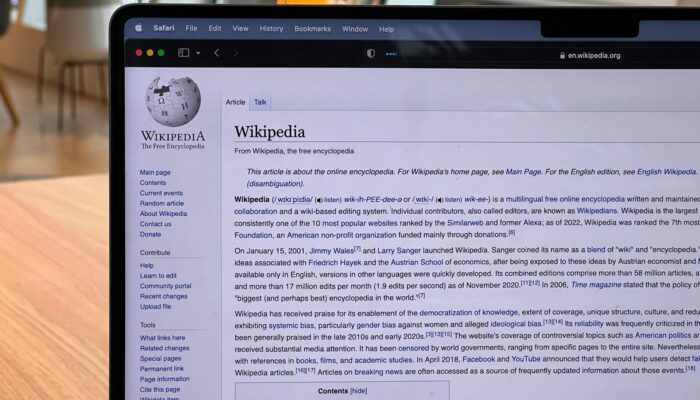
The year was 2001. A time before smartphones, before social media took over, and back when scrolling usually involved a physical microfilm reader at the library. On January 15 of that year, something revolutionary erupted onto the scene: Wikipedia was launched. As we celebrate its 25th anniversary, it’s time we come clean. While we might tell our professors we spent all night elbow-deep in the primary literature of the Natural Hazards and Earth System Sciences journal, many of us actually started that journey in the comforting, blue-linked clutch of a Wikipedia page.
Let’s face it: Geoscience is a linguistic minefield. Take, for instance, the subatomic lattices of minerals, or the planet-sized puzzles of plate tectonics: there is an exhausting amount of terminology to keep track of! Even the most seasoned geologist occasionally has a brain-fart (excuse my French) and forgets the exact difference between a graben and a horst, or the precise chemical formula for glaucophane.
Wikipedia acts as a digital Rosetta Stone. It is that incredibly knowledgeable (if slightly eccentric) peer who knows a little bit about everything. When you stumble upon an obscure paper mentioning ophiolites in a context you haven’t revisited since undergraduate years, Wikipedia is there. It tells you, in plain and simplified language, that you’re looking at sections of oceanic crust thrust onto continental margins, and it does so without making you feel like a sediment at the bottom of the class!
The genesis:
Every great geological formation has a point of origin, and Wikipedia’s nucleation began with Jimmy Wales and Larry Sanger. On January 15, 2001, they launched a project that was essentially a magma chamber of ideas. Originally intended to be a feeder for Nupedia (a much more rigid, peer-reviewed project), Wikipedia metamorphised. Sanger is credited with the name and the initial “wiki” concept, while Wales became the face of the Wikimedia Foundation, the non-profit that supports the whole operation.
Unlike a traditional encyclopedia, Wikipedia is run by a global network of volunteers known as Wikipedians. There is no single chief handing down edicts from a mountain top. Instead, it operates on a model of consensus. Through a complex system of Talk pages, bots that scrub for digital vandalism, and community-elected administrators, the site self-regulates. It’s a bit like a self-healing ecosystem; when someone tries to dump toxic waste ( in this case, misinformation) into an entry, the community usually neutralises it.
Benefits, faults, and fool’s gold
Like any complex system, Wikipedia has its peaks and its trenches. On the sunny side of the mountain, its greatest benefit is accessibility. For a student in a developing nation where universities offer no access to resources (like myself when I was an undergrad in Morocco), or a geologist in a remote field camp with only a satellite link, Wikipedia is a priceless open-pit mine of data. It democratises science as it does not ask for a 150 euros-per-textbook paywall. It also excels at niche connectivity: where else can you jump from a technical description of Uranium–lead dating to the age of the Earth in a single click?
However, we have to talk about some of its shortcomings. The site’s greatest strength, that anyone can edit it, is also its primary shortcoming, as it renders it prone to systemic bias. For years, the contributions leaned heavily toward Western-centric history and male-dominated perspectives, though efforts are being made to reclaim the diversity of the scientific record.
Furthermore, there’s the issue of citogenesis, which is a circular reporting loop where a mistake on Wikipedia gets cited in a news article, which is then used as a reliable source to verify the mistake on Wikipedia. In the world of geoscience, this can lead to fool’s gold: facts that look shiny and solid but lack the structural integrity of peer-reviewed literature. This is why we must always treat a Wiki-page like a weathered outcrop. Think of it as a great place to start your observation, but you’d better dig a little deeper before you bet your career on the results!
Final reflections:
As Wikipedia turns 25, it’s clear that its relationship with geoscience isn’t just a phase (like Geosyncline, if you know what I mean). It has survived the erosion of time and the weathering of skeptics to become a permanent feature of our intellectual landscape. It has taught us that knowledge, much like the Earth’s crust, is always being recycled, renewed, and built upon. It is a collaborative effort where every small contribution matters. So, the next time you’re stuck in the field with a spotty 5G connection, trying to remember if that rock is Pumice or Scoria, give a little nod to the giant digital encyclopedia that’s had your back for a quarter-century.
Happy Birthday, Wikipedia!