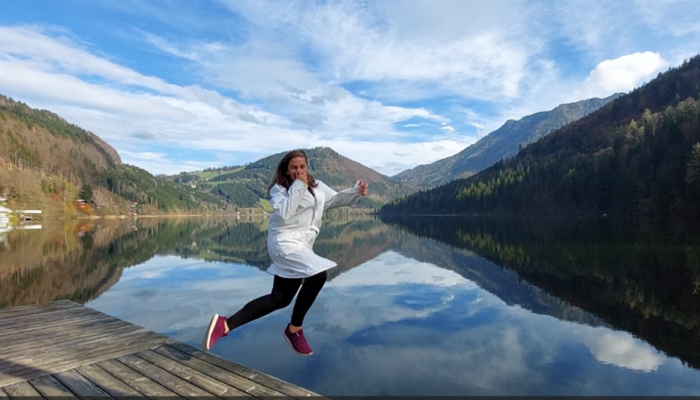
This was the moment when our video duet lesson really started to take shape. Yes, we’d already sketched the idea for a lake stratification lesson months earlier when we applied for EGU’s Teacher–Scientist Pairing Scheme, supported by the Education and Outreach committees, but we wanted an opening that would stop students in their tracks. Nothing like a cold plunge to get everyone’s attention!
We begin by introducing ourselves: Sarah, a Ms. Frizzle–type middle school science teacher (sadly without her magic school bus), and me, Laura, a scientist who’s eager to share her excitement about research with the world. Luckily, we’re sisters-in-law, which made it easy and fun to work on this together.
The process of creating the lesson was, in itself, a teaching duet. With every new concept I wanted to introduce, Sarah was there to help me understand what her students needed. We traded notes constantly: what’s essential for grasping lake stratification, what’s going to be confusing, and what will make students lean forward. Laura (that’s me) brought in the science: stratification, lake habitats, the thermocline, seasonal turnover, density differences with temperature, and how light and mixing affect oxygen and life in different layers. Sarah translated those into classroom-ready pieces, which were simple, clear messages, quick checks for understanding, and interactive worksheets like Habitat House Hunters, where students find homes for lake plants and animals in the different layers based on temperature, light, and oxygen conditions.
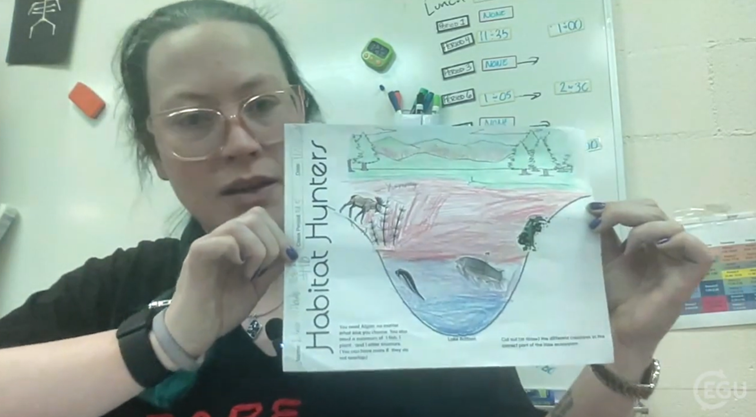
Sarah, the co-author of this post, sharing an example of the Habitat Hunter worksheet completed by one of her students.
We wanted the lesson to feel like an invitation: lakes aren’t just pretty scenery; they’re layered, dynamic ecosystems. So we built a narrative around the question, “Where would different organisms live and why?” From there, we eased into the vocabulary and the visuals. The video walks through the structure of a stratified lake (epilimnion up top, metalimnion in the middle, hypolimnion below) and pauses at the thermocline as a turning point. The thermocline isn’t just a line on a graph; it’s a boundary that shapes how heat, oxygen, and nutrients move. We paired footage from the lake with simple diagrams so students could see what the words describe and how the science shows up outdoors.
Because students remember what they experience, not just what they hear, we layered in hands-on elements. In the classroom, Sarah uses a clear container, water at different temperatures, and a bit of food coloring to show density differences. In the video, you see temperature depth profiles and lake diagrams during different seasons (as well as pictures of lakes during these seasons. We kept the content focused and visuals strong, always circling back to the big ideas: warm water floats, cold water sinks, mixing matters, and living things track those changes.
To show what happens in a lake, Sarah explores the density of warm and cold water, using clear containers, water, and a bit of food coloring. While less-dense, warm water (red) floats above cold water (blue), denser cold water mixes with the bottom cold water.
Behind the scenes, our Google Doc looked like a wall of sticky notes: segment ideas, demo setups, ways to rephrase a sentence so it lands with sixth graders. We’d ask: Is “thermocline” too complicated a term? Are we asking students to remember too many new words at once? Can we swap jargon for images? Sarah’s classroom instincts kept us honest. I’d get excited about adding a bit on turnover, and she’d say, “Yes, but one clear example, and let’s scaffold it with a question they can answer.”
The result is a tight, accessible lesson that still feels like real science. Students get to see the lake as a system: the sun warming the surface, wind mixing the top layer, the thermocline holding its line until seasonal changes break the stratification and the whole water column turns over. From there, the Habitat House Hunters activity asks them to think like ecologists: If you’re phytoplankton, where’s your best “address”? If you’re a cold-loving fish, what’s your layer and why? What happens when oxygen gets used up in deeper water?
Our end product was just a tiny slice of our spate of brainstorming notes. Honestly, we could have created a semester’s worth of lessons about lakes, food webs, invasive species, nutrient cycles, human impacts, and winter dynamics under ice. The video lesson and all teaching materials are available online following the links shown below:
- The full video lesson, with chapter markers for easy pausing (watch video)
- A teacher’s guide (embedded at the end of the video) with lesson objectives, timing, and tips
- Printable Habitat House Hunters worksheets (download here)
If you’re a teacher, we hope this feels ready-to-use. If you’re a scientist, we hope it’s a reminder that translating your work for students is about choosing the right entry points and building from there. For us, the partnership was the magic: Sarah kept our message clear and student-centered, and I kept the science accurate and alive. The duet made the lesson better than either of us could have made alone.
And yes, the lake was really cold.
Are you interested in creating a teacher-scientist pairing video? Then get in touch with the Outreach Committee: outreach@egu.eu