
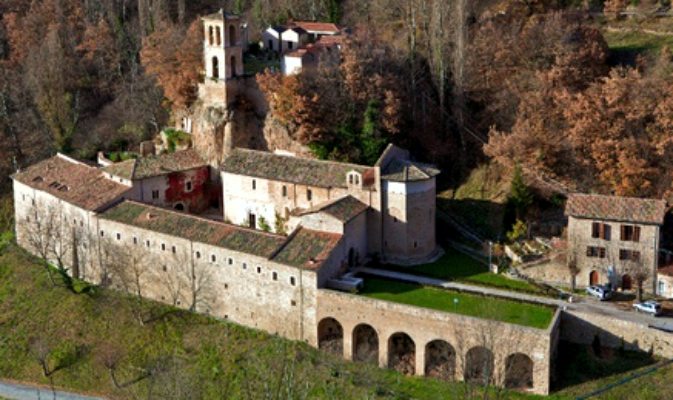
With today’s post, I would like to temporarily leave (geo)myths behind and enter (geo)history. I was first introduced to the following historical account by Professor Francesco Brozzetti of the University of Chieti (Italy), whose extensive knowledge of the Apennines of Central Italy extends well beyond geology.
Geological Origins of Monasticism
This is the brief history of how monasticism spread through the occidental world from a small deposit of Pietra Sponga, whose natural caves formed near the village of Preci, in Central Italy (Fig. 1). Pietra Sponga is the traditional term used in Central Italy to identify porous carbonatic rock deposits, nowadays classified as either calcareous tufa or porous travertine.
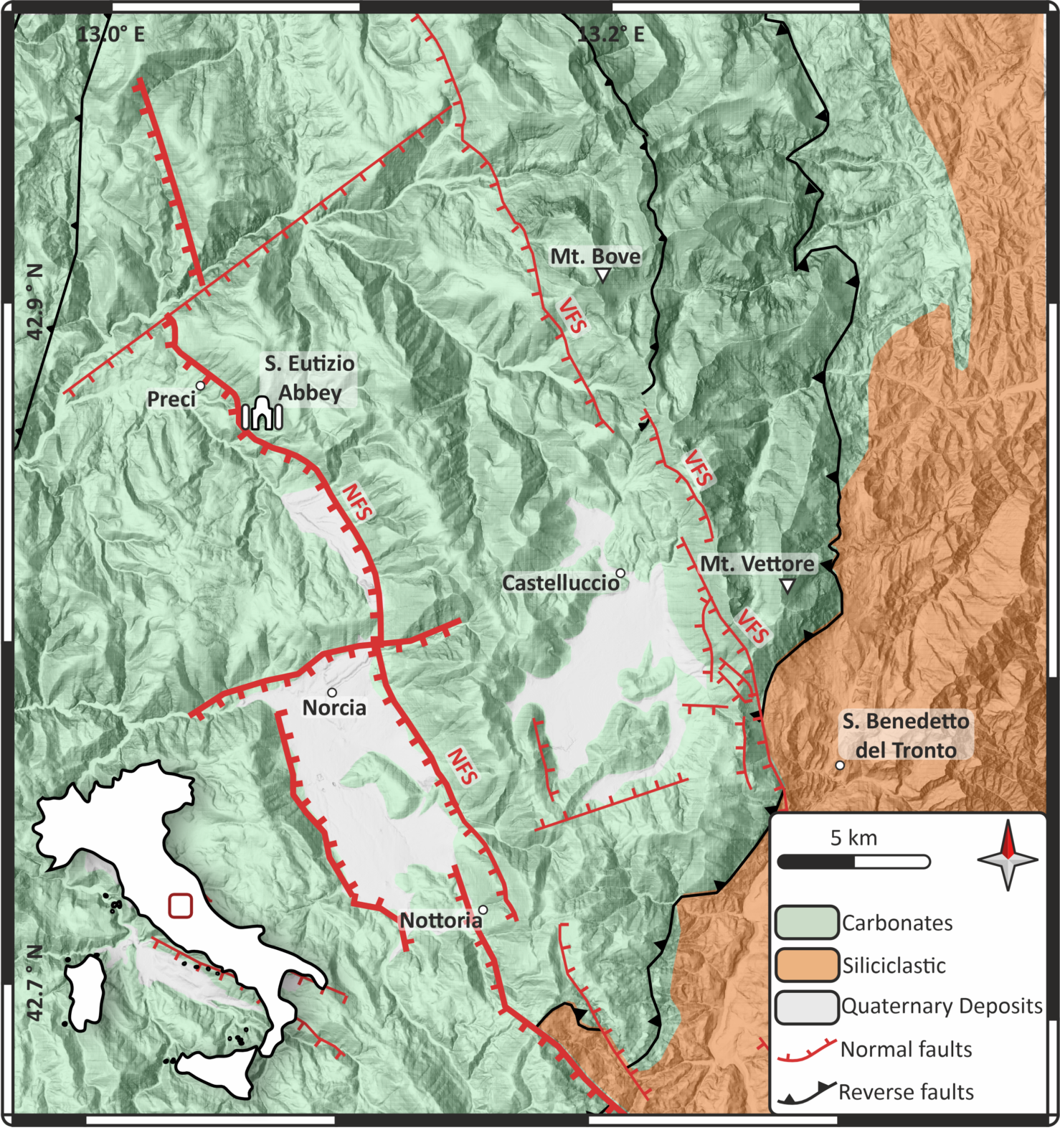
Fig.1. Geological map showing: i) the location of Preci and Nottoria villages, which give the name to the Nottoria-Preci fault section pertaining to the Norcia Fault System (NFS); ii) the location of the S. Eutizio Abbey; iii) the Vettore Fault System (VFS); iv) the carbonate and siliciclastic rocks, as well as continental Quaternary deposits.
Travertine and calcareous tufa are terrestrial carbonate deposits whose precipitation occurs from bicarbonate-rich saline waters emerging at thermal springs. Their formation is driven by the degassing of carbon dioxide (CO2) from carbon-rich waters, according to the reaction:
H2O + CO2 + CaCO3 ↔ Ca(HCO3)2
Degassing occurs due to (i) fluid pressure drop, (ii) turbulent fluid flows, and (iii) biological activity (e.g., Brogi and Capezzuoli, 2009). These processes are controlled by the geological environment hosting the springs, which in turn influences the facies and morphologies of the deposits (e.g., Mancini et al., 2021).
In particular, the rise of bicarbonate-rich thermal waters from relatively deep-seated reservoirs may be influenced by interconnected brittle structures (i.e., faults and fractures) developed within carbonatic rocks, which increase rock permeability (Fig. 2).
However, such permeability is limited in time because of voids infilling and sealing. Consequently, prolonged hydrothermal activity can be maintained only by continuous faulting and fracturing, promoting the (re)opening of fluid conduits (Brogi et al., 2012). Travitonics is the term coined to highlight the strong connection of travertine and tufa deposition with faulting (Hancock et al., 1999).
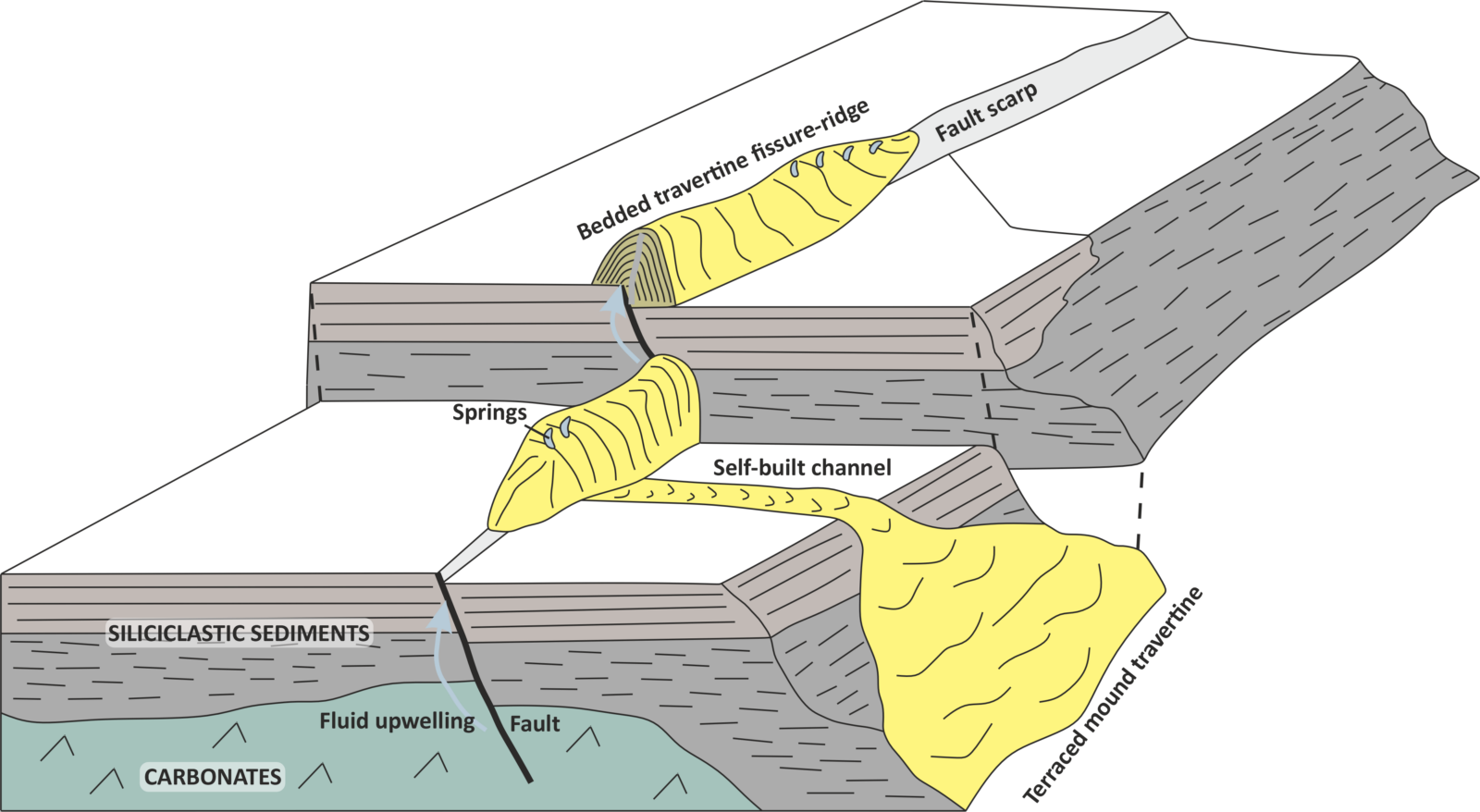
Fig.2. 3D sketch illustrating the geological relationships between normal faulting, hydrothermal circulation, and travertine fissure-ridge, idealized from the case study in Terme S. Giovanni (Italy). Modified after Brogi and Capezzuoli (2009).
A few kilometres south of Preci (Fig. 1), travertine and/or calcareous tufa deposits crop out in proximity to a major fault that likely acted as conduits for fluid migration over a relatively long time. This fault, known in literature as the Nottoria – Preci Fault, is a major tectonic seismogenic structure, pertaining to the Norcia Fault System (NFS, Fig. 1). The NFS has been seismically active since the late Pleistocene (ca. 30 ka) with a minimum slip rate of ca. 0.8 mm/yr, and an average recurrence time (time passed between two different earthquake sequences) of ca. 1.8 kyr, promoting up to 6, Mw ≥ 5.7 events (Galli et al., 2018). The southern portion of the same system also moved during the last destructive 2016-2017 Central Italy earthquake sequence, following the activation of the Monte Vettore Fault System (VFS, Fig. 1).
In this context, the tectonically controlled formation of caves associated with a spring, still spilling today, in the surroundings of Preci, attracted the attention and sensibility of a Syrian monk, whose name was Spes. Those natural caves, formed over thousands of years by geological processes, would eventually become the birthplace of monasticism in the Occident.
Historical Origins of Monasticism
During the fifth century, the Italian Apennines witnessed an important hermitic movement thanks to the arrival of Syrian monks, who fled the theological controversies, as well as political and ecclesiastic conflicts that followed the Christological councils in the Orient. Around 450 CE, the monk Spes remained apparently captivated by the natural wonders of the Apennines, and in particular by tufa caves, where he eventually founded a first hermitage. Around it, a broader hermitic community raised through the building of new monasteries, where hermits lived in isolation, poverty, meditation, and prey. The first hermitage and monasteries, although described as monasterium by S. Gregorio the Great in his Dialogorum (Nel silenzio delle abbazie, 2004), were actually simple caves and/or huts.
According to S. Gregorio the Great’s Dialogorum (Book IV, Chapter 10), Spes was preserved from eternal perdition by God himself, who had Spes undergo blindness; at the same time, God granted him extraordinary grace and deep interior peace. After 40 years, shortly before his death, God miraculously restored his sight and instructed him to preach the importance of the soul’s spiritual light to his disciples. Following the death of Spes, his devoted disciple Eutizio became the spiritual leader of the hermitic community. Under his guidance and following his death, a monastery was established over his tomb and named after him. Only a few fragments remain of the original monastery. The present-day Abbey of S. Eutizio is the result of several phases of construction and expansion spanning from ca. 1000 CE to the 17th century. Before the 2016-2017 Central Italy earthquake sequence, the original hermits’ caves could still be seen beneath the bell tower (Fig. 3).
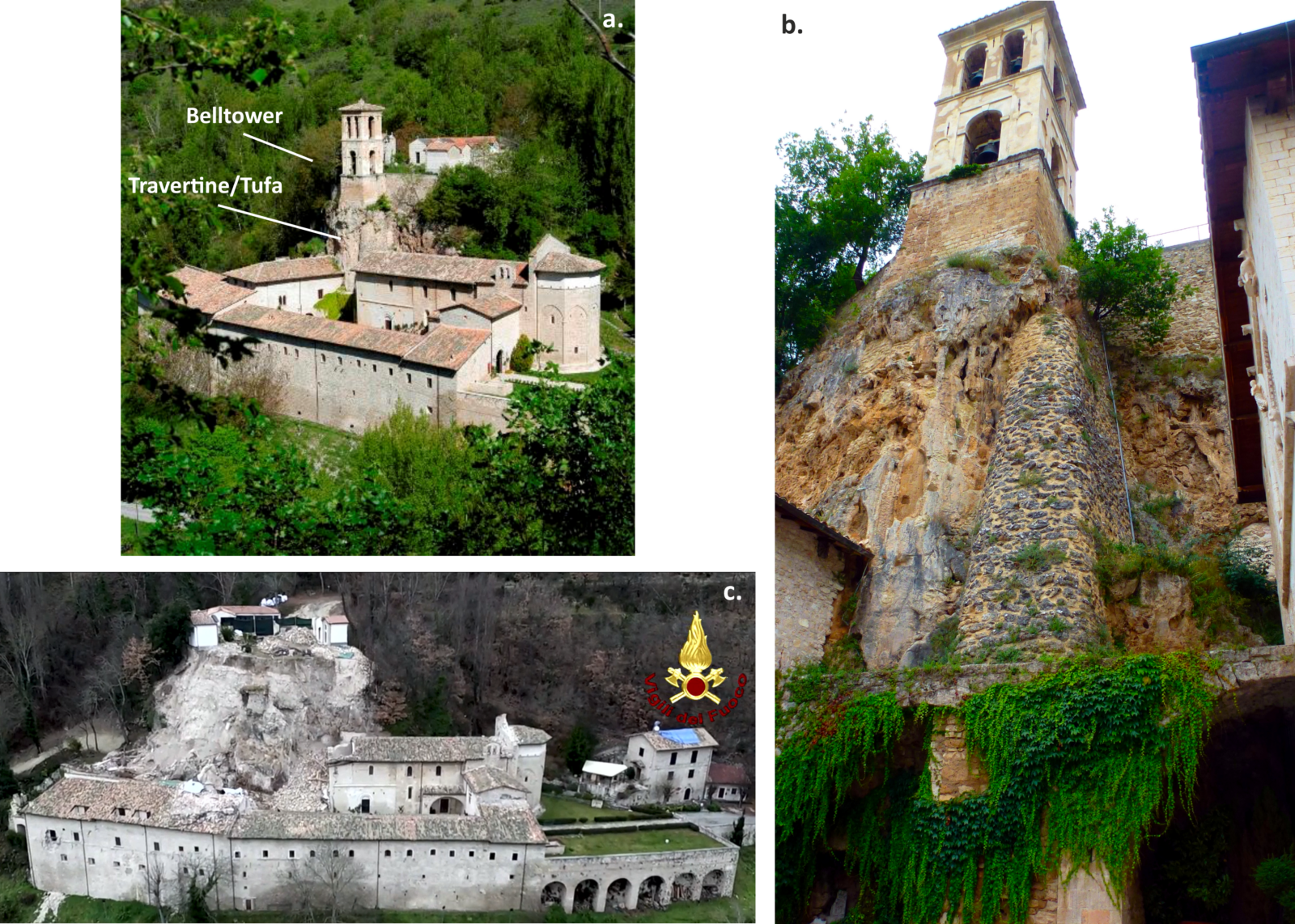
Fig.3. (a) S. Eutizio Abbey before the 2016-2017 Central Italy earthquake sequence (Giulia Sampi via Wikimedia Common); (b) inset over the belltower showing the travertine/tufa deposit and underlying caves (Dino Michelini via Wikimedia Common); (c) S. Eutizio Abbey after the 2016-2017 Central Italy earthquake sequence and before the ongoing reconstruction (extracted frame from a video of the Vigili del Fuoco).
The importance of Spes and Eutizio lies in their role in spreading early monasticism throughout the central Apennines and in influencing a devout Christian named Benedict. Benedict of Norcia accepted the lifestyle and ideologies of the monastic community and established his Benedictine monastic tradition, based on the famous Rule of S. Benedict: ora et labora. Unfortunately, following the 2016-2017 Central Italy earthquake sequence, the S. Eutizio Abbey was severely damaged, and it is now under reconstruction.
Although I consider myself an atheist, I find this history and its connection with geology deeply fascinating. For better or worse, it is remarkable to think how the activity of a seismogenic normal fault, by influencing the circulation of a carbonate-rich thermal water and the consequent precipitation of travertine and/or tufa deposits, may have contributed to the establishment and spreading of monasticism in the Occident.
I would like to thank Professor Francesco Brozzetti again for introducing me to this historical account.
References
Brogi, A., Capezzuoli, E., 2009. Travertine deposition and faulting: the fault-related travertine fissure-ridge at Terme S. Giovanni, Rapolano Terme (Italy). Int. J. Earth. Sci. (Geol. Rundsch) 98, 931–947. https://doi.org/10.1007/s00531-007-0290-z.
Brogi, A., Capezzuoli, E., Buracchini, E., Branca, M., 2012. Tectonic control on travertine and calcareous tufa deposition in a low-temperature geothermal system (Sarteano, Central Italy). Journal of the Geological Society 169, 461–476. https://doi.org/10.1144/0016-76492011-137.
Hancock, P.L., Chalmers, R.M.L., Altunel, E., Çakir, Z., 1999. Travitonics: using travertines in active fault studies. Journal of Structural Geology 21, 903–916. https://doi.org/10.1016/S0191-8141(99)00061-9.
Galli, P., Galderisi, A., Ilardo, I., Piscitelli, S., Scionti, V., Bellanova, J., Calzoni, F., 2018. Holocene paleoseismology of the Norcia fault system (Central Italy). Tectonophysics 745, 154-169. https://doi.org/10.1016/j.tecto.2018.08.008.
Mancini, A., Della Porta, G., Swennen, R., Capezzuoli, E., 2021. 3D reconstruction of the Lapis Tiburtinus (Tivoli, Central Italy): The control of climatic and sea-level changes on travertine deposition. Basin Research 33(5), 2605–2635. https://doi.org/10.1111/bre.12576.
Nel silenzio delle abbazie: Proposte di visita al patrimonio abbaziale del territorio della provincia di Perugia. Provincia di Perugia, Assessorato al Turismo, 2004.
Gregorio the Great’s Dialogorum, Book IV, Chapter 10. https://www.tertullian.org/fathers/gregory_04_dialogues_book4.htm. Last visited on 26.06.2026.



Antos
Davvero molto interessante.complimernti al dottor Carboni
Gianpi
Complimenti.Rigoroso e interessante
Filippo Carboni
In the specific case of the Abbey of St Eutizio, it is, if you like, more of an indirect contribution. The beauty of the carbonate tuff outcrops scattered amidst a deciduous woodland certainly evoked a sense of the divine, which in turn convinced the first monks to settle there.
In turn, the tuff deposit was influenced by the presence of a significant active geological structure which has a direct geomorphological effect and which facilitated the passage of fluids to the surface. This first settlement represented the cradle of monasticism in Italy, which subsequently influenced the whole of Europe.