The next European Seismological Commission (ESC) meeting will be held next year in Trieste. This assembly will be the 35th General Assembly. The local organising committee, the National Institute of Oceanography and Experimental Geophysics (OGS), is glad to invite seismologists, geologists and engineers to the 35rd General Assembly of the European Seismological Commission that will be held from 4 ...[Read More]
INVITATION: Special Issue on Georisks in the Mediterranean
A special issue themed “Georisks in the Mediterranean and their Mitigation” is being compiled to be published in Natural Hazards (Springer) (Impact Factor of 1.719) http://www.springer.com/earth+sciences+and+geography/natural+hazards/journal/11069 Manuscripts containing original research or reviews are welcome for submission. They will be accepted or rejected after a peer review process. Topics co ...[Read More]
Who are you? An EGU Seismology Division Visibility Survey
When a PhD student publishes a new paper, of course he/she would like that other scientists will read the work. However, in a busy academic world with many institutional obligations, it might be hard to promote the work and the research you are performing. Social media and blogs, however, can play an important role in research visibility and therefore we can help you! As Early Career Scientists of ...[Read More]
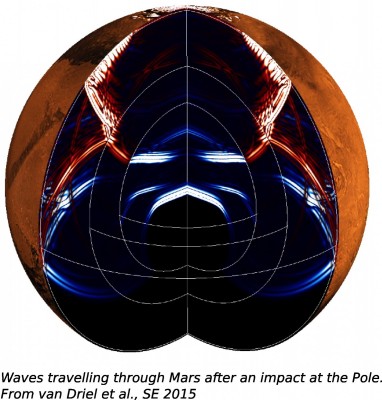
Brewing wiggles on Mars
Creating 1 Hz-seismograms in a 3-D Earth model, and comparing them to observed body waves, is a dream that’s today still too expensive for routine use. But even tackling the problem for a spherically symmetric Earth poses certain challenges. Recently, a new tool entered the stage (you might have followed the Solid Earth discussion): Instaseis allows users to extract seismograms for a spherically s ...[Read More]
Postdoctoral Research Assistant in Planetary Seismology
Applications are invited for a two-year Post-doctoral Research Assistant in Planetary Seismology, within Bristol University’s School of Earth Sciences. The post will focus on NASA’s InSight geophysics mission, which lands on Mars in late 2016. NASA InSight aims to probe the detailed internal structure of Mars for the first time by deploying two tripod-mounted seismometers onto the surface to deter ...[Read More]
What if everyone jumped at once?
One person’s jump is practically negligible when compared to Earth’s internal forces. But, what if everyone jumped together at the same time? There are roughly 7 billion people on Earth, with a total weight of approximately 350 billion kilogram. What if we all jumped together at once? Are we able to shake the planet? Are we able to slow down time? Although this might sound like a fun g ...[Read More]
Young Scientists renamed Early Career Scientists
A message from Laura Roberts the EGU Communications Officer (early career scientists’ contact person at the EGU Office) Following feedback from the 2014 young scientists survey, supported by the findings of the Young Scientist Forum at the EGU General Assembly 2014, the EGU Council has decided to replace the term Young Scientist (YS) by Early Career Scientist (ECS). For the time being, the definit ...[Read More]
Looking for a new position in seismology?
Did you know that EGU has a dedicated page for jobs. The EGU offers a platform for job seekers to find vacancies in the Earth, planetary and space sciences. Available research positions are displayed online. Checkout the seismology jobs currently advertised on the EGU page: https://www.egu.eu/jobs/search/?category=18 Employers can post a vacancy, free of charge, by filling the Job Submission Form.
EGU2016: Call-for-Sessions
The next EGU General Assembly 2016 (EGU2016) will be held again at the Austria Center Vienna from 17 Apr 2016 to 22 Apr 2016. The European Geosciences Union invites you, from now until 18 Sep 2015, to take an active part in organizing the scientific programme of the conference. You can do this at: http://meetingorganizer.copernicus.org/EGU2016/provisionalprogramme Please suggest new sessions with ...[Read More]
Open call for submission: EGU Meetings Support and the launch of the Galileo Conferences
The EGU welcomes proposals of support for the Galileo Conferences: a newly established type of meeting which will be fully supported by EGU. The EGU Galileo conferences address well-focused cutting-edge topics at the frontier of geosciences research. A limited number, typically about one hundred internationally recognised scientists meet for 3-5 days to discuss and debate issues at the forefront o ...[Read More]