The contribution from Sergio León-Ríos, Associate Researcher at the Advanced Mining Technology Center (AMTC) at the University of Chile, where he does seismology research. Introduction Earthquakes and tsunamis are not only purely scientific geophysical phenomena. They are also deeply embedded in social memory, cultural narratives, and everyday life – especially in countries like Chile, where ...[Read More]
What Distributed Acoustic Sensing (DAS) can find in the Atlantic Ocean
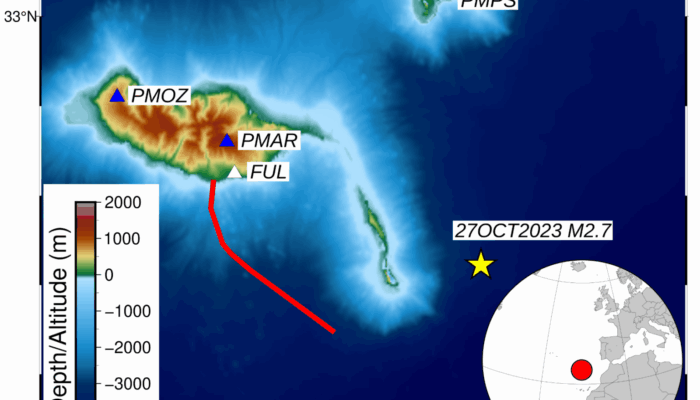
The contribution from David Schlaphorst, the member of ECS SM division team. David is a PostDoc in Dom Luiz Institute (IDL), University of Lisbon, where he does seismology research. Introduction Distributed Acoustic Sensing (DAS) has been used exponentially over the last decade.If you are eager to learn the basics but in song form try this link. In this blog post, we want to dive into one example ...[Read More]
Earthquake Watch: Santorini-Amorgos earthquake swarms
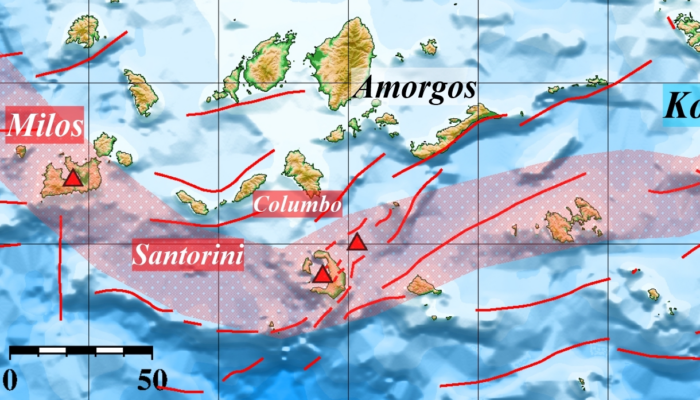
For this Earthquake Watch we are very pleased to have a contribution about the 2025 Santorini – Amorgos seismic sequence, by Dr. Andreas Karakonstantis, a postdoctoral researcher at the University of Patras and National and the Kapodistrian University of Athens. He obtained his Ph.D. in seismology in 2017. Does life move in circles? That is an excellent question to ask, especially in our case rega ...[Read More]
What is Distributed Acoustic Sensing?
In this blog we give a succinct introduction to Distributed Acoustic Sensing for the starting seismologist, or the interested reader. The blog is by no means a complete overview and serves as a starting point for you to understand DAS and get started with the data. It was written by SM ECS members Ana Nap and Katinka Tuinstra. By now, Distributed Acoustic Sensing (DAS) is a pretty widely kn ...[Read More]
Statistical earthquake forecasting – is that possible?
This blog post will take you through what can and can’t be done with statistical earthquake forecasting. We are happy to have it explained by Dr. Leila Mizrahi, who is a postdoctoral researcher at the Swiss Seismological Service (SED) at ETH Zürich. Let’s get started! “My research topic is earthquake forecasting” – “Oh, really, I thought that’s not possible! So, when is the next one going to ...[Read More]
Earthquake of the month: Samos-Izmir earthquake
On October 30th, a strong earthquake with Mw 7.0 occurred in the Aegean Sea, between the main cities of Samos in Greece and Izmir in Turkey. The hypocenter location and focal mechanism suggest shallow depth (~10 km) and normal faulting on the E-W plane. This is in agreement with the tectonic setting where an N-S extension is dominant. Moreover, the rupture propagates near the Menderes Graben in We ...[Read More]
Earthquake of the month: Bransfield Basin – Antarctica M 5.4
As well as August, September was not highlighted by a large event (> M 7). The TOP 3 strongest earthquakes which occurred during this month correspond to a strike-slip earthquake in the Mid-Atlantic Ridge (M 6.9), an interplate EQ in central-north Chile (M 6.8), and another EQ in a different segment of the Mid-Atlantic Ridge (M 6.7). Furthermore, the largest event in Europe occurred on Septembe ...[Read More]
Earthquake of the month: Bengkulu – Indonesia M 6.8-6.9
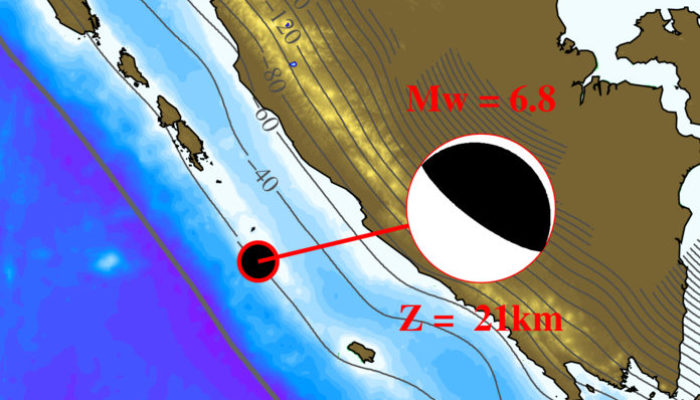
August was not highlighted by a large event (> M7) and the choice for the earthquake of the month was a bit tricky. Four events were available to choose from: An intraplate EQ in the US (M5.1), the largest event in this region since 1916, an M6.6 in the Philippines, a deep earthquake (~620 km) M6.9 in Indonesia, and a doublet earthquake (M6.8 – 6.9) in Indonesia. After some discussion, we ...[Read More]
Earthquake of the month: Simeonof – Alaska M 7.8
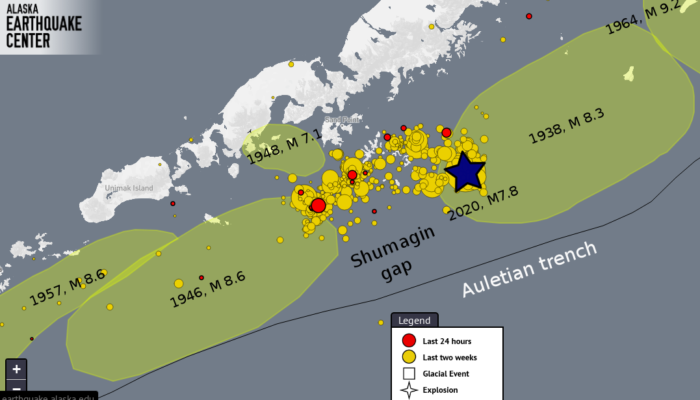
On July 22nd, Alaska was the scene of last month’s largest earthquake, a Mw 7.8 earthquake that hit the Aleutian Islands, offshore the Alaska Peninsula. The hypocenter location, tectonic setting and focal mechanism suggest a megathrust earthquake. The hypocenter of the so called Simeonof earthquake is located at the western edge of the historical 1938 earthquake (M8.3) slip zone, near the Shumagin ...[Read More]
Ten years after the 2010 Maule earthquake: how science and ancestral knowledge build-up resilient societies
At 3:34 a.m. (local time) on February 27, 2010, a magnitude Mw 8.8 earthquake occurred in Central Chile and extended over around 500 km along the Maule and Bio Bio regions, a convergent zone between the Nazca and South America plates (Figure 1a). The occurrence of this large earthquake in the context of active subduction zones, as Central Chile, was expected by many Chilean and European res ...[Read More]