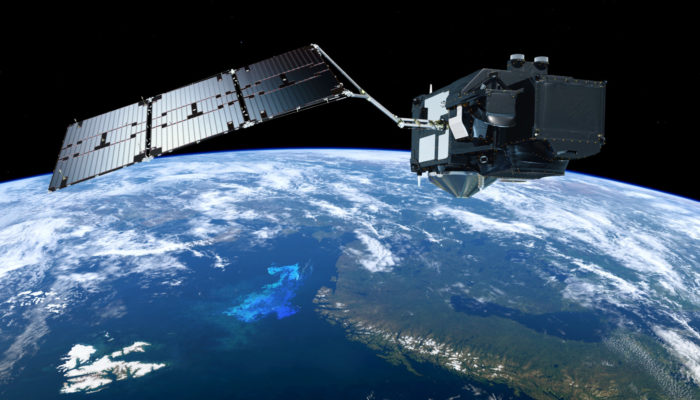
To understand the fundamental behaviour of the ocean, and any changes it’s undergoing, we need to know what the ocean is doing today, and on each day in the recent past. We can do this by creating reanalyses, which use data assimilation to combine state-of-the-art models with observations. The focus is often on ocean physics, but we also need to know about the marine ecosystem and carbon cycle. As ...[Read More]
Eurec4a: Tales from the Tropics
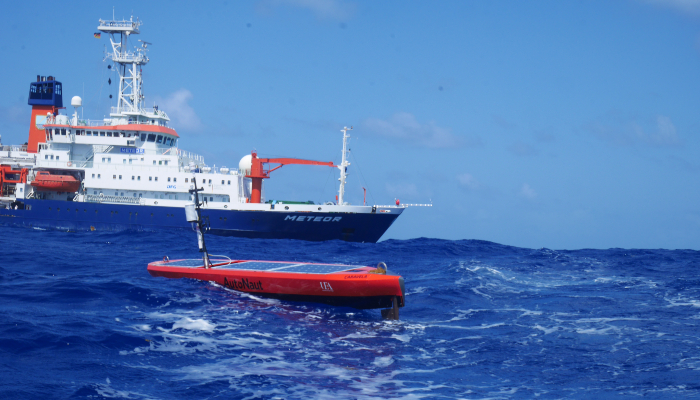
As many seagoing oceanographers find themselves on land for the foreseeable future, we’ve decided to share a tale of a research cruise to fill that ship-shaped void. Back in January 2020, four research vessels ventured out into the Tropical North Atlantic as part of the Eurec4a and ATOMIC campaigns. Eurec4a’s aim: to investigate the couplings between clouds, circulation and convection ...[Read More]
How Climate Models helped uncover the mechanisms behind the North Atlantic Warming Hole
One of the only regions that have been observed to cool over the past century is the North Atlantic cold blob just south of Greenland. In our recent paper, we analyse the cold blob or “warming hole” and the processes that contribute to its creation and evolution. While sea surface temperature has been reliably observed, the underlying mechanisms of changing ocean circulation are only sparsely meas ...[Read More]
Why do mesoscale eddies disappear at ocean western boundaries?
In the ocean, mesoscale eddies are everywhere. In fact, about 90% of the ocean’s kinetic energy is contained within these ubiquitous, ~100 km swirling vortices. We know how these eddies form, through a process known as baroclinic instability, where density surfaces are tilted too steeply and become unstable. What remains unclear however, is what happens to this energy when eddies die. This knowled ...[Read More]