
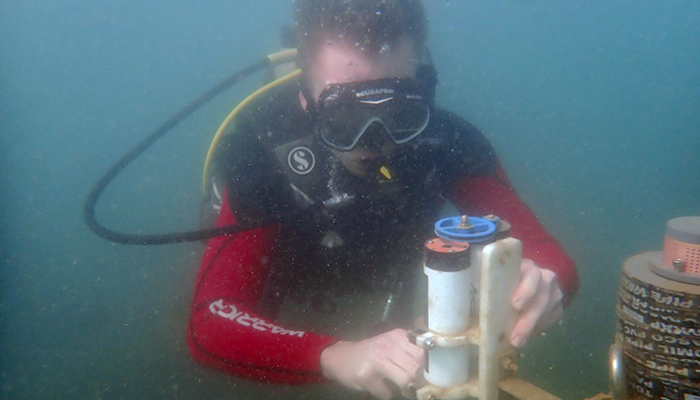
When most people imagine a coral reef, they picture clear, warm, sunny tropical waters. However, the coral communities of Hong Kong live in a vastly different setting. In the shadows of one of the most densely populated coastlines in the world, these corals persist under highly turbid conditions, receiving relatively little light over the year. Water conditions are also highly seasonal, with large changes in temperature, rainfall and nutrient loads between the wet and dry seasons.
These environmental conditions are challenging for coral organisms that normally depend heavily on optimal temperatures, high light and low nutrients to thrive. And yet, Hong Kong’s coastal waters still support highly diverse coral communities (> 90 hard coral species), including locations where corals cover much of the seabed.
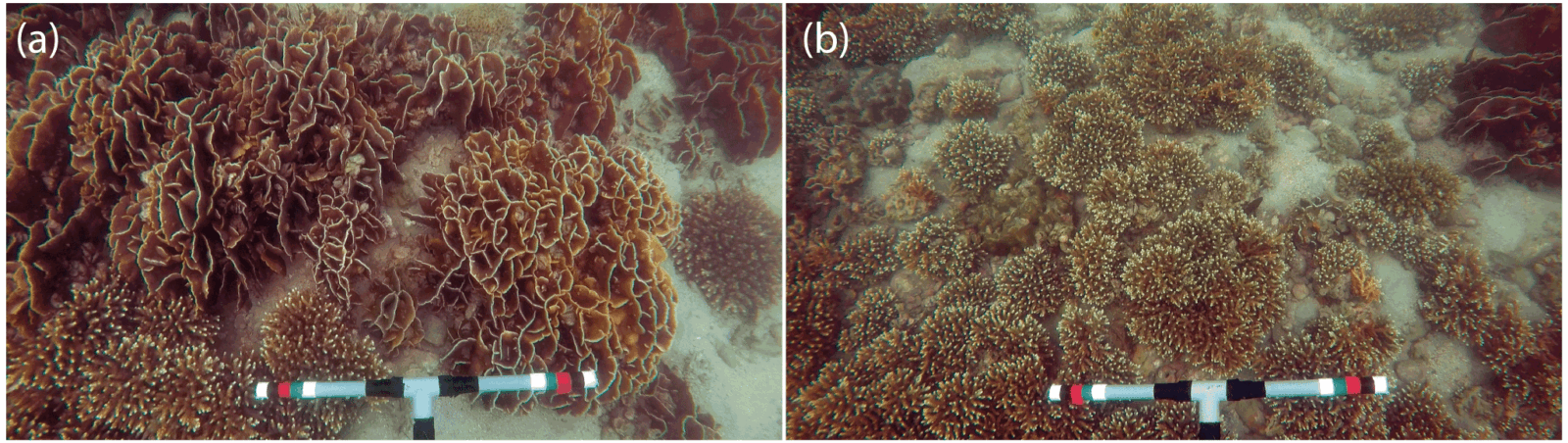
Figure 1: Examples of high coral-cover, but low net ecosystem productivity, communities found in Sharp Island variably dominated by (a) cactus corals (Pavona) and (b) branching corals (Acropora). Note: these images taken during rare conditions of good visibility in Hong Kong. Scale bar is 50 cm wide. (Photo credit: Yu-De Pei)
This makes Hong Kong a useful natural laboratory for determining how coral communities might function under future coastal conditions, where climate change and coastal development may make conditions more challenging for corals to thrive. A central motivation for this study was to look beyond coral cover as the default way of judging how well a coral community is doing. High coral cover can tell us that corals are present and persisting but does not necessarily tell us how the whole community is functioning. To address this, we measured net ecosystem production, a measure of whether a whole community is producing more organic carbon through photosynthesis than it consumes through respiration, at several sites across Hong Kong.
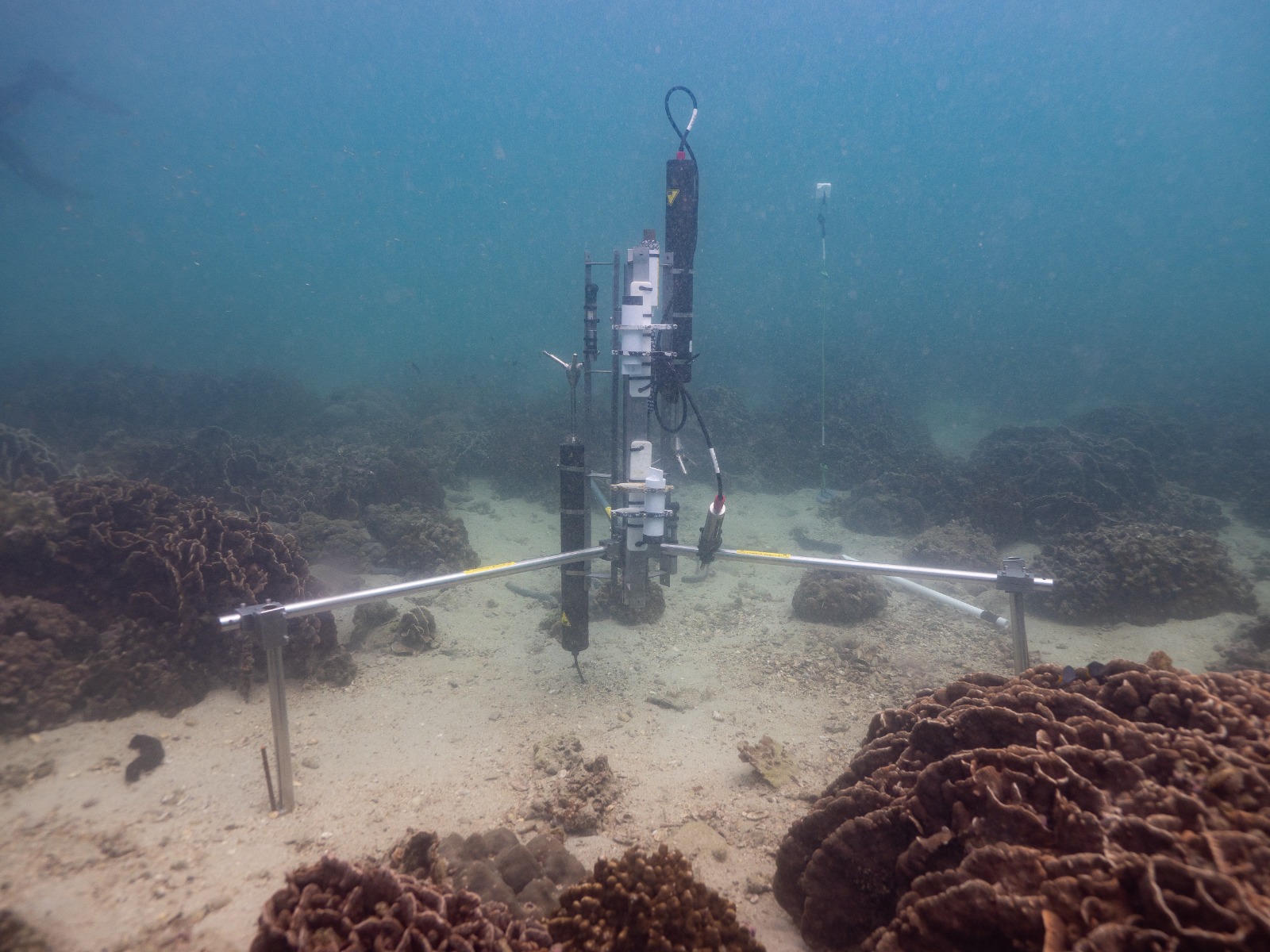
Figure 2: The gradient flux system deployed in a coral community at about 3 m water depth at Sharp Island, Hong Kong to measure net ecosystem production rates from dissolved oxygen exchange across the benthic boundary layer. (Photo credit: Markus Rummel)
When net ecosystem production is positive, it means the community is net productive in terms of organic carbon. When it is negative, the community consumes more organic carbon than it is producing. One striking result from the study was that even sites with moderate to high coral cover had low or negative net ecosystem production. In other words, visually coral-rich communities were not necessarily highly productive at the community scale. This pattern of low or negative net ecosystem production was observed in both the wet and dry seasons. This does not mean that these corals are “failing”. Rather, it shows that survival, coral cover and ecosystem productivity are related but not interchangeable.
Our findings suggest that visual surveys of coral cover and diversity should be combined with direct measurements of biogeochemical processes whenever possible to improve understanding of the community’s underlying function. The study also showed the difficulty of measuring reef function in a highly heterogeneous coastal environment. We had also hoped to measure carbonate cycling, including whether the community was building or losing calcium carbonate reef structure. However, in Hong Kong’s highly dynamic coastal setting, those measurements were not robust enough to interpret confidently, so we chose not to include them in the final study. Rather than over-interpreting uncertain data, we focused on the measurements we could support confidently. Future work combining organic carbon cycling with carbonate cycling will help build a more complete picture of how these communities function.
The wider implication of this study is that coral communities living under marginal environmental conditions, such as those found in the urbanized coastal waters of Hong Kong, may persist through alternative pathways that do not match the classic clear-water reef model. Assessing their future trajectories requires measuring function directly, rather than relying solely on visual metrics of the community. Hong Kong’s corals show that a coral community can persist under difficult conditions, but persistence alone does not tell the full story. To understand the future of coral reefs, especially in increasingly urban and turbid coastal waters, we need to measure not only what a reef looks like, but also what it is doing.
Read the paper in Biogeosciences: King, T. B., Pei, Y.-D., Bennett-Williams, J., and Wyatt, A. S. J.: Net ecosystem production of coral communities persisting under marginal environmental conditions, Biogeosciences, 23, 6267–6286, https://doi.org/10.5194/bg-23-6267-2026, 2026.