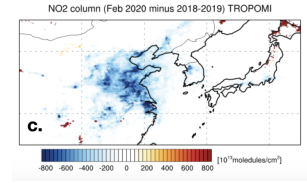
While a previous blog entry dealt with the question whether we can use lessons from the nonlinear nature of climate for projections of the Covid-19 pandemic, there is now a first example of how the pandemic can teach us something on climate. The several weeks long lockdown of China made February 2020 an exceptional month …[Read More]
Nonlinear Processes in Geosciences
#shareEGU20: Networking event of the NP Division
The current COVID-19 situation has profoundly changed our daily lifes and has also affected our way to perform and share research. In today’s world a lot of efforts have been made to minimize the impact of working from home and exchange thoughts with colleagues, and also the usual annual General Assembly of the European Geosciences …[Read More]
NP Interviews: the 2020 Lewis Fry Richardson Medal Valerio Lucarini
Today’s NP Interviews hosts the 2020 Lewis Fry Richardson Medal Valerio Lucarini. Valerio (b. Ancona, Italy, 1976) is the Director of the Centre for the Mathematics of Planet Earth and Professor of Statistical Mechanics at the University of Reading, and former Professor of Theoretical Meteorology at the University of Hamburg. His main expertise is in …[Read More]
NPG Paper of the Month: “Application of a local attractor dimension to reduced space strongly coupled data assimilation for chaotic multiscale systems”
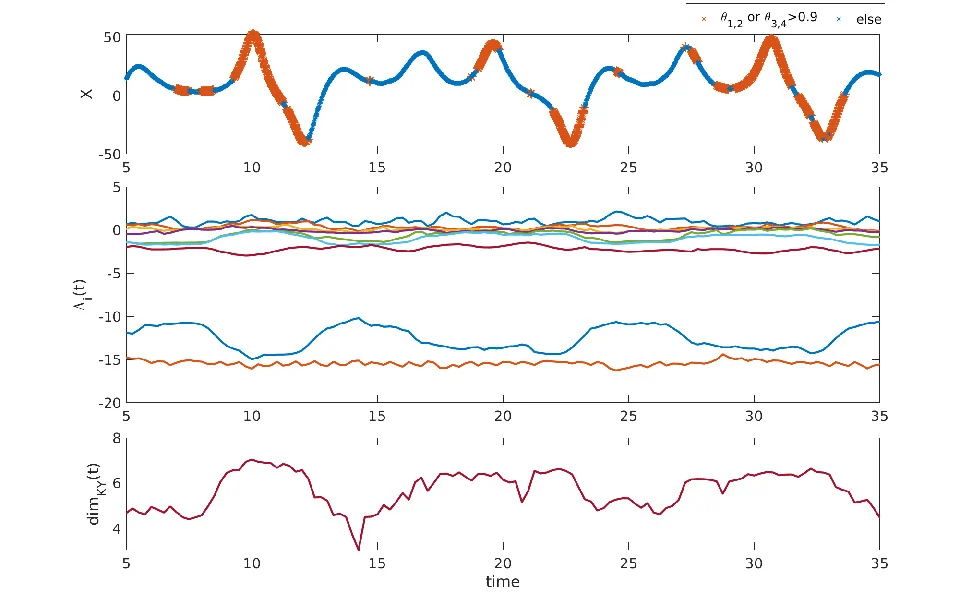
This month the NPG Paper of the Month award is achieved by Courtney Quinn for her paper “Application of a local attractor dimension to reduced space strongly coupled data assimilation for chaotic multiscale systems” (https://www.nonlin-processes-geophys.net/27/51/2020/). Dr. Courtney obtained her PhD in Mathematics at the University of Exeter (UK) researching critical transitions in dynamical systems. She …[Read More]
How Climate Sciences can help in understanding uncertainties in Covid-19 epidemic projections
COVID-19 is currently affecting over 180 countries in the world and poses serious threats to public health as well as economic and social stability of many countries. Modeling and extrapolating in near real-time the evolution of COVID-19 epidemics is a scientific challenge, which requires a deep understanding of the factors undermining the dynamics of the …[Read More]
NP Interviews: the newly elected NP Division President François Schmitt
Today’s NP Interviews hosts the newly elected NP Division President François Schmitt. François has a PhD degree from Université Pierre et Marie Curie in Paris (1993), in atmospheric turbulence, and an Habilitation degree from the same university (2001). He has stayed in Belgium during 6 years as a post-doc, working in meteorology and in fluid …[Read More]
The 2020 extra-tropical monster cyclones and their (possible) relations with climate change
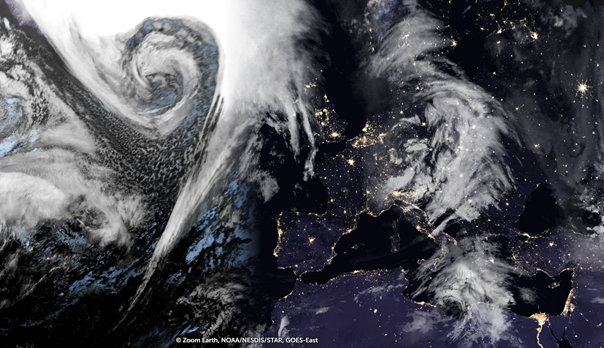
On February 9th, a British Airways Boeing 747 landed in London Heathrow airport just four hours and 56 minutes after its take-off in JFK, New York, setting the shortest flight-time for non-supersonic jets over this route. The jumbo jet took advantage of the fast upper-tropospheric winds associated with an exceptionally strong jet-stream which created tail …[Read More]
NPG Paper of the Month: “On fluctuating momentum-exchange in idealised models of air-sea interaction”
This month the NPG Paper of the Month award is achieved by Achim Wirth for his paper “On fluctuating momentum-exchange in idealised models of air-sea interaction” (https://www.nonlin-processes-geophys.net/26/457/2019/). Achim tells us about the importance of the results achieved with this paper for investigating the energy coupling between the ocean and the atmosphere. Achim obtained his PhD …[Read More]
Why Bushfires raged out of control across Australia?
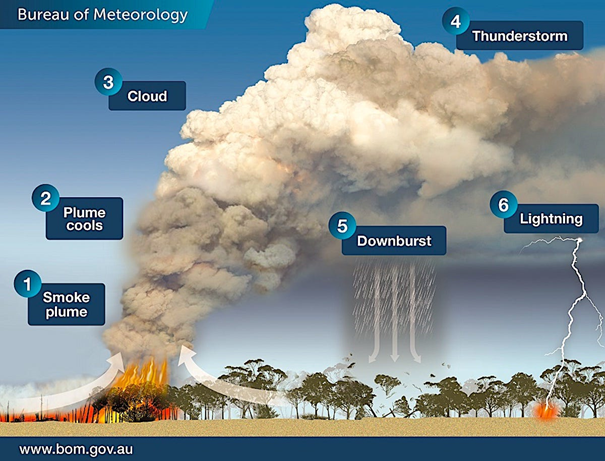
Australian wildfires have burned an impressively large surface and caused the death of at least 24 citizens as well as of numerous animals. This immense disaster raises questions about its linkage with climate change, the possibility of controlling these events and the future of Australian wildlife ecosystems. While the first question will be addressed by …[Read More]
Medicanes, thunderstorms and Acqua Alta in Venice: what is the role of climate change?
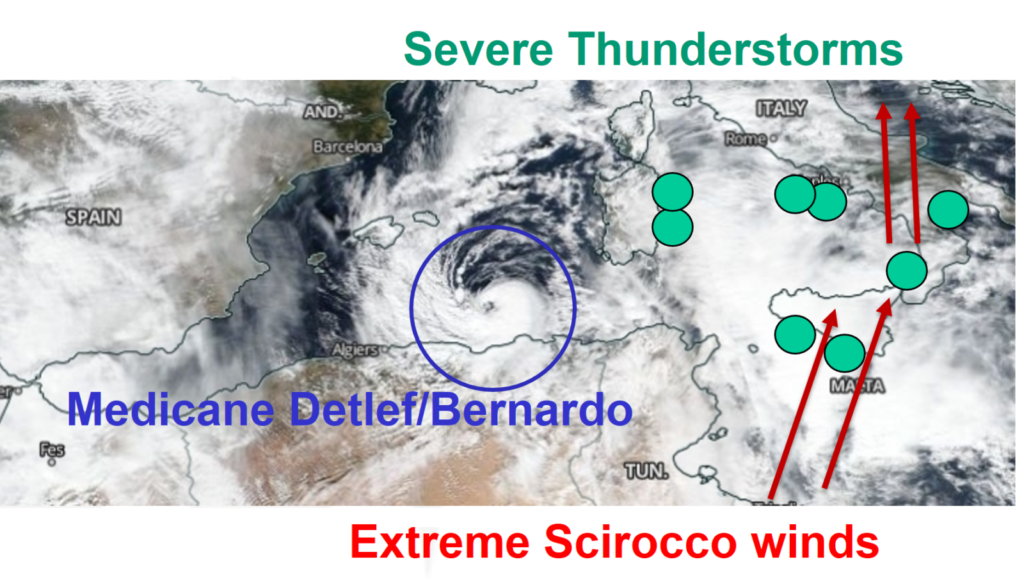
A Mediterranean cyclone, high tides and climate change: these three ingredients made the 12/11/2019 acqua alta event in Venice exceptional. This combination of causes determined what climate scientists define as a compound extreme event, a non-linear mix of factors which led to several and connected extreme weather phenomena in the Mediterranean area. Let us start …[Read More]