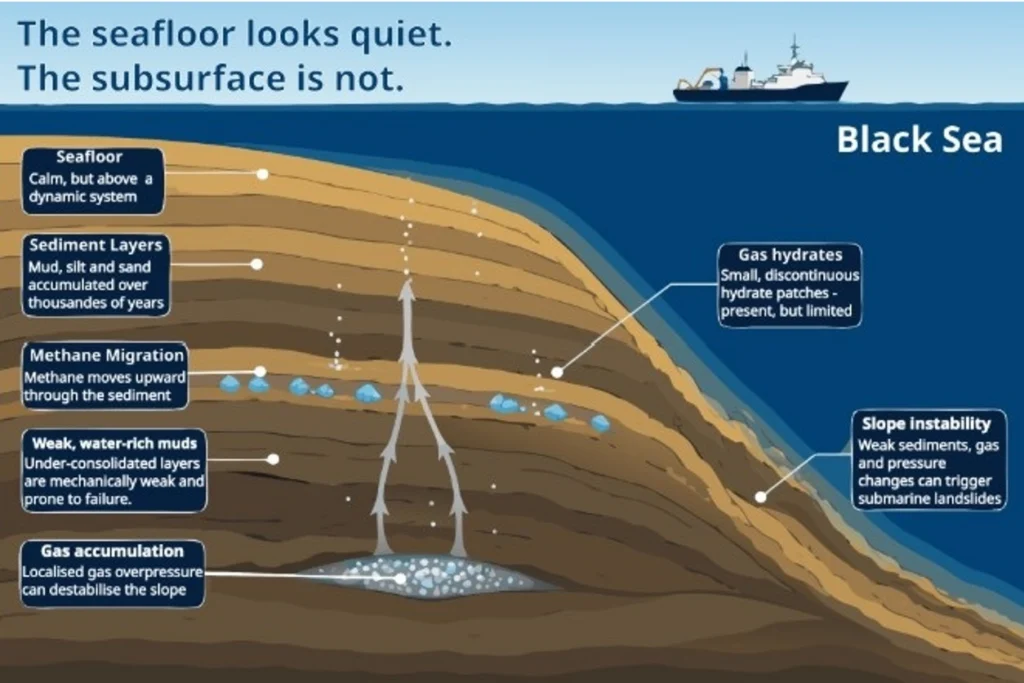
Quiet, boring and unchanging? This is probably how most people imagine a typical seafloor. In reality, it is the complete opposite.
The Black Sea is a good example of why geology rarely follows simple expectations. At first glance, it seems an ideal place for gas hydrates: ice-like structures in which methane is trapped under high-pressure and low-temperature conditions [16]. These structures have attracted considerable interest because they store methane, the main component of natural gas, and are therefore considered a potential future energy resource. However, extracting this gas safely and economically remains a major challenge [5].
The Black Sea has many of the ingredients for gas hydrate formation. Its sediments are rich in organic material, methane occurs beneath the seafloor, and geological changes have repeatedly shifted the conditions under which hydrates form and remain stable [8,15]. Yet having the right ingredients does not guarantee the expected result. The Black Sea’s seismic record preserves traces of a dynamically changing gas hydrate system, yet that does not mean that large amounts of gas hydrates remain today.
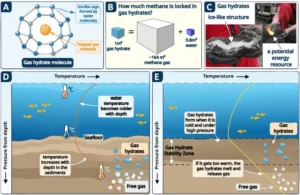
Figure 1. Gas hydrate structure, methane storage capacity and stability conditions in marine environments. (A) Methane molecules trapped within ice-like cages formed by water molecules. (B) Approximate volumes of methane gas and water released by dissociation of 1 m³ of gas hydrate; the gas volume refers to standard conditions. (C) Photographs of natural gas hydrate samples, including a burning sample demonstrating the presence of methane. (D) Temperature variations with depth in the water column and beneath the seafloor, together with the distribution of gas hydrates and free gas in marine sediments. (E) The gas hydrate stability zone, illustrating the pressure and temperature conditions under which hydrates can form and the release of methane gas when temperatures exceed the stability limit. Schematic illustrations, not to scale. Photographs: MARUM – Center for Marine Environmental Sciences (distributed via imaggeo.egu.eu).
This distinction matters for another reason. Gas hydrates are often discussed not only as potential energy resources, but also as a possible contributor to submarine slope failure. When hydrates break down, they can release methane and alter the pressure of fluids in the pore spaces between sediment grains, potentially weakening the seabed [17]. And there is another puzzle. Along the northwestern Black Sea margin, submarine landslides have left scars on the seafloor and deposits of displaced sediment [7,10]. But what happens when a slope fails in a place where gas hydrates are surprisingly scarce? What if the most important clue is actually the sediment?
Let’s explore together the evidence from the Danube Fan and how various geophysical data and drilling results reveal a different picture of what may contribute to slope instability: weak, water-rich mud and migrating methane, even where gas hydrates appear to be scarce.
Looking beneath the seafloor
This question led us to the Danube Fan, where sediment carried by the Danube River has accumulated on the seafloor over thousands of years. Layer upon layer of mud, silt and sand built up a complex underwater landscape that has been reshaped by submarine landslides [13].
From the seafloor alone, it is difficult to tell what makes a slope vulnerable. The clues lie beneath it, hidden in the strength and layering of the sediment, and how methane accumulates and moves through these layers. Gas can spread sideways through sediment layers with connected spaces between the grains, or migrate upwards through narrower zones that act as pathways towards the seafloor.
To investigate what lies beneath the surface, we combined several kinds of evidence. Seismic surveys use sound waves to reveal buried layers and structures. Ocean-bottom-seismometers record how seismic waves travel through the seabed, helping us to estimate how the physical properties of the sediments change within the study area [2]. We compared these results with drilling observations, which provide a more direct view of the material beneath the seafloor [15]. Each dataset offered a different clue. The challenge was to work out whether they told the same story.
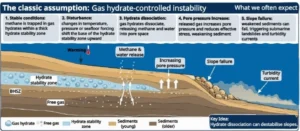
Figure 2.The classical view of gas hydrate-controlled slope instability. Hydrate dissociation releases methane, increases pore pressure, and may trigger slope failure (based on Sultan et al. (2004) and Xu et al. (2018)). Illustration not to scale, vertically exaggerated.
The container-sized drill rig repeatedly sank approximately 3 m into the soft sediments.
A different story emerges
What emerged was a surprisingly coherent, but unexpected picture. The first surprise was that the sediment itself is remarkably soft. Our seismic models indicate that sound waves travel unusually slowly through these layers, while drilling results reveal that the shallow layers contain water-rich mud that has not fully compacted under the weight of the sediment above it. Field observations provide another indication: during the drilling campaign, the container-sized drill rig repeatedly sank approximately 3 m into the soft sediments in the study area, making it difficult to land and operate the equipment [3]. In other words, the sediment is already mechanically weak, even before we consider what the gas might be doing. This makes it more vulnerable to changes in pressure and other disturbances [15].
Then came another clue: methane is moving through the seabed.
In the seismic images, we found structures consistent with gas trapped in sediment and moving through it. In some places, the pattern of reflected sound waves changes in a way that can indicate the presence of free gas. One indication is a reversal in the polarity of the seismic signal. This happens because gas bubbles make the sediment more compressible, reducing the speed at which sound waves travel through it and causing a contrast with the surrounding sediment. This produces a seismic reflection with the opposite polarity. We also identified a possible seismic chimney: a vertical zone that may mark a pathway for gas rising through the sediment. Similar gas migration pathways have been documented elsewhere in the western Black Sea [10, 18].
But the third clue brought us back to the original puzzle. Gas hydrates appear to be scarce. The seismic data contain signals associated with the gas hydrate system, known as bottom-simulating reflectors or BSRs. These reflectors run roughly parallel to the shape of the seafloor and often mark the base of the zone where gas hydrates can be stable [14]. They can also preserve evidence of past changes in that zone as a response to shifts in the climate, sea level or in the subsurface conditions [15]. Therefore, their presence does not necessarily mean that large amounts of hydrate remain today [8].
The available drilling evidence points instead to small, scattered amounts of hydrate, rather than thick, widespread deposits [11]. Within the limits of our measurements, we found no clear indication that these hydrates substantially strengthen the surrounding sediment [9].
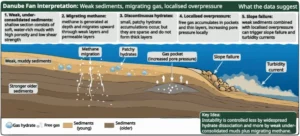
Figure 3. A different story beneath the Danube Fan. Seismic and drilling observations point to weak sediments and migrating methane as possible contributors to slope instability, despite the apparent scarcity of gas hydrates. Inspired by Hilbert et al. (2026); not to scale, vertically exaggerated.
Why can weak mud matter more than gas hydrates?
Put the clues together and the picture looks different from the classic hydrate-centred explanation. The sediment is already weak. Methane moves through it. Yet there is little hydrate to account for the instability. Could gas pressure make a vulnerable slope even less stable, without large amounts of gas hydrates being involved?
Our findings suggest that this is a plausible explanation. When pressure builds in the fluids between sediment grains, it can reduce the contact between grains that helps them support the weight above. In already weak mud, this could make a slope more prone to failure. There is an important limit to what we can conclude, however. Our observations do not establish what triggered any individual submarine landslide, or whether gas migration began before or after a failure occurred or was facilitated by it. The evidence points to a possible mechanism, not a definitive reconstruction of every failure.
When the unexpected is the clue
The Danube Fan tells a different story from many well-known gas hydrate provinces. Systems such as the Amazonas Fan [12], the Krishna-Godavari Basin [6], and the Mississippi Fan [4] contain substantial hydrate accumulations. The Danube Fan, by contrast, combines scarce hydrates with weak sediments and migrating methane.
That contrast matters. Gas hydrates are one possible contributor to submarine slope failure, but are not the only process worth considering. Studies from continental margins illustrate this; off northern Norway, weak, water-rich sediment layers have been linked to submarine mass movements even though no evidence of gas hydrates was found [1]. These weak layers acted as sliding surfaces, allowing the overlying sediment to move downslope. This example highlights why sediment strength and fluid pressure also deserve attention, particularly in places where hydrates play little or no role.
For us, one of the most rewarding parts of this study was seeing how different datasets complemented one another. No single dataset could tell the whole story. Only when we brought these perspectives together did a different explanation begin to emerge. And that is what makes geoscience so fascinating: the Earth does not always cooperate with our expectations. Sometimes, the most valuable discovery is not finding what we thought should be there, but understanding what the unexpected evidence is trying to tell us.
In the Danube Fan, the answer may not be spectacular amounts of gas hydrate. It may begin with something much less dramatic: weak mud, migrating methane and the hidden pressures beneath the seafloor. These processes matter not only because they may contribute to submarine slope failure, but also because they remind us that the potential of gas hydrates as an energy resource cannot be considered in isolation. Any attempt to extract methane from beneath the seafloor would also need to account for the stability of the sediments hosting it.
References:
[1] Baeten, N.J. et al. (2014). Origin of shallow submarine mass movements and their glide planes—Sedimentological and geotechnical analyses from the continental slope off northern Norway. JGR Earth Surface, 119, 2335–2360. doi:10.1002/2013JF003068
[2] Bialas, J. et al. (2020). Joint interpretation of geophysical field experiments in the Danube Deep-Sea Fan, Black Sea. Marine and Petroleum Geology, 104551. Doi: 10.1016/j.marpetgeo.2020.104551
[3] Bohrmann, G. et al. (2018). R/V METEOR cruise report M142, drilling gas hydrates in the Danube deep-sea fan, Black Sea, Varna-Varna, 04 November – 22 November – 09 December 2017. ( No. No. 320). Berichte, MARUM – Zentrum für Marine Umweltwissenschaften, p. 121, Universität Bremen: Fachbereich Geowissenschaften. Retrieved from https://media.suub.uni-bremen.de/entities/publication/56b4a85f-3c61-44d
E-9d9a-24a5bd255951
[4] Boswell, R. et al. (2012). Subsurface gas hydrates in the northern Gulf of Mexico. Marine and Petroleum Geology, 34, 4–30. Doi; 10.1016/j.marpetgeo.2011.10.003
[5] Boswell, R. & Collett, T.S. (2011). Current perspectives on gas hydrate resources. Energy Environ. Sci., 4, 1206–1215. doi:10.1039/C0EE00203H
[6] Collett, T. S. et al. (2019). India National Gas Hydrate Program Expedition 02: Gas hydrate systems along the eastern continental margin of India. Marine and Petroleum Geology, 108, 39–142. Doi: 10.1016/j.marpetgeo.2019.05.023
[7] Fabre, M., et al. (2024). Did gas-hydrate dissociation promote slope instability in the western Black Sea since the end of the last glacial period? Marine and Petroleum Geology, 170, 107088. Doi: 10.1016/j.marpetgeo.2024.107088
[8] Gupta, S. et al. (2024). Numerical analysis of the dynamic gas hydrate system and multiple BSRs in the Danube paleo-delta, Black Sea. Marine Geology, 469, 107221. Doi: 10.1016/j.marpetgeo.2024.107221
[9] Hilbert, H.-S. et al. (2026). Gas migration and slope instability in the Danube Fan: Insights from integrated OBS-MCS seismic analysis. Solid Earth, 17, 923–946. Doi: 10.5194/se-17-923-2026
[10] Hillman, J. I. T. et al. (2018). Gas migration pathways and slope failures in the Danube Fan, Black Sea. Marine and Petroleum Geology, 92, 1069–1084. Doi: 10.1016/j.marpetgeo.2018.03.025
[11] Ker, S. and Riboulot, V. (2015). GHASS cruise report. Ifremer. Doi: 10.17600/15000500
[12] Ketzer, J. M. et al. (2018). Gas seeps and gas hydrates in the Amazon deep-sea fan. Geo-Marine Letters, 38, 429–438. Doi: 10.1007/s00367-018-0546-6
[13] Popescu, I. et al. (2001). Late Quaternary channel avulsions on the Danube deep-sea fan, Black Sea. Marine Geology, 179, 25-37. Doi: 10.1016/S0025-3227(01)00197-9
[14] Popescu, I. et al. (2006). Multiple bottom-simulating reflections in the Black Sea: Potential proxies of past climate conditions. Marine Geology, 227, 163–176. Doi: 10.1016/j.marpetgeo.2005.12.006
[15] Riedel, M. et al. (2021). Controls on gas emission distribution on the continental slope of the western Black Sea. Frontiers in Earth Science, 8, 601254. Doi: 10.3389/feart.2020.601254
[16] Sloan, E. D. and Koh, C. A. (2008). Clathrate Hydrates of Natural Gases, 3rd edn. CRC Press. Doi: 10.1201/9781420008494
[17] Sultan, N. et al. (2004). Effect of gas hydrates melting on seafloor slope instability. Marine Geology, 213, 379–401. Doi: 10.1016/j.marpetgeo.2004.10.015
[18] Xu, C. et al. (2018). The character and formation of elongated depressions on the upper Bulgarian slope. Journal of Ocean University of China, 17, 555–562. Doi: 10.1007/s11802-018-3460-7
Reviewed and edited by: Hedieh Soltanpour and Harriet Thompson